[NOTE: our apologies for those who came early and got the wrong file. We hope at least that you enjoyed the re-run. The correct file is now in place. –CC]
Topsfield, Massachusetts wanted to be prepared when the British came. What’s more, they wanted to ensure that their militiamen were drilled and fully outfitted should the need arise. To that end, they offered some of the best wages for their Minutemen.
But they had some trouble recruiting at first, until the town’s selectmen decided that their initial force wasn’t nearly formidable enough.
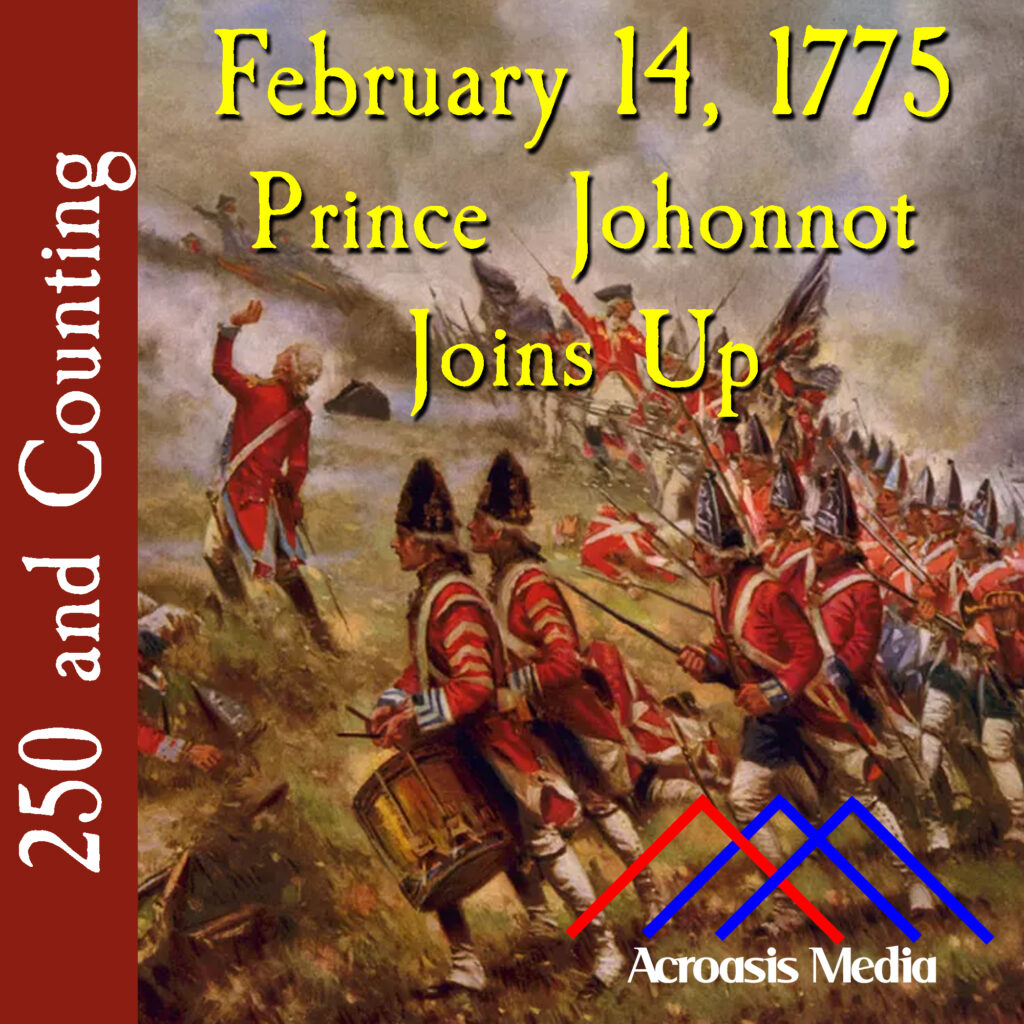
Prince Hall, who appears in today’s artwork in an undated and unattributed picture, became interested in becoming a Mason but was turned down because of his race. The British Masons, however, were perfectly willing to accept Blacks into their ranks…so long as they fought on the British side of the Revolution.
It wasn’t long before the Americans caught on to the scheme and reversed their decision. But Hall wasn’t done with simply joining the Freemasons. He had additional ambitions for himself, and others who looked like him.
Joseph Warren’s life as a Patriot was rather brief (in fact his life overall was relatively short), but it was quite important to the cause. Warren was part of the committee that investigated the Boston Massacre, he sent Paul Revere on his midnight ride (just go with it for now), he wrote a song called “Free America,” which was based on a British melody called “The British Grenadiers”, he fought at Lexington and Concord, and he died at Bunker Hill.
And he was one of only two men who was asked to speak more than once on the anniversary of the Boston Massacre. And this second time was the one that really sold the crowd.
It’s one thing to hear someone hollering “The British are coming!” and quite another to actually see them arriving in your port. And that’s especially true when they’re also seen confiscating the cannons that you’d hidden upriver.
This wasn’t the first time something like this had happened, but there was something different about the Colonists’ response—and it almost touched off the war nearly two months before it actually did.
Today we review two different pieces of correspondence—one local, the other trans-Atlantic—in which the letter writers are clearly coming to the conclusion that things are not going well between the British and the Colonies, and that preparing for war is probably inevitable at this point.
And that’s interesting on its own, but we also wanted to call your attention to the cover art for today’s episode. The person in the picture is Josiah Quincy II, who is discussed in the episode as a “side” character of sorts. The painting is by Gilbert Stuart, who is pretty famous for painting hundreds of American politicians and public figures, and perhaps most famous for the “unfinished” portrait of George Washington that served as the model for the one-dollar bill. There aren’t a lot of portraits of Quincy extant, but this one (which was painted after Quincy’s death in April 1775) gets a lot of attention from Stuart scholars because it provides a very candid representation of Quincy’s strabismus, or misalignment of the eyes. (It’s possible that he simply had amblyopia but we don’t know for sure nowadays.) Most people agree that it actually gives Quincy a little extra dignity and esteem.
The interesting thing about surveillance in the 18th century is that, when you’re dealing with trans-Atlantic distances, the information moves slowly, and errors can be costly.
We told you not long ago about someone who’d heard about the Minutemen, but had their numbers wrong by a factor of thousands. Fortunately in that case, it was just casual gossip rather than actual spycraft. But today in history, a bit of information about Colonial artillery that was reported to the Provincial Congress in Massachusetts leaked to the British, along with information about the Minutemen’s numbers and level of preparedness. But as we’ll discover in the next couple of days, the British were already taking precautions.
Of all the indignities we laid upon Claudius Herrick in this episode (okay, there weren’t that many), the worst is that we misspelled his name in the cover art.
Only a few people had figured it out, and it’s not clear whether they were just guessing, but by this point in time both England and the Colonies were locked into a path that would lead inevitably to a shooting war.
To that end, Parliament approved sending over four thousand soldiers and sailors to the Colonies to help keep them in line. But it wasn’t as simple as that; there were still some people protesting the action, not that anyone listened to them.
Today we also peek in on someone who’s watching the action and has some thoughts.
When it comes to Black people and their role in the American Revolution, the one name that most people appear to remember is that of Crispus Attucks, largely because he was the first person killed in the Boston Massacre, and that event is thought of as the beginning of the Revolutionary War, therefore it’s significant that the first person to die in the name of American freedom was a person of color.
Other people, more fussy about events, would say that Lexington & Concord was the beginning of the war. The reasoning behind that is that it’s the first event in a series of hostile actions that took place close to one another. But the real argument is that most historical events of this nature don’t have definitive “beginning” and “ending” points; it’s much like a roll of paper towels. Sure, there are perforations marking each sheet, but you know for a fact that when you pull one off, it’s going to tear at an oddball angle and those perfectly rectangular sheets are a rarity.
The fact is, however, that over 100 Black men fought as part of the militia in the opening battles of the Revolution. Here’s the story of one of the first.
Here’s a peek behind the curtain: Mike and Claude do their own research for the individual shows, though Mike did the initial setups for the dates. So he’s the one who figured out what happened when, and then they each do the deeper research for the episodes they record.
So Mike probably had no idea that there was a familial connection to this episode for Claude. For what it’s worth, neither did Claude, until he started looking into the story of Nathaniel Gorham. So if Mike had been recording this episode, it’s likely that he wouldn’t have had anything to say about it other than “Oh, fun coincidence.”
We’re only sad that we couldn’t find a portrait of Nathaniel; we have no idea whether there’s a family resemblance.