Conanicut Island isn’t much of an island to look at, but they had supplies of some kind, and the British were looking.
Admiral Graves had the task of finding supplies for the British who were under siege in Boston, and he decided to move beyond the local waters, and went into Narragansett Bay. In some towns (such as Newport, which was Loyalist) he was able to just buy supplies. But if the locals resisted, that’s when he broke out the guns.
Conanicut Island looked like a vulnerable place to get supplies. He was able to get some of what he needed, but it wasn’t the cake walk he thought it would be.
Note once again that the map is drawn with North on the bottom. Hover to get the guide to the markers.
The Battle of Great Bridge is a little bit overlooked these days, and more’s the pity. It was the first battle in Virginia, it was a big victory for Patriot troops, the Royal Governor and his crowd got pushed out altogether, and nobody died on the Patriot side.
On the British side, about 100 soldiers were dead. The last time the British lost a substantial number of troops, it was at Bunker Hill, which they won. (The vocabulary word you seek is “Pyrrhic Victory.”)
Best of all, it fueled Virginia’s moves toward independence.
The siege of Quebec was an event that was months in the making, and it was still just the penultimate act of the play.
Benedict Arnold and his troops thought they could get to the American side of the St. Lawrence River within 21 days; instead it took several weeks. Along the way they lost about a third of their troop strength. Some of the men died of illness en route, but most of them finally gave up altogether and headed home.
When they finally arrived they realized they didn’t have nearly what they needed to effect a decent attack on the city, so they had to hunker down and wait for supports to arrive. They were able to institute a couple of blockades, but that wasn’t nearly enough.
Finally General Montgomery showed up, and after an attempt at getting the city to surrender, they began the shooting. Unfortunately that didn’t do a lot of good, so the Continental Army had to settle for placing the city under siege. At this point, however, the clock was ticking because a big chunk of the Colonial soldiers were due to have their enlistments end on December 31. Something had to give, and soon.
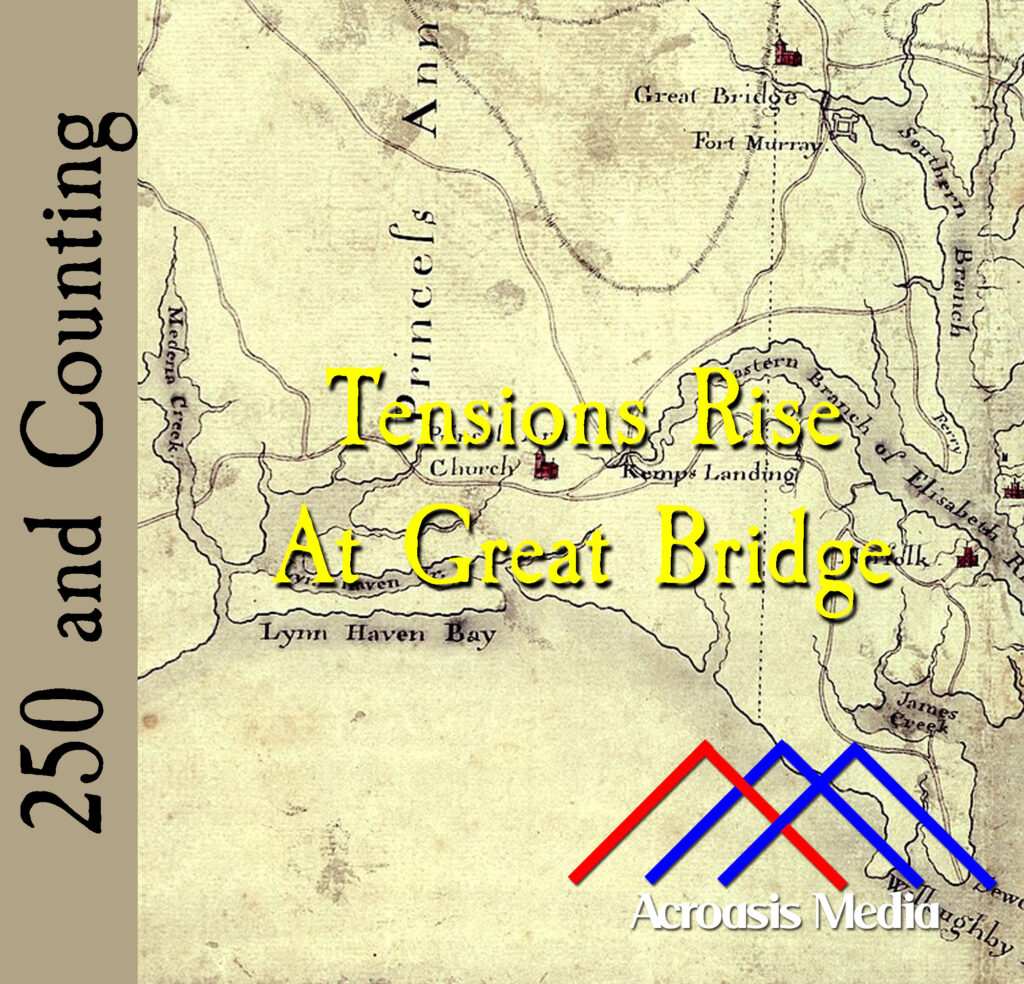
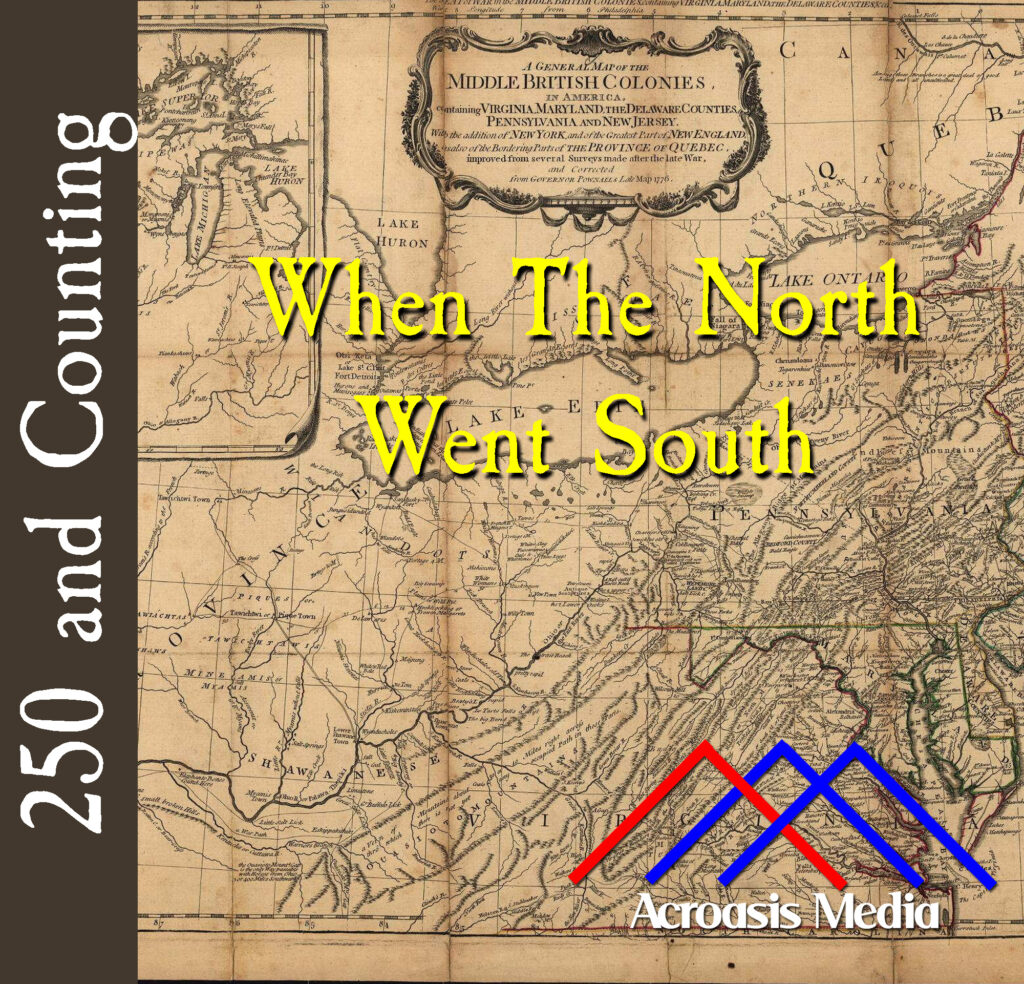
The map in today’s cover art might be a little confusing to people who live and work in the modern-day Norfolk area. That’s because it’s oriented with North at the bottom. What’s not known is why this was done in this particular case. North/Up South/Down is, of course, the usual convention, and there are arguments that there’s a psychological component to this (e.g. north/up is somehow “better” than south/down).
From a cartography standpoint, there isn’t much difference between a map oriented one way and a map oriented any other way. In fact, most cartographers consider the matter trivial in nature.
The bodies are gathering at Great Bridge; in a couple of days the battle begins.
There are a couple of things that it’s kind of important to remember about American history.
First, by this point Independence was still NOT on the table for the Continental Congress. That’s not to say that there wasn’t talk about it, but little of it was in earnest. Americans were fighting the British because of all the business that was going on in Boston. If everybody just settled down then the decision to politically separate wouldn’t have been made.
Second, once the war did start, it was by no means a foregone conclusion that the Americans would win. In fact, they didn’t have a snowball’s chance of winning. It took several years of effort and the help of at least a couple of other nations to get the job done. (And not to get too political, but current events have some of these same nations glancing at us askance, after all this time. )
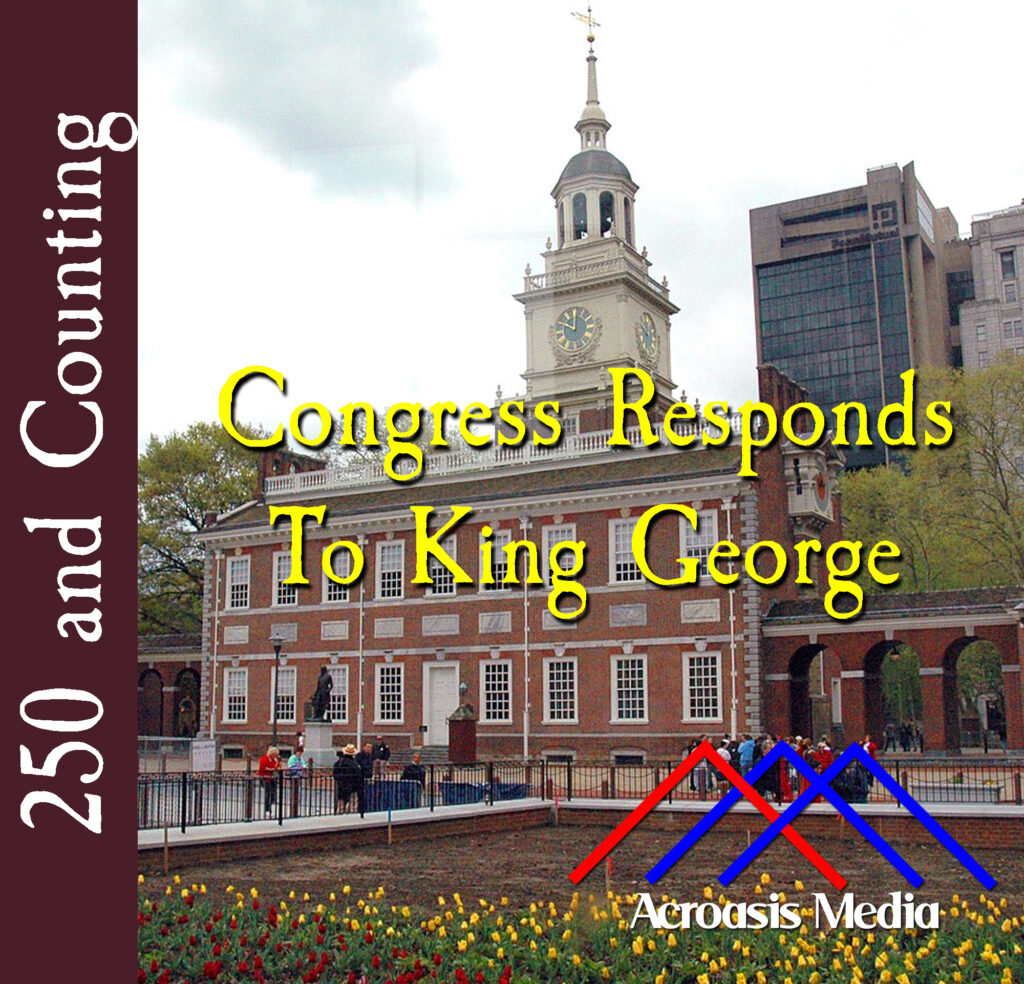
The Continental Congress’ Committee of Proclamations studied King George’s announcement that the Colonies were in rebellion, and prepared a very careful response, including the suggestion that “rebellion” has no legal definition and is therefore semantically null. And for all that, it still holds out some hope that things can get back to normal, maybe.
Yarmouth, Nova Scotia was a frequent target of raids throughout the Revolution. Indeed, most of Nova Scotia was harassed from both land and sea by Americans. This had a huge impact on the maritime economy there. But all those attacks—mostly by American (and probably some French) privateers—inflicted lots of disruption on British supply lines the entire time.
On the downside, all these attacks pretty much put an end to any trade between America and Nova Scotia.
But the Raid on Yarmouth, as the event came to be known, was especially egregious both for its intensity and the lasting effect it had on its inhabitants.
While the premise of today’s episode seems a little far-fetched, if you look closely at the map in today’s cover art, you’ll see it makes a lot of sense. In the mid-1700s, neither Pennsylvania nor Virginia had well-defined western borders. In fact, Virginia was occasionally thought to continue northward all the way to Lake Erie. Some maps even have a Pennsylvania boundary somewhere east of Pittsburgh.
The point is, there have been times when the borders have been blurry, and others where they’ve overlapped, and still others (before West Virginia was a thing) when the two colonies had well-defined borders AND were neighbors. And now we’ve brought the South into the realm of mutual commitment.
John Paul Jones was born in Scotland as John Paul and began his maritime career at 13 when he was hired as an apprentice.
In 1770 he was involved in an incident wherein a crew member was flogged after a failed mutiny. The crew member later died, and it was clear that his reputation had taken a big hit. So John Paul left Scotland and took command of a British vessel. Again, however, he put down a mutinous sailor, this time killing him with a sword in Tobago. Before he could be tried, however, he fled the area and essentially disappeared for 18 months.
In the meantime his brother, who lived in the Fredericksburg, Virginia, area, died. John Paul went to America to settle his brother’s affairs. It was at this time that he appended the last name “Jones” to his name. Shortly thereafter he joined the American Navy. During his time as an American naval officer, it doesn’t appear that he killed anyone, but in his later years, he sailed for the Russian Navy, where he was derailed by the accusation of rape of a ten-year-old Russian girl. It was only because of the murkiness of some of the details that gave the Empress Catherine some leeway to have him exiled rather than beheaded.
But as an American sailor, he did shine. And he shone for the first time on this day in 1775.
All of the men who were part of the Second Continental Congress were serious men who had businesses of their own back at home. So spending so much time in Philadelphia had to have been taxing on them, especially since the days were so long. Of course many of them were going to be homesick. Read the letters between John and Abigail Adams as an excellent example.
And remember: to go home to, say, Boston could take about a week in 1775. So they’d be away for two weeks at a minimum, and that’s entirely traveling time. Taking care of whatever they needed to only added to the absence.
We do know that many of them did go home from time to time, but they were obliged to return and continue the business of running a country while simultaneously ducking interference from the British.
Joseph Hewes’ letter to Samuel Johnston has a special poignancy about it.
Back on November 14 we told you about the Royal Ethiopian Regiment, which was assembled following Lord Dunmore’s Proclamation. The proclamation offered freedom to slaves belonging to Patriot owners who chose to fight on the British side in the Revolution.
Dunmore was putting together another band of soldiers at the same time, called “The Queen’s Own Loyal Virginia Regiment,” which suggests that he knew something about George III that wasn’t common knowledge. (Heh, kidding.)
They both fought in the Battle of Kemp’s Landing, which went very well for the British, but Dunmore took the win as a sign that the Patriots were weak, so he went in to the Battle of Great Bridge, as we’ll see in just a few days.