Category: American Revolution

  • New Command for John Paul Jones–October 27, 1776

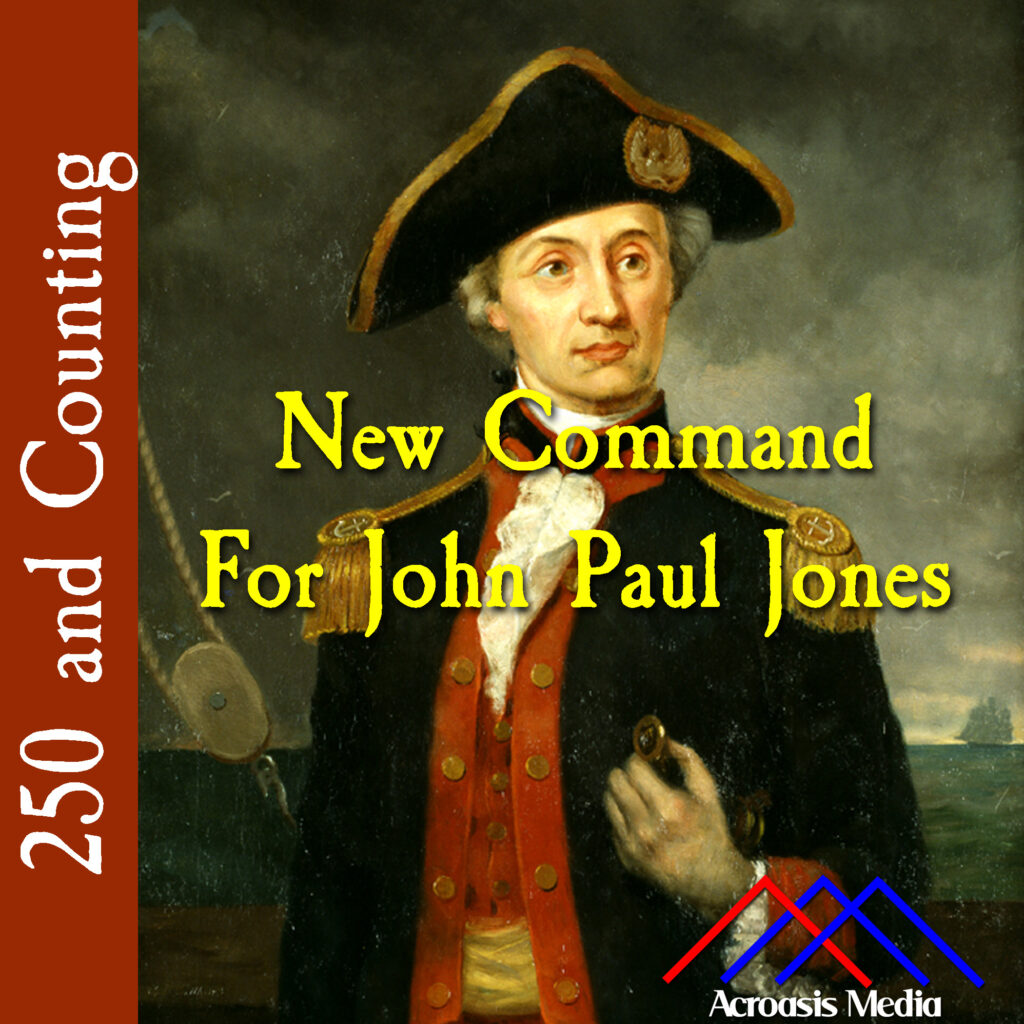
    Cover art for October 27, 1776: portrait of John Paul Jones by George Matthews, ca. 1890, based on a 1781 portrait by Charles WIllson Peale. via the US Senate Collection.

    John Paul Jones (Mike would have me note it’s not the guy from Led Zeppelin) led a relatively short life, but it was certainly eventful.

    Jones was born in Scotland and became a sailor at age 13, where he served on multiple merchantmen, including a few slave ships. Jones fled to the Virginia colony to avoid arrest after killing a mutinous subordinate and joined the Continental Navy in 1775. Less than a year later he was the captain of the USS Alfred, which is the subject of today’s episode.

    After Jones’ successes in France, he harassed British merchant ships in the Irish Sea, and he made a couple of attempts to deeply sabotage the ships in Whitehaven, but his efforts weren’t successful.

    In 1779, while still in Europe, Jones took command of the Bonhomme Richard and continued to give the British a hard time in their own waters, sometimes with mixed results. This was the ship he was commanding when he was said to have uttered the phrase “I have not yet begun to fight!”, which is pretty gung-ho, but unfortunately apocryphal.

    Jones was left without a command in 1787, so he entered in o the service of Empress Catherine of Russia. He experienced some successes, but was undercut by an ambitious underling who deliberately mis-translated his letters to the Empress. Two years later, Tadeusz Kościuszko, a veteran of the American Revolutionary War, suggested that he leave Russia and serve another nation. Not long thereafter he was accused of raping a young girl and left the country despite the evidence being rather thin. He returned to Paris but couldn’t get a foothold in society.

    In 1792 Jones was appointed the US Consul to negotiate with Algiers for the release of American captives. Unfortunately before he could do this, he was found deat at home. The cause of his death was interstitial nephritis, an inflammation of part of the kidney which is sometimes symptomless. Nowadays it’s most often caused by reactions to certain medications but is easily treated. Jones was 45 when he died and in significant debt, largely because he hadn’t been paid for some of his endeavors. He was buried in a cemetery specifically for Protestants who weren’t native Frenchmen, but the grave was either unmarked or the marker stone was taken. It took until 1905 to locate his coffin. Today his remains are interred in a sarcophagus at the US Naval Academy in Annapolis, Maryland.

  • Ben Franklin Heads To France–October 26, 1776

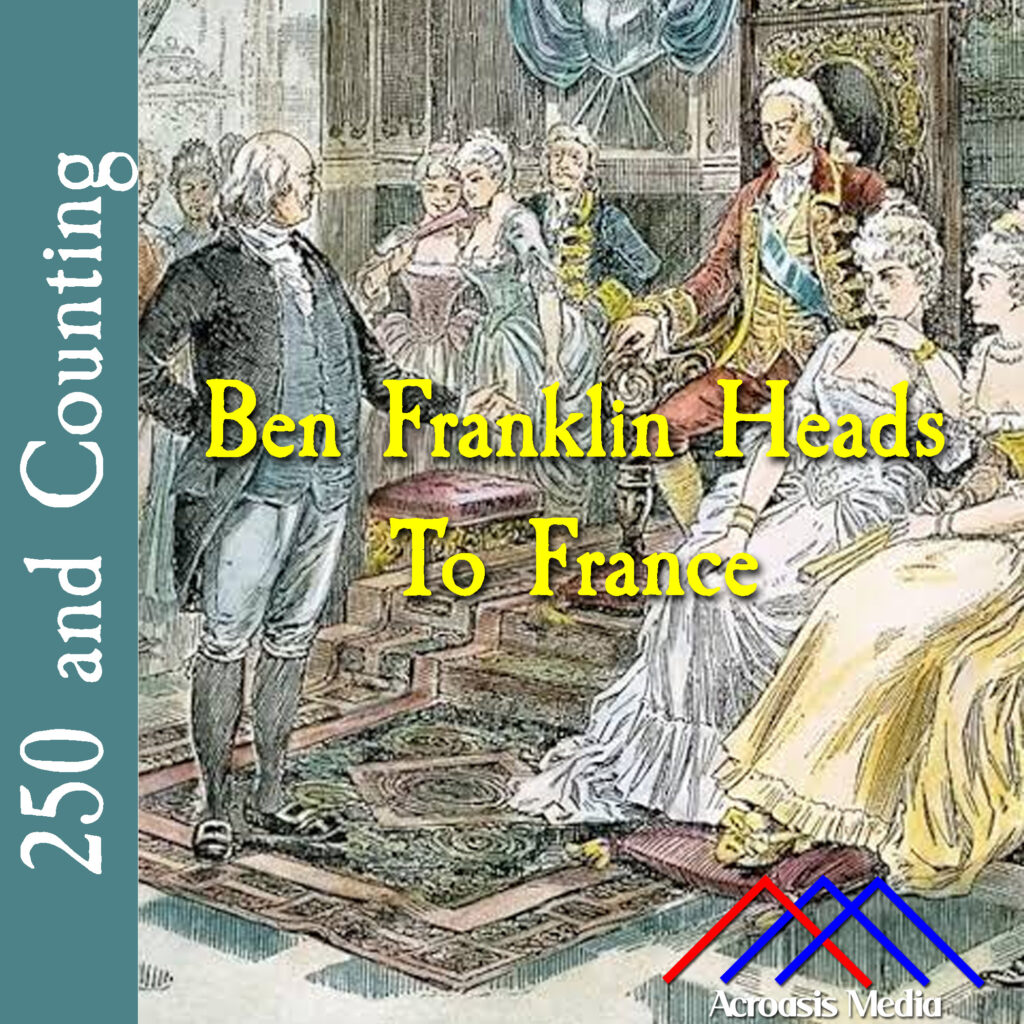
    Cover art for October 26, 1776: A 19th century lithograph titled "Franklin at Versailles," artist unknown.

    While Benjamin Franklin departed for France on this day, actually having Franklin in France wouldn’t happen until early December. Remember, he was traveling by ship and it took a few weeks to cross the Atlantic Ocean.

    What’s more, as Mike mentions, it would take him over a year to secure the support that we needed. In fact, I cheated a little on the artwork, which depicts Franklin presenting himself before Louis XVI and Marie Antoinette at the Palace of Versailles. This didn’t happen until March of 1778, after formal diplomatic relations had been established, and Franklin named our ambassador. But the truth is, I didn’t think I was going to find a contemporary image of Franklin embarking on a ship, and there’s something about the use of line and color that has me loving this art style, so an image of Franklin in France already is where we all are now.

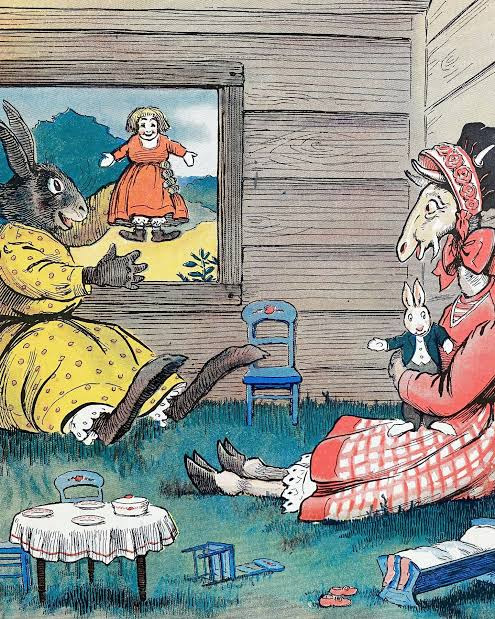
    Side note: there’s a very similar art style from about 100 years ago, maybe more like 80-90 years, that has a lithographic/woodcut feel and similar use of colors—though just a hair more vivid—and it just speaks to me somehow. I know that there were a few picture books from my childhood that employed that art style, and maybe that’s what I’m responding to. (There’s a sample here and I have no idea what story it’s telling, but you get the general picture [heh] of what I’m talking about, visually.)

  • Uncle George Wants You–October 25, 1776

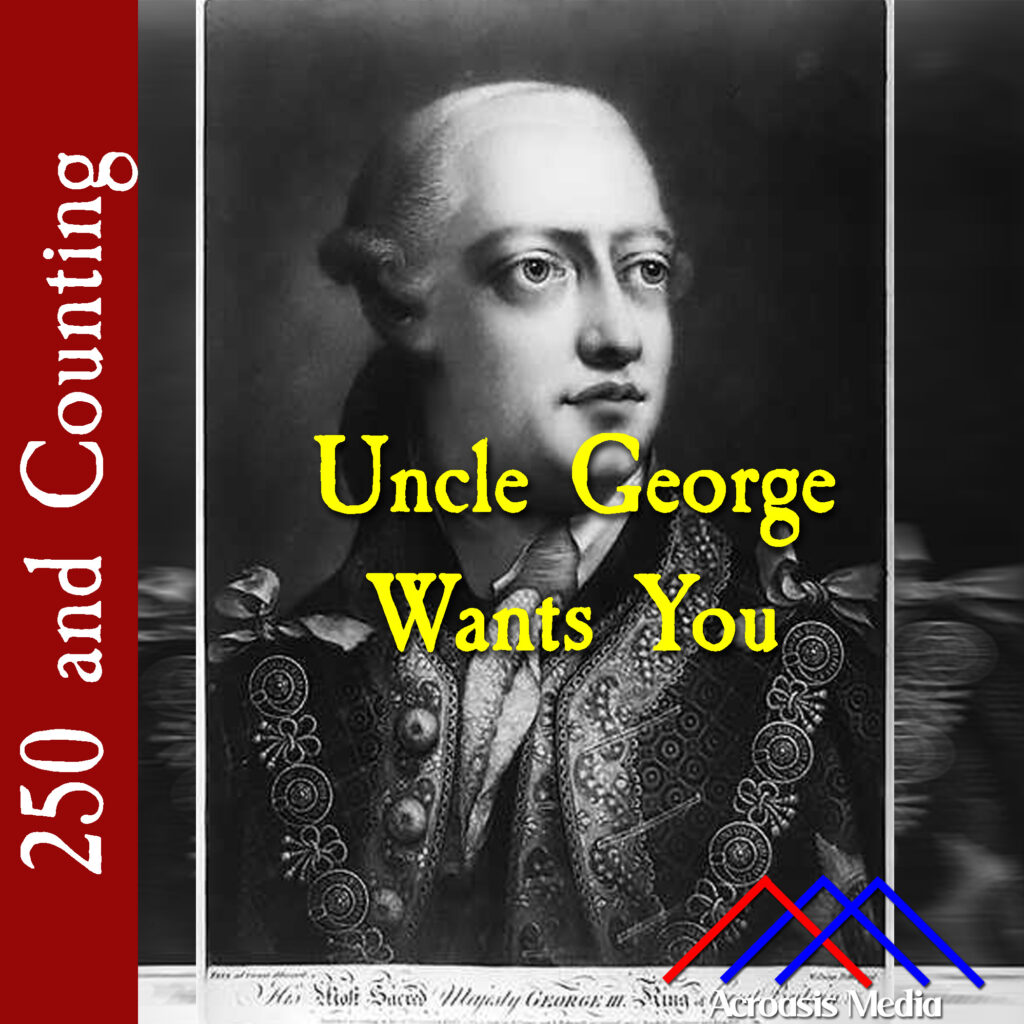
    Cover art for October 25, 1776: portrait of King George III in 1762, drawn from life by artist Thomas Frye and engraved by William Pether. via Library of Congress.

    King George III offered up some naval incentives throughout 1776. Seamen who enlisted would get bonuses depending on their level of experience, but the Royal Navy wasn’t above impressing sailors into service, either.

    However, it’s also worth noting that King George also put some disincentives out there as well. For instance, in November of 1776 he forbade British mariners and seafaring men from working on foreign vessels, or working for a foreign government or prince without a special license. He also demanded that all natural-born British subjects who were working abroad return home so they can servc the Crown. Violations of these rules would be met with the “utmost severities of the Law”, though those punishments weren’t always clear. And don’t get George started on privateers.

    These warnings came after news got out about a thousand men being impressed into service about a week earlier.

  • Battle of Mamaroneck–October 22, 1776

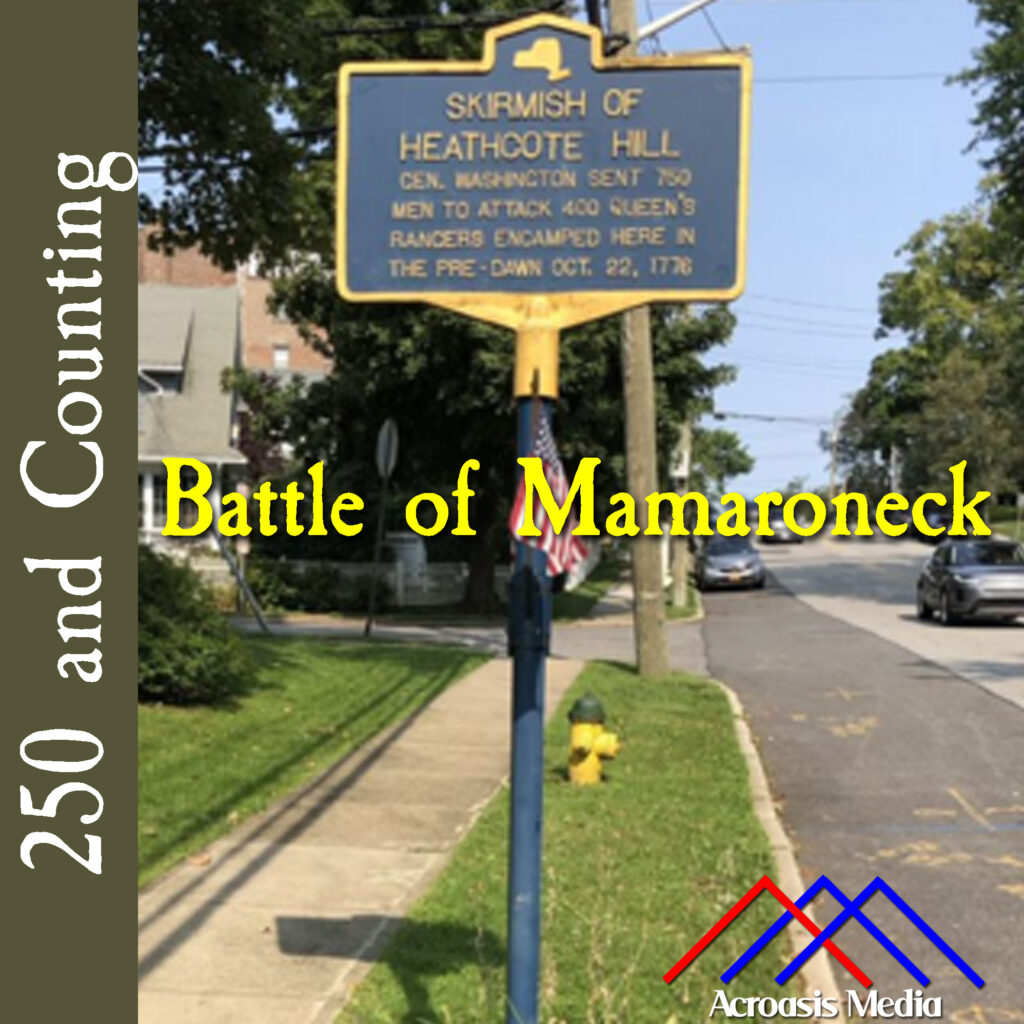
    Cover art for October 22, 1776: Historical marker denoting the location of the Battle of Mamaroneck, using its alternate name. via Wikimedia Commons.

    Oddly enough, having an episode about the Battle of Mamaroneck is one of those times when it pays to have grown up in New York.

    I saw that note in our common research document, then I clocked the date and said to myself, “No way is Mike going to know how to pronounce that.” So I gave him a little coaching.

    We’ve done this before, with each of us having to coach the other on pronunciation of locations when we have to report on events on the opposite coast (I get a lot of the Spanish West stuff, somehow).

    The fact is, a lot of locations on the East Coast get their names from Native American words (Mamaroneck), or the Dutch (Catskill), or are just idiosyncratic because they’ve been around so long that the pronunciation has changed (Bowie, MD).

    All of this has nothing to do with what I wanted to discuss here. This is what I wanted to discuss here:

    In 1959 artists Eli Bauer and Ralph Bakshi created the cartoon character Hector Heathcote for the Terrytoons cartoon production company. Hector (seen at right in an image I totally stole) was an 18-year-old Colonial-era person with a red ponytail and a tricorner hat. Hector, and sometimes his dog Winston, got himself into various situations related to American History, though occasionally he’d wander into a science lesson. Sometimes he was opposed by a big bully-type named Benedict (as in Arnold, geddit?).

    Anyway.

    I saw that the alternate name for the Battle of Mamaroneck is the Skirmish of Heathcote Hill (like the historical marker says) and I wondered if there was any connection between Hector and this part of the world. It turns out that there may be!

    Eli Bauer is from the Bronx, just south of Mamaroneck. Ralph Bakshi is from Brooklyn. And Terrytoons’ headquarters was in New Rochelle, which is about 10 miles from Mamaroneck as the crow flies.

    Do with that what you will.

  • A Pause in New Rochelle–October 19, 1776

    Cover art for October 19, 1776: reproduction of the American colors captured by Hessian troops at White Plans. Created by Wikipedia user HoosierMan816 from an undated engraving.

    Before I get into the events of New Rochelle, I have to confess that I’m kind of hating today’s artwork, and it’s not even published yet.

    Well, if I have to look at it then so do you. They can’t all be gems.

    The Battle at Pell’s Point had the Continental Army putting up more resistance than any reasonable British general should expect, so General Howe knew that reinforcements and supplies would be needed, so he camped out in New Rochelle for a few days while the bodies gathered for action.

    Lord Stirling was able to do some reconnaisance and see just what the Americans were going to be facing, and Washington used the information to move a little more hastily toward White Plains. As a rseult, he had a base of operations before the British had moved significantly; what’s more, he was able to set up a defensive position on high ground near the Bronx River.

    It would be another few days but before long another significant battle would take place.

  • Battle of Pell’s Point–October 18, 1776

    Cover art for October 18, 1776: mural depicting the Battle of Pell's Point, by James Monroe Hewett, 1930s. The mural is in the Bronx County Courthouse.

    The Battle of Pell’s Point, also known as the Battle of Pelham, was an important battle of the Revolution that doesn’t get the attention that so many others get, largely because of the When and Where of the battle, and the fact that it wasn’t a huge win or loss for either side.

    What it did do, however, was provide some cover and distraction from the fact that Washington was still moving forces out of New York—that is, off of Manhattan Island—and onto the mainland, toward White Plains.

    As noted yesterday, the British army’s original goal was to make this move inland yesterday, but the winds weren’t cooperating with their ships in Hell’s-Gate, so it was very slow going getting from Throgs Neck, which was little more than marshland and not even quite connected to the mainland, to Pell’s Point. There were 4000 British soldiers faced against about 750 Continental soldiers, but fortunately the Americans saw them coming and were ready for them despite being quite outnumbered.

    In the end, this was technically a victory for the British but a tactical one for the Americans, since the battle gave Washington the cover he needed to finish moving troops out of Manhattan and up toward White Plains.

    Yesterday I took my four-year-old grandson to the National Museum of Railroad History and Innovation (some people may remember it as the B&O Museum) in Baltimore, and that visit reminded me of the fact that when a train passes by, the things you most notice are the engine and the caboose. This may be why I’ve described so many battles as “important but overlooked”; they took place in the middle of things and don’t have some deep iconography attached to them (e.g. Washington crossing the Delaware before the Battle of Trenton). But they’re all part of the larger mosaic that makes up the story of the American Revolution.

  • Leaving New York–October 17, 1776

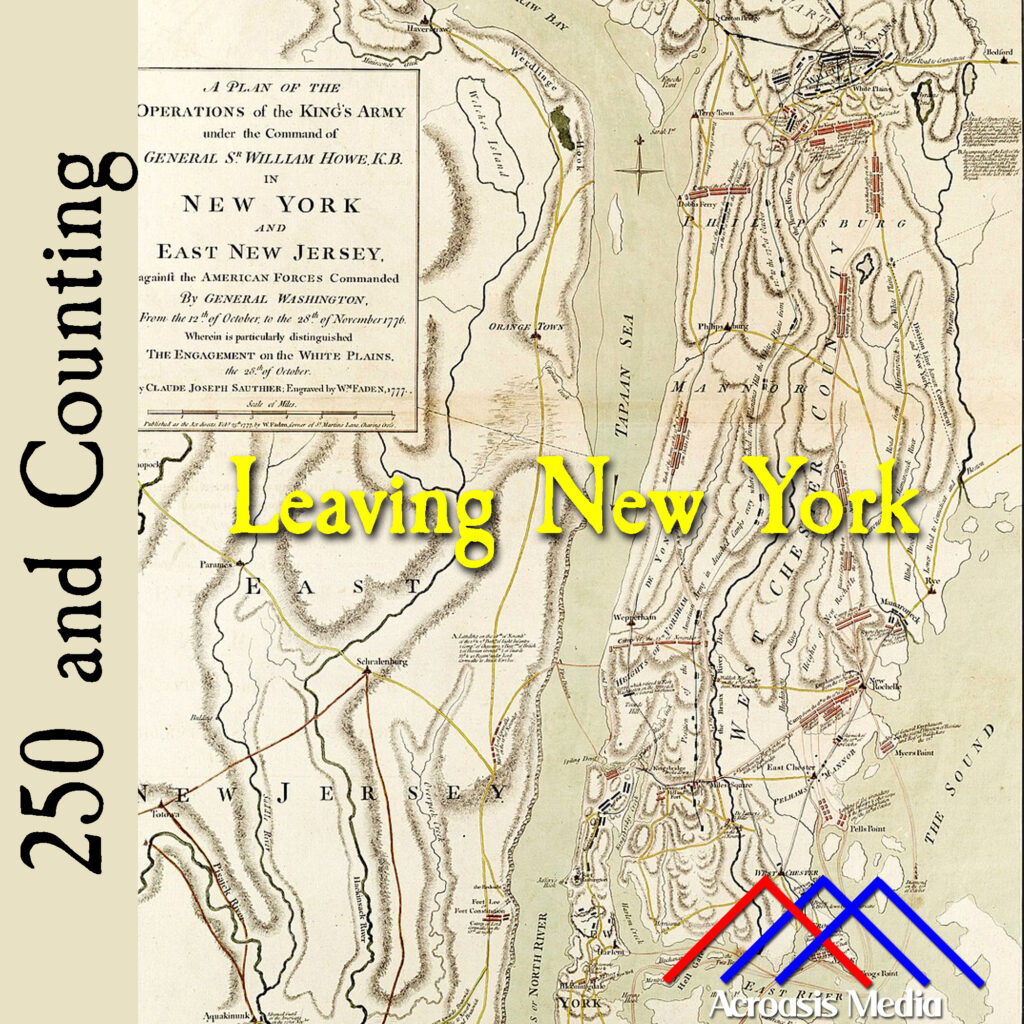
    Cover art for October 17, 1776: A 1777 map depicting British troop movements before and during the Battle of White Plains, which will be in about ten days. via National Maritime Museum, Greenwich, London

    When Washington’s Council of War (with a single exception) determined that sticking around New York City was a bad idea, the next step was deciding which way to go, and how to go about it.

    To a certain extent, the decision was made for them, because the British had pretty well sewed up the Hudson River, which meant that getting across and into New Jersey stealthily would be problematic.

    The other option was to move north, into the Bronx and the downstate area west and north of Pelham. There would still be a river to cross (the Bronx River), but that was much smaller and, better still, it wasn’t fortified by British ships.

    They identified several crossing points and set up units to monitor those places, plus another couple of units to keep an eye on the British in general. In this manner they were able to move four regiments of men across to the mainland without alerting the British.

    But having this option made for them also helped ensure that they could continue to defend the lower Hudson Valley and stave off that severing of the connection between New England and the rest of the colonies that Britain so coveted.

    Over the next several days we’ll bring you up to the conflict that today is known as the Battle of White Plains.

  • In And Around New York–October 15, 1776

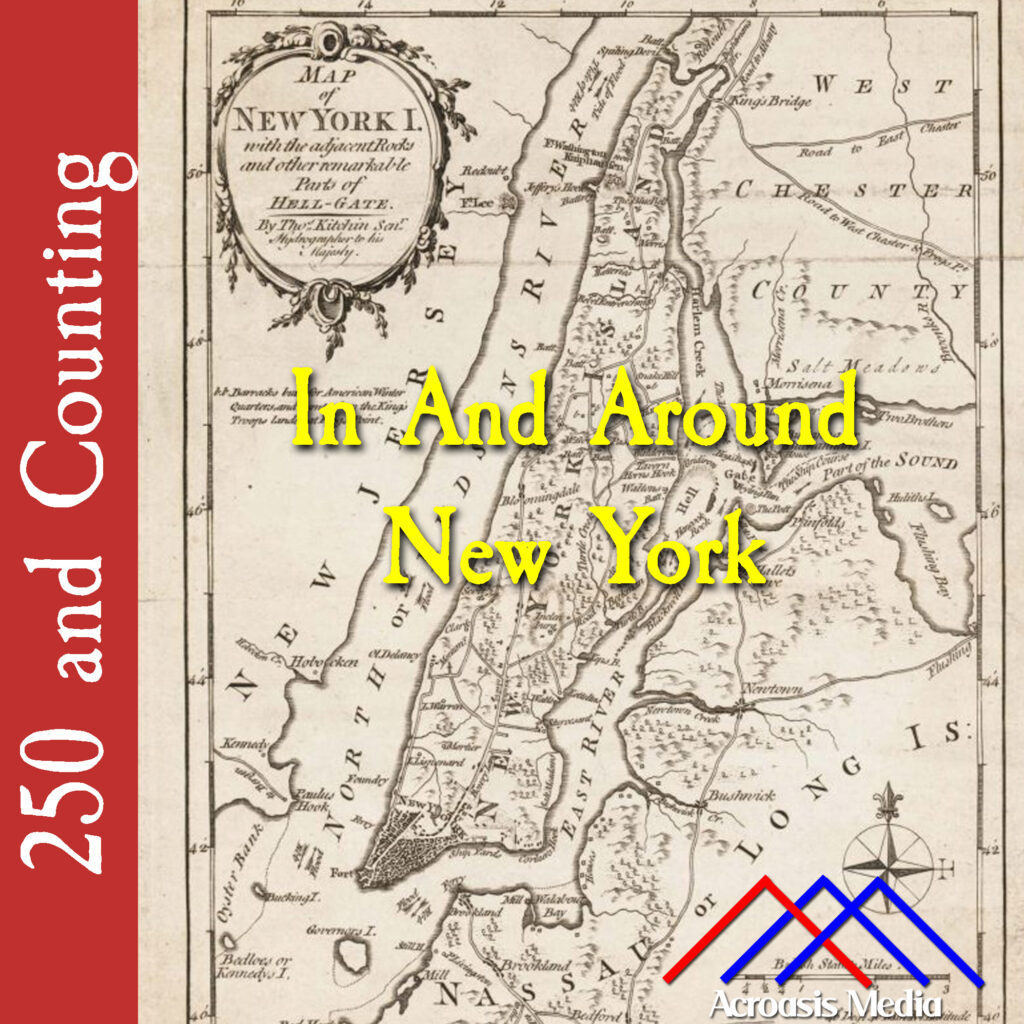
    Cover art for October 15, 1776: Map of New York I[sland], with the adjacent Rocks and other remarkable Parts of Hell-Gate, map by Thomas Kitchin, Sr, Hydrographer to King Charles III, April 1778. via New York Public Library.

    By the time Charles Lee returned to duty, the Continental Army in New York was in a sad state of affairs. Many men had been injured or deserted. Supplies were low. Ammunition was low. Morale was low. And the British were up in the Bronx, gearing up for…something, who knows what.

    Lee had, of course, missed all the action in Brooklyn and Manhattan, so he brought a new perspective to the table. And it was fortunate that Lee felt free to say what he thought of the situation, namely that it was untenable.

    Fortunately, Washington was of a similar mind and apparently Lee’s comments were what he needed to take appropriate action. He immediately summoned a council of war.

    Down in Staten Island, Nathanael Greene and Hugh Mercer were in Staten Island, encountering far less resistance than they expected. They got word of the war council and Greene departed while Mercer continued on…at least until he learned the status of his intended target.

  • The Return of Charles Lee–October 14, 1776

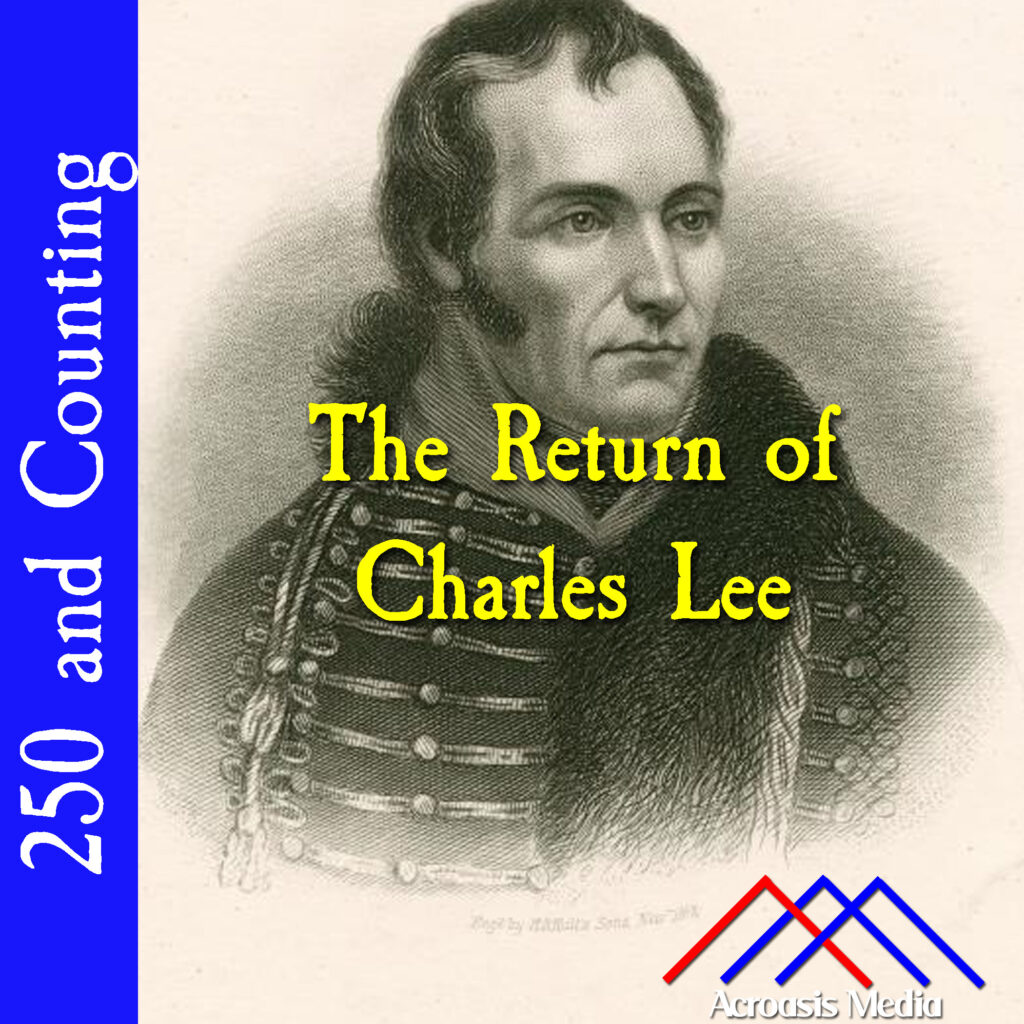
    Cover art for October 14, 1776: Portrait engraving of Major-General Charles Lee, ca 1860 by Henry Bryan Hall, based on historical sources. via New York Public Library Digital Collection.

    Charles Lee was born in Great Britain and only came to British America in 1773, when he purchased an estate in western Virginia.

    It wasn’t his first time in America; he’d fought for the British in the French and Indian War and married the daughter of a Mohawk chief.

    Lee was injured in 1758 during an attack on Fort Ticonderoga. The following year he was part of the capture of Fort Niagara and of Montreal the year after that.

    Lee returned to Europe and served in Portugal as a lieutenant colonel. In 1763 he returned to England and retired on half-pay. Two years later he served as an aide-de-camp under King Stanislaus II of Poland. He saw some action in the Russo-Turkish War but it was during a duel in Italy that he lost two fingers.

    Lee returned to England and realized that he was sympathetic to the Colonists’ cause, so he moved to America and purchased an estate in what would now be West Virginia. When the Continental Army formed, he joined up immediately, expecting to be second-in-command to George Washington (he did realize that Congress would want a native-born Commander in Chief).

    Lee took on the command of the Southern Department and was present for the Battle of Sullivan’s Island. He was given credit for the victory, though based on some accounts the win didn’t really belong to him.

    Lee was captured in December 1776 in New Jersey and released in a prisoner exchange in 1778. In subsequent battles Lee was cast in a villain role by official reports, and he was court-martialed. He was found guilty by the jury but the court reduced the final charges and suspended from the army for a year. In 1780 Lee sent a scathing letter to Congress that led to his dismissal from the army.

    He returned to Virginia but his debts piled up and he was advised to sell off his property. Unfortunately he died in 1782 before he could complete the sale and his sister Sidney Lee inherited the property. It’s not clear but he likely died of tuberculosis.

    Lee’s legacy has waxed and waned over the years, and most recently it’s in a “down” cycle, as documents have been discovered that he may have been attempting to communicate with British officers regarding a potential plan with which they might defeat the American rebellion. However, there are still many who doubt the idea that Lee was specifically acting treasonously.

  • Battle of Split Rock–October 13, 1776

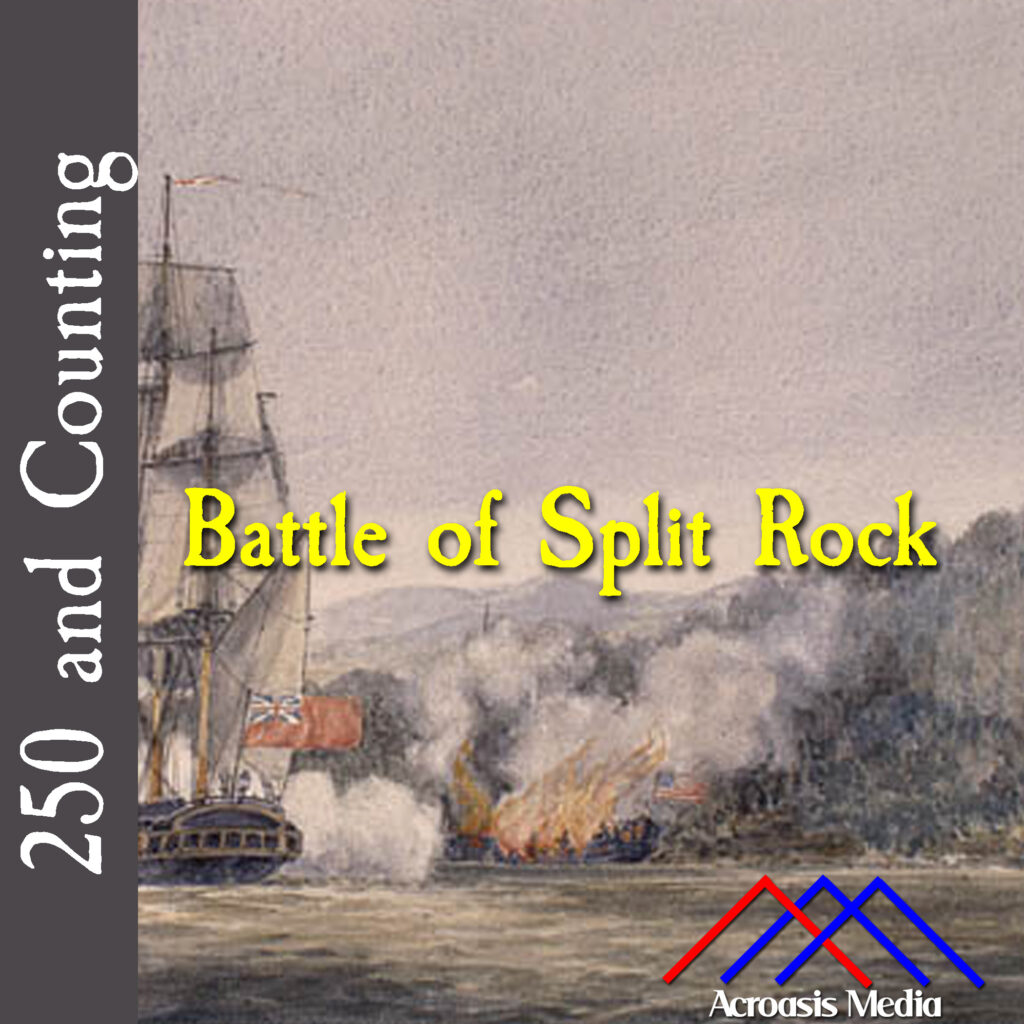
    Cover art for October 13, 1776: Battle of Valcour Island in the American Revolutionary War, artist unknown, ca. 1925. via National Archives of Canada.

    The Battle of Split Rock is really just a continuation of the Battle of Valcour, and a lot of it takes place in a location called Button Mould Bay (or Buttonmold Bay).

    So why is it called the Battle of Split Rock?

    That’s a fine question. On the western shore of Lake Champlain, just north of Button Mould Bay, is a formation called Split Rock Mountain. It rises sharply from the lake to an altitude of just over 1000 feet, and it’s where the confrontation between the British and the Americans resumed.

    Button Mould Bay is an area of shallower water on the opposite side. It gets its name from a series of clay masses which have hardened almost to the point of concrete, into a shape much like an oversize button, or like the molds used in button making. Those concretions actually made it easier for Benedict Arnold to run his ship, and the galleys accompanying him, aground and set ablaze. This was the ship that had all of Arnold’s papers on it that I told you about the other day.