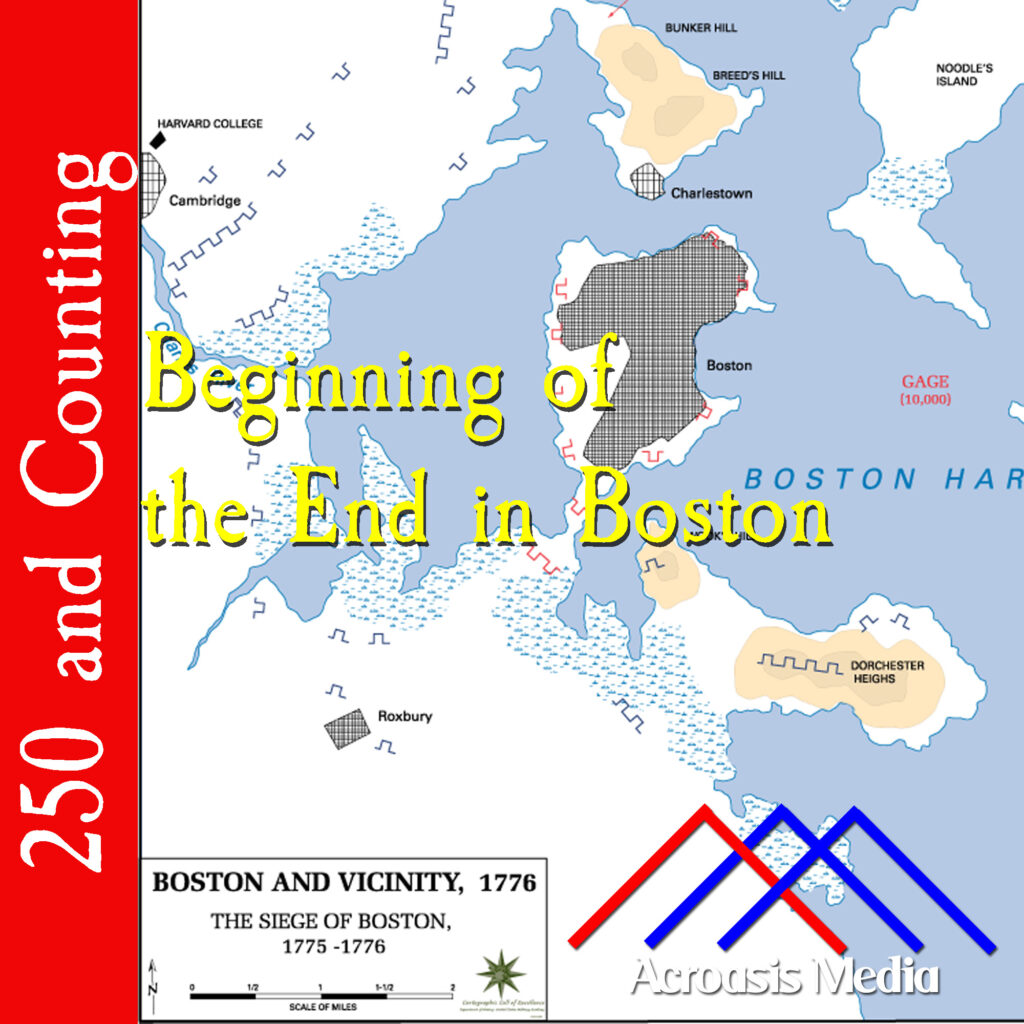
The occupation of Dorchester Heights, just across the river from Boston, was perhaps the final step that George Washington needed to end the siege that had gone on for nearly a year.
Of course, it wasn’t just occupying Dorchester Heights; Washington could have pretty much done that at any time. It was occupying them with a terrifying speed, thanks to Rufus Putnam (the guy in today’s cover art, by the way) and his clever plan for assembling the defenses there. And thanks also have to go to the big cannons that had been brought down from Ticonderoga. These guns had the range that Washington needed to not only shoot at Boston if he needed to, but to fire upon British ships in Boston Harbor.
Howe had a couple of moves left, but it was nearly over.
Colonel Henry Knox took about ten weeks to get from Ticonderoga to Cambridge rather than the two he anticipated. But his arrival meant the siege’s end in Boston would come soon.
Knox had brought something like 60 tons worth of material overland using hand-built sledges and carts drawn by oxen. The last leg of the trip is still a mystery, because Knox’ diary ends about two weeks early. What is known is that as he passed through the occasional town, people would line up to watch. So we know when he was where, but the usual stuff that ran through Knox’ head for that portion of the trip is gone.
Still, his arrival at Cambridge meant that Washington now had what he needed to fortify his position and do what he needed to drive the British out of Boston. After nearly a year, the siege’s end was actually in sight.
Letters from John Hancock to George Washington weren’t especially scarce, nor were letters going the other way. However, today’s letter takes on a few important topics for Washington that one hopes came greatly appreciated.
There was commendation that Washington had the foresight to send troops to New York, there was some good financial news, there was also good news in the realm of troop recruitment, and there was a warning about likely military action coming fairly soon.
All in all, it was a letter packed with information, and if we had to guess (because we don’t know), it was likely conveyed by courier rather than the postal system, which was still prone to interception by the British.
“Knox entering camp with artillery” by William H. van Ingen, c. 1831. via Library of Congress. Depicts Henry Knox on horseback with soldiers transporting a disassembled canon on a sled through the snow, winter 1775-76, following his famous capture of artillery at Fort Ticonderoga. Wood engraving, hand-colored.
The Noble Train of Artillery has finally arrived!
Given that it was over 150 miles from Ticonderoga NY to Cambridge, MA, and that it was wintertime, and that Interstate 90 was still over 150 years in the future, it’s pretty amazing that Henry Knox was able to move so much artillery so efficiently.
As Mike notes in the episode, the arrival date is largely a guess, since Knox’s diaries ended the last time we checked in with him, about two weeks ago when he was in western Massachusetts and, it appears, nobody else kept accurate notes on the event. There are, however, notes on the disposition of the materiel, so that makes this a pretty good guess. And it allowed the Continental Army to maintain the Siege of Boston until the British finally bailed out two months later.
Correspondence from Charles Thompson, Secretary to the Second Continental Congress, to George Washington. via Library of Congress.
As George Washington’s aide-de-camp, Joseph Reed was privy to a lot of things on his Commander-in-Chief’s mind. And it shows in the level of prose that Washington uses when writing to Reed, because it’s much less formal.
Compare that to the letter he sent to the Continental Congress the same day. In both cases he was expressing concerns regarding his troops, but in one case it’s a criticism of their readiness (Joseph Reed), and in the other it’s concern for their well-being (John Hancock).
Washington’s troops would remain relatively undisciplined for several months, until the winter encampment at Valley Forge. But I’m getting waaaaay ahead of the story, so stick around. Meanwhile, put this in your ears.
Joseph Warren conferring with Israel Putnam before the battle at Bunker Hill, at which Warren was killed.
Mike’s pretty much covered the story of the capture of a British ship in the episode, so I’m going to tell you a little bit about Joseph Warren, who (you may recall) was killed at the battle of Bunker Hill.
Warren became a doctor early in his career, and he also became a Patriot before it was fashionable. He was a powerful speaker, and for several years in a row he would deliver a speech commemorating the anniversary of the Boston Massacre.
In the fall of 1774, he composed the Suffolk Reserves, which urged armed resistance to the British and a boycott of British goods.
So by the time 1775 rolled around, he was one of the most influential men in Massachusetts; in fact he was the president of the Provincial Congress, which by then was the body actually running things there.
In addition, he was on the Safety Committee, ensuring that gunpowder and ammunition was available to militiamen who needed it.
We’ve been talking about the Siege of Boston since April. That was his doing; he’d organized the siege in the first place. George Washington took over a while later. He then organized the building of the earthworks at Bunker Hill before that battle started. And when the British began to overrun the Patriots, he was instrumental in giving them an opportunity to escape. But that’s where his luck ran out: a British soldier recognized him and shot him in the head, killing him instantly.
The Brits then stripped his body and stabbed it several times, then buried him in a shallow grave with another Patriot who’d been killed. Later on, Paul Revere had to identify the body.
The point to all of this is that, had he survived the battle, Joseph Warren would almost certainly have been a much larger figure in the American mythos; maybe he’d even have been our first President instead of Washington.
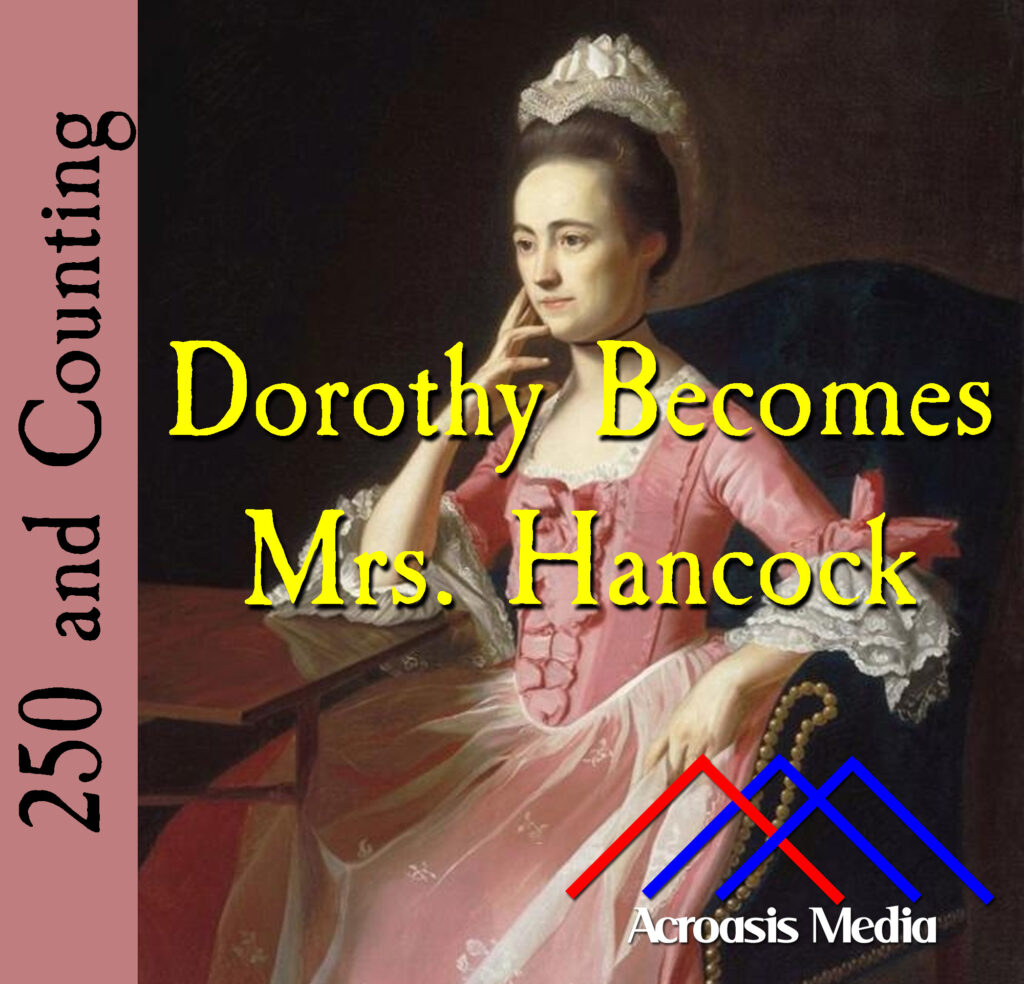
Most of the portraits we see of Martha Washington were made when she was older, so we have (I think) this image of her as a bit of a crabby old frump.
And maybe she was, by the time her husband got to be President. She didn’t really love the life of the public spouse and charming party hostess. But it turned out she was good at it, and if it made her crabby, nobody who mattered knew about it on a firsthand basis.
In fact, Martha Washington was known to be fashionable, calm, outgoing and easy to get along with. And because Boston was rather straitlaced compared to Virginia, she gave off a bit of an exotic air during her time in Cambridge.
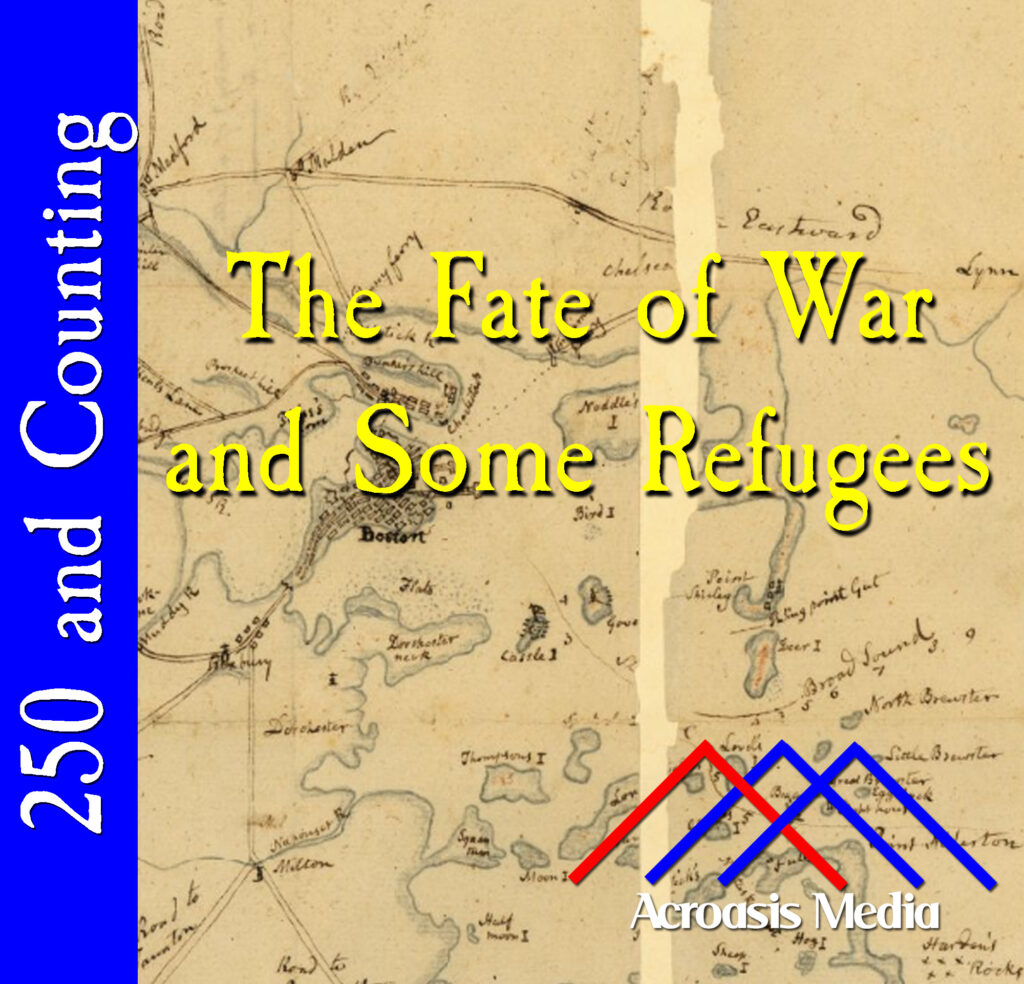
It’s hard to emphasize just how remote Point Shirley is compared to the Boston. Let me try anyway. On most maps of Boston, Point Shirley isn’t even on the map. It’s so far to the east that it’s nearly in the ocean. I’m not sure it’s even possible to see Boston from Point Shirley.
And given Point Shirley’s location at a place between the bay and the ocean, and the fact that it’s November, and you’ve got a cold, windy place where you’ve just dumped 300 sick, destitute people without provisions or a means of getting warm.
Here’s a weird coincidence: if you look closely at this “manuscript” map from 1775, Point Shirley is at the center right. Need another hint? It’s just under the “fu” in the word “Refugees.” And if anyone got a big FU from the British, it was this group.
After the Pyrrhic victory at Bunker Hill, the fact that General Gage was about to be replaced probably came as a surprise to nobody.
That he was replaced by William Howe…well, that also probably wasn’t a surprise. Howe had experienced success in the Seven Years’ War. And while he was known to have shown some sympathy with the Colonies (he’d voted against the Intolerable Acts, for instance), it was thought that he could break the Siege of Boston.
So Howe came to America and on October 11 he took over the job from Gage. He stayed in Boston with the besieged soldiers. And he had lots of ideas about breaking the siege, and eventually the Continental Army. What’s more, Lord Dartmouth had some creative ideas as well.