Category: Siege of Boston

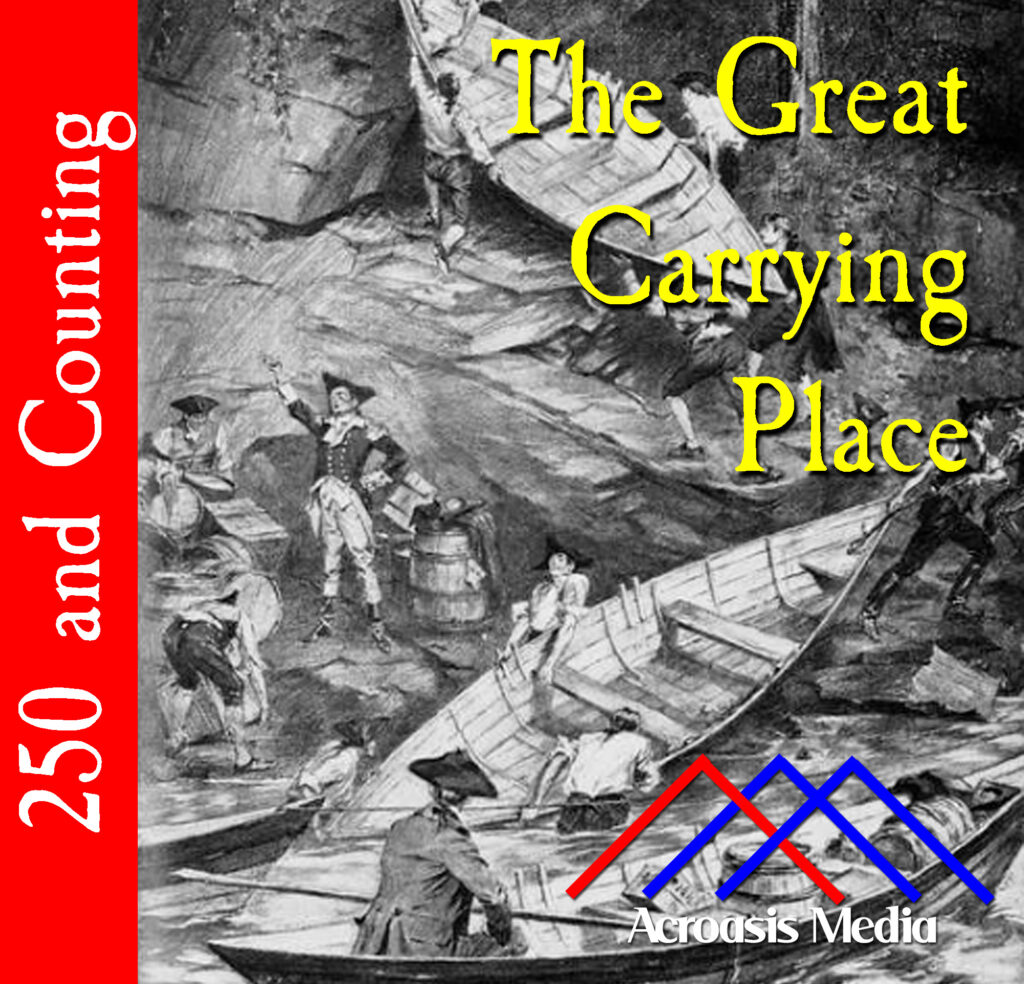
  • The Great Carrying Place–October 11, 1775

    Cover art for October 11, 1775: "Carrying the bateaux at Skowhegan Falls", drawn by Sydney Adamson; halftone plate engraved by CW Chadwick, 1903.

    Benedict Arnold and Company are still on the move toward Quebec. Over a three-week period they’ve moved fewer than 90 miles, with only…300 to go. Today they’ve reached The Great Carrying Place, a 13-mile walk alternating between woods and knee-deep mud, all while carrying everything they’ll need to get to Canada.

    Back in the Colonies proper, General Gage is being replaced by General Howe. Gage was largely responsible for the Siege of Boston, especially since they weren’t able to break that siege. And then Bunker Hill came along. Sure, the British won but at great cost—a Pyrrhic victory. Once word got back to Britain about that, Lord Dartmouth appointed Howe within a couple of days. Of course, it took several weeks for the news to get back to America, and on September 26 he learned he was being replaced. By this days’ end, Gage was on his way back to Britain.

  • The British Have War Plans (October 9, 1775)

    Cover art for October 9, 1775: portrait of George Germain by George Romney, 1766.

    By now the British appear to accepted the fact that the war was going to go on for much longer than they thought. They thought that fighting the colonies would be a cake walk.

    They discovered that it was quickly becoming a quagmire.

    Fortunately they recognized it and began to make plans. Lord Dartmouth and General Howe started drawing something up that involved isolating Washington’s army from the rest of the Colonies, but George Germain, who was about to replace Lord Dartmouth, thought more aggressively. He didn’t want to defeat the Colonies; he wanted to punish them, besides.

  • October 7, 1775: The Bombardment of Bristol

    Cover art for October 7, 1775: A commemorative plaque in Bristol, RI, marking several events in the War for Independence, including the Bristol Bombing. via Wikimedia Commons.

    While Boston was under siege, the British were having a hard time getting food and other supplies. But they still controlled the water, so British naval vessels went in search.

    Captain James Wallace was especially good at procuring supplies, largely because he harassed people until they gave in, or he would threaten to shoot up the place.

    This second tactic was the one he chose for Bristol, Rhode Island, and it’s unclear how much actual damage he did to the town (reports vary wildly). But what is known is that he came in search of 200 sheep and 30 cattle, and came away with 40 sheep after he cut a deal with the town.

    We’re calling this one a draw.

  • October 6, 1775: A Strongly-Worded Letter

    Cover art for October 6, 1775: Seal of the Commonwealth of Massachusetts. Basic design adopted by Governor John Hancock and the Council on December 13, 1780 [1], present design adopted in 1901, rendered by E.H. Garrett

    We actually touched on this once before, but George Washington was known for being quite the gentleman, but he did have a temper, especially when things weren’t handled in a gentlemanly way. Cross the lines of civility and he was hoisting the Jolly Roger, my friend.

    In a previous episode we noted that Washington wrote to General Gage about the treatment that captured American soldiers were receiving. In it was a thinly-veiled hint that he had prisoners too. And he’d be more than happy to treat them the way the British were apparently treating American soldiers. It’s not clear whether this had the desired effect. What is clear is that when something didn’t meet his expectations, he was going to make himself heard.

    And by this date, Washington had a few things that needed to be addressed by the Massachusetts General Court. That sounds like a legal body but it was, in fact, the provincial government at that time. There were some things that the Continental Congress handled for the army, but the General Court took care of much more at that time. Unfortunately for Washington, the General Court was—in his opinion—dragging its feet and needed a nudge in the right direction.

    And Washington was only too happy to provide that nudge.

  • September 11, 1775: One Siege Begins, Another Continues

    Cover art for September 11, 1775: "Siege of Boston" wood engraving (detail), created 1879, artist not cited. via the New York Public Library digital collection.

    As the winter of 1775 approached, George Washington had to think about the state of the siege of Boston. In short, housing and clothing thousands of men in a New England winter is a very different proposition than doing it in the summer.

    So Washington convened his War Council to discuss the possibility of breaking the siege by attacking the city from a different direction.

    Meanwhile up in Canada, General Philip Schuyler takes another run at Fort St. Jean.

  • September 3, 1775: The British Move To Break the Siege

    Cover art for September 3, 1775: Early map of Boston showing the neck. From the collection of Historic New England. The blue line shows present-day Washington Street.

    Anyone who’s been to Boston in the modern day has a hard time recognizing that the city of Boston was just the segment in the top center of the map. The area called Boston Neck is clearly marked at the bottom left, and wasn’t part of the city. The Continental Army’s line ran about where the blue line ends. (The blue line is modern-day Washington Street.)

    It was the city having that kind of geography that made the Siege of Boston relatively easy for the Patriots. Unfortunately for them, the British were still able to use the surrounding waterways.

    This made the siege not the battle of attrition that it could have been, since supplies were able to get in via water. Consequently it was an ongoing battle of wits, as we learn today.

  • September 1, 1775: Virginia Gazette Headlines

    Cover art for September 1, 1775: photo of a mullet, via Wikimedia.

    Nothing beats the speed of gossip, and apparently the Virginia Gazette on this day had plenty of it to share.

    A few of the stories were quite serious, relating to events in both Virginia and Massachusetts. They closed out with a local story that had a more humorous edge to it…though it’s likely that the people involved had a hard time seeing the humor in it all.

    PS Why is there a picture of a fish in today’s cover art? Well…mullet over a little and see if it comes to you.

  • August 31, 1775: The Liberty Tree Dies

    The cover art for today’s episode may be one of the most famous art pieces depicting an event of the American Revolution, and it happened under the Liberty Tree, which is clearly marked here.

    This event, the tarring and feathering of Loyalist John Malcolm, took place about 18 months earlier and shows Malcolm already tarred and feathered, and now he’s having (also marked) tea poured into his mouth. The Stamp Act is nailed to the tree, upside down. Really, there’s a lot to unpack in this picture. So it makes sense that people were upset that the tree had been cut down.

  • August 29, 1775: From One Virginian To Another

    George Washington was a very good general and a disciplined soldier, but the fact that his men weren’t…well, that worried him a lot.

    He had a huge number of soldiers with him at Cambridge for the Siege of Boston. But since the British were so bottled up in the city, there weren’t many things for them to do other than patrol and keep an eye open for any possible moves the British made.

    Fortunately (or unfortunately, depending on whom you ask), Washington was typically forthcoming with this information and he’d tell it to anyone relevant. In today’s case, his concerns fell on someone who was actually paying attention.

  • August 14, 1775: “Stolen” Goods From Bermuda

    Cover art for August 14, 1775: Map of Bermuda from 1778, origin not known to this writer.

    There’s an episode of The West Wing in which Leo McGarry explains how, several years earlier, the President wanted to meet the Dalai Lama. The problem was that China was strongly opposed to such a meeting, so they arranged for an “accidental” meeting between the two:

    Set up a low-level meeting with someone else and leave the door open. The President wanders by, “Hey, how ya doing, Dalai Lama?”

    The point is, diplomacy can be weird. And when the Continental Army, needed gunpowder from Bermuda, it was arranged to have the gunpowder be “stolen” from their armory and somehow make its way into American hands.

    Who knew!