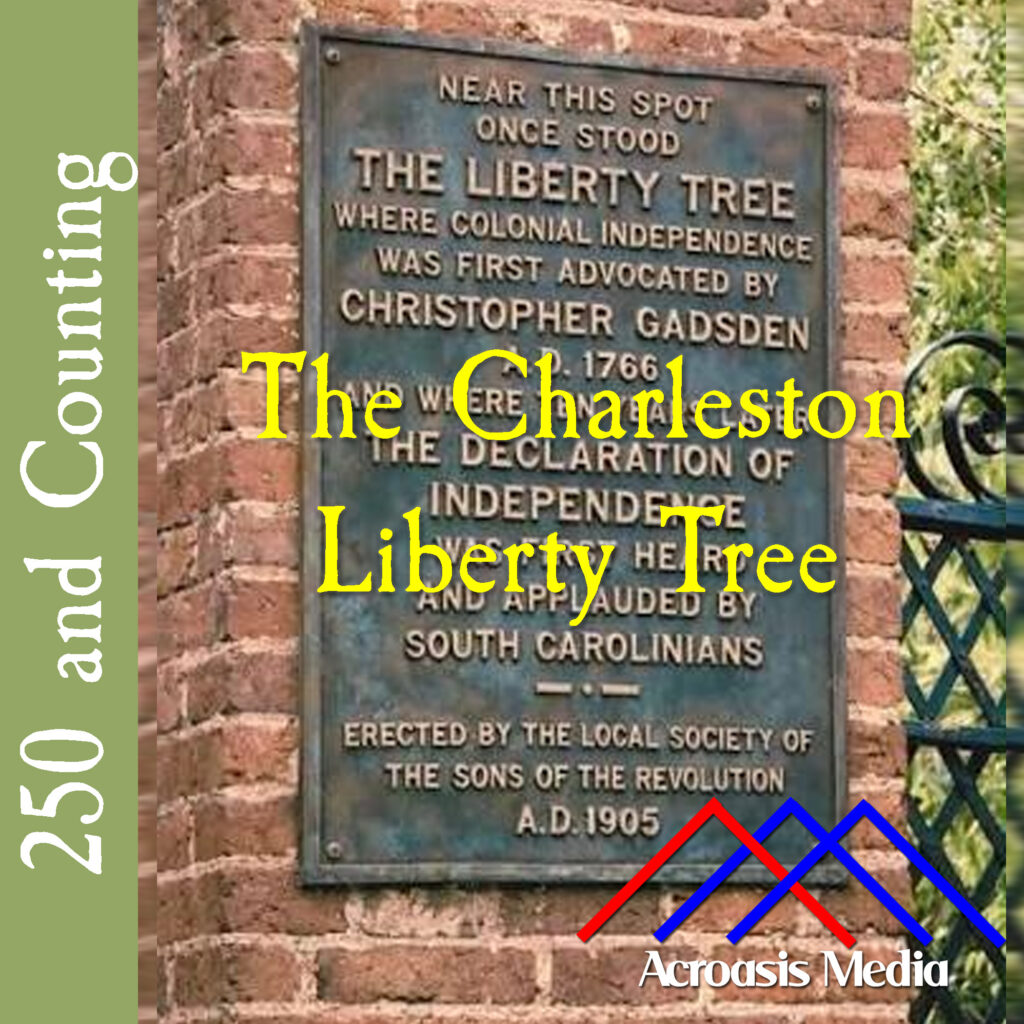
The Charleston Liberty Tree has something in common with its more famous counterpart in Boston: neither tree made it to the end of the Revolutionary War.
The Boston Liberty Tree was cut down by Loyalists in 1775, and the Charleston Liberty Tree was burned down by the British in 1780.
In researching these trees and their ultimate fates, I couldn’t help but laugh: the trees are meaningless. They’re literally landmarks, not secret meeting houses. Removing the trees does nothing whatsoever to prevent the Patriots from doing the Patriot thing; in fact, it’s entirely possible that it spurred the “victims” to rebel all the harder.
It’s just a weird thing for Loyalists to get upset about, right?
And then I realized that things really haven’t changed very much since then. Politically active people of all stripes these days also get kind of overwrought over relatively stupid stuff.
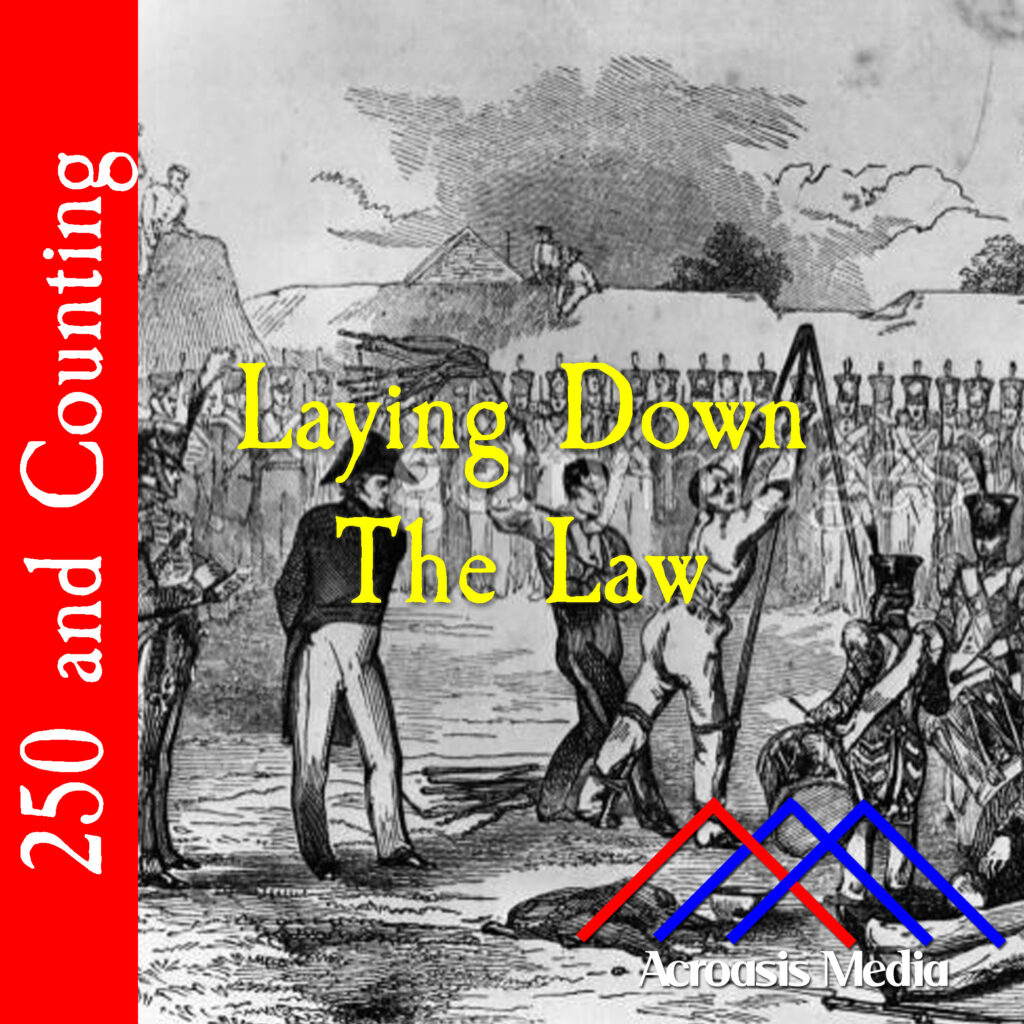
When it came to army discipline, George Washington had some definite opinions. The punishments we hear about were rather harsh by modern standards, but Washington had some problems with his recruits that modern armies don’t tend to have.
Specifically, (and we’ve mentioned this before), the Continental Army had a relatively short enlistment period, which meant that soldiers were constantly turning over and by the time someone was finally in good shape as a soldier, they were gone and replaced with the next guy who had little idea of what he was doing. So Washington was constantly beset by soldiers who didn’t know how to be soldiers. This often meant that he had to lay down some harsh punishments to help ensure that his message got across.
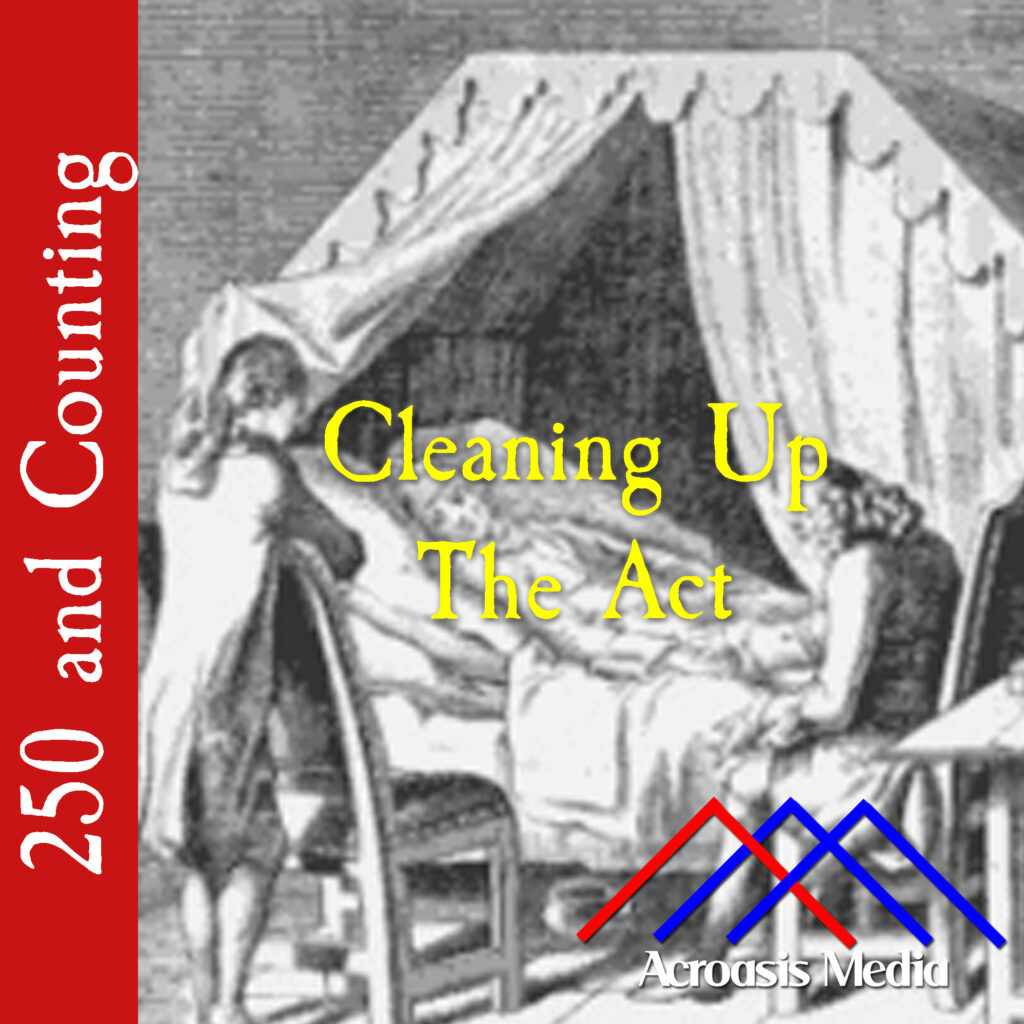
The punishments themselves weren’t especially unique; discipline of this nature was meted out in many places. In fact, today’s cover art is actually taken from a British flogging nearly a hundred years later. But Washington and other military leaders of the Revolution cut their teeth on British army discipline, and it didn’t look a lot different: the prisoner was strapped to a frame of some kind; the other soldiers were required to witness; and the drummer boys (at right in this image) did their best to drown out the cries of the man being punished. We had to crop this image to fit the space, but you can also see a pair of legs sticking out from the bottom right: that’s a soldier who has fainted from the stress of watching. And the man at left is a doctor, who is actually monitoring the prisoner’s health to ensure that the punishment isn’t fatal. So he’s got that going for him, which is nice.
George Washington had a deep-set sense of right and wrong, and sometimes his sense of Army decorum could get in his way. Our July 14 episode demonstrated that to a certain extent.
Other times it demonstrate the high expectations he placed on himself and others. He wanted his officers to be behavior models, especially because so many of the troops were so undisciplined. This only worked to a certain extent; it took the influence of some outside officers for the lessons to really sink in, but we won’t get to talk about that for some time.
It’s also important to note, as I think today’s episode demonstrates, that Washington did care about the well-being of his men. Not just their physical comforts (he was always trying to get blankets, better food and such for them), but their mental and spiritual comfort as well. It wasn’t all army decorum. So he made allowances for the men to take a day to worship if they so desired, and to be exempt from fatigue duty on Sundays, “until further orders.”
“Further orders” turned out to be until August 25, when the order was rescinded, but the fact that the order was given in the first place goes a long way.
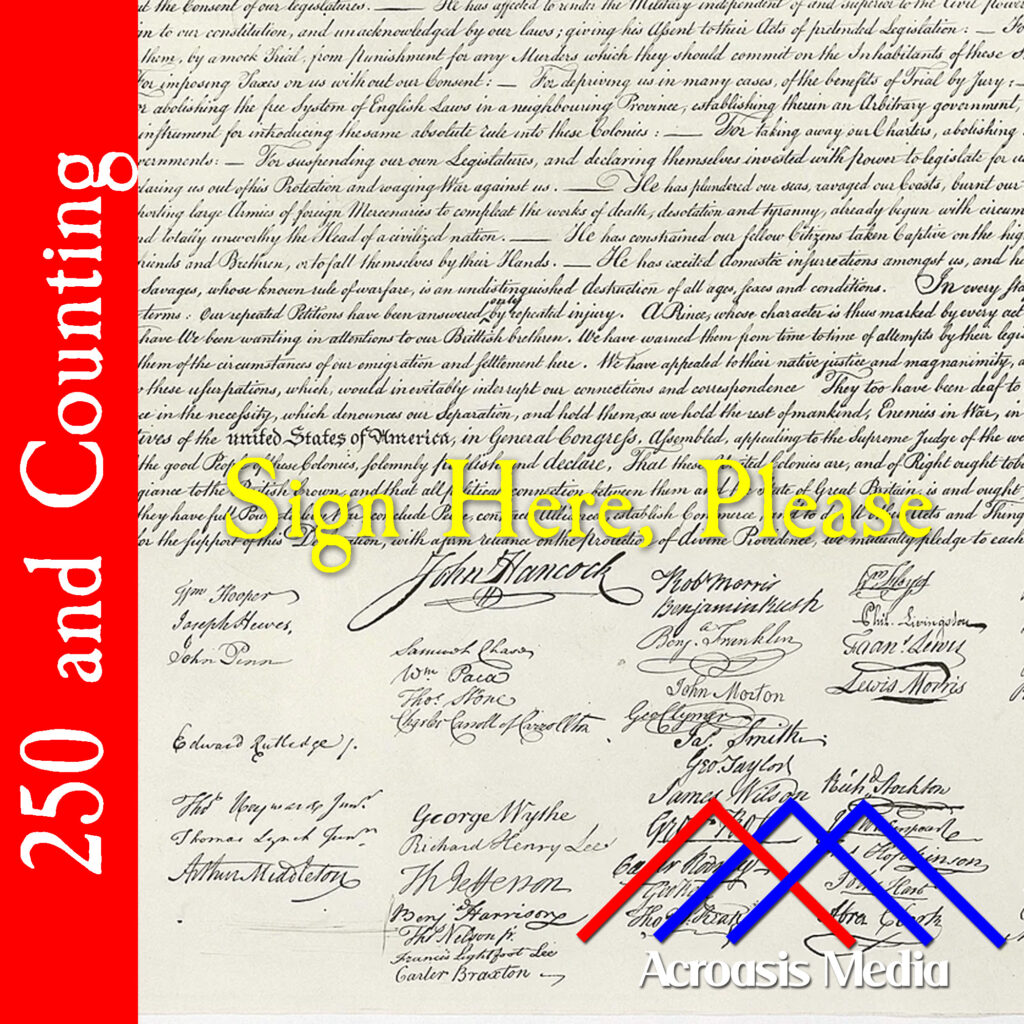
The approval of the Lee Resolution was July 2, the Declaration was approved July 4, the signingof the Declaration was (mostly) on August 2.
Which date would you have considered for Independence Day if you were in charge back then?
Ah, who are you kidding. You’d have picked the Fourth as well. The approval of the Lee Resolution was a detail of procedure. The signing of the Declaration was just finishing up the paperwork. And we have an actual document with a date on it! Of course everyone chose the Fourth! (Sorry, Mike.)
Incidentally, practically every American knows what the Declaration of Independence looks like. But do you know that there’s something on the back?
Remember that early on, the original document was not especially well-treated. And oftentimes it was simply rolled up for transport. Because there were probably other documents it was housed with, someone wrote along one edge, “Original Declaration of Independence, dated 4th July 1776”.
At this point, Americans were fighting a two-front war. More accurately, they were fighting two wars against different enemies: the Cherokee in the southwest areas of the country (so far), and the British…well, practically everywhere else. But today we’ll focus on the British in New York.
After yesterday’s disaster in the Ninety-Six District of South Carolina, the Cherokees, plus a bunch of Loyalists, moved east about 30 miles to Seneca, which at that time was called Esseneca Ford.It was there that they met up against Andew Williamson, who they outnumbered by something like four-to-one. But with the assistance of some men on horseback, plus another batch of reinforcements, the Cherokees were forced to retreat.
In New York, the British, along with a huge number of Hessian mercenary soldiers, were massing in Staten Island with an eye toward taking Manhatten, Long Island and the Hudson Valley in an effort to cut off New England. George Washington will be facing an enormous battle very soon, but on Monday we’ll be telling you about something at least as important fo the General.
As I mentioned very early in this podcast, Francis Salvador’s life was especially notable for two things: the day he was elected to public office, and the day he died. And in his case, the dates were notable largely for the fact that Francis Salvador was a Sephardic Jew, making him the first man of his faith to be elected to office in America, and the first of his faith to die in the Revolution.
Francis Salvador was born in London, but his family were part of a Portuguese and Spanish Sepharidic Jewish enclave in that city. Salvador had an uncle who’d invested heavily in the British East India Company, and they still owned lots of land in Portugal, so they were pretty comfortable financially.
Until, that is, the Great Lisbon Earthquake of 1755, and the subsequent failure of the East India Tea Company. They were in much worse shape after those two blows, but by that point Salvador had already purchsed some land in South Carolina. In 1773 he emigrated to America, intending to bring his family over when he had the money to do so, but he was killed before they could make the move.
Both Dr. Benjamin Franklin and the Reverend John Witherspoon made good points when they discussed state representation in Congress under the Articles of Confederation they were trying to put together.
The interesting thing is that the debate sounds very much like a modern-day discussion with regard to the nations that participate in NATO. Smaller nations are feeling a little “pushed out” by larger nations; the larger nations feel as though they’re dealing with most of the burden. And while those larger nations are correct in that the smaller nations aren’t making the contributions to which they initially agreed, it’s a matter of cure, not disengagement.
At any rate, as Mike notes, the siguation won’t be fully addressed through the Articles of Confederation; ultimately they kicked the can down the road and, when the AoC finally collapsed, our current bicameral legislature attempted to address the large/wealthy states vs. small/poorer states representation conundrum. The system could still use some fixes (e.g. the current total number of Representatives in the House is unconstitutionally low, by literally a couple of decimal places), but it’s all in pursuit of a more perfect Union. We screwed up today but we’ll get it a little more right tomorrow.
After Reverend John Witherspoon left Congress, he returned to Princeton, where the campus had been badly damaged by the British. He worked diligently to repair the damage. He was also a member of the New Jersey convention that ratified the US Constitution, and he organized the Presbyterian Church in the United States.
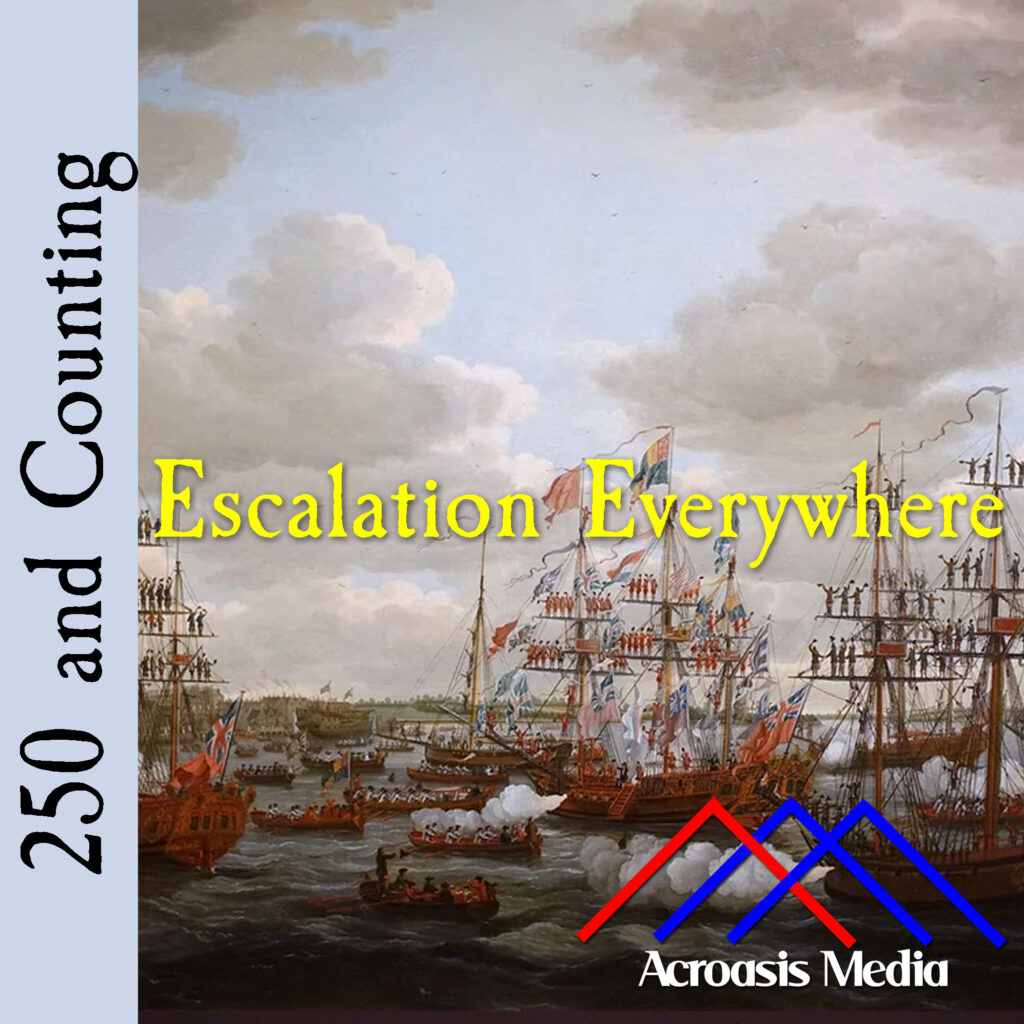
The presence of the British in Staten Island wasn’t a big mystery, but within a month after they first arrived, the number of ships in New York Harbor was well over 100, and still growing.
And, as George Washington suspected (along with many others), the British began moving up the rivers surrounding Manhattan, working their way up the Hudson River in the effort to use New York as a wedge between New England and the rest of the colonies. Specifically, if supplies couldn’t get through, then it weakens both sides of the line.
As for New York itself, part of Washington’s problem was that he didn’t know if the British plan was to take New York City (still a small chunk of Manhattan Island at that time), or to move through Long Island. As a result he had to hedge the bet a little bit and send troops in both directions, spreading the Continental Army rather thinly. This may have forced the British to do something quite similar, but they still had Washington vastly outnumbered.
Hygiene in the Continental Army was practically nonexistent. As you can imagine, things got pretty ripe around camp, especially in the summer.
And when people don’t take good care of such things, they’re probably going to wind up sick. Getting sick when you’re supposed to be on duty likely means that you’re going to do your “business” fairly close to where you’re working, This, in turn, is going to have the effect of getting other people sick while simultaneously perpetuating your own illness. This was especially true when such things took place too close to the water source, thereby contaminating that as well.
Ain’t we got fun!
There were a few people—the Officer grade men, primarily—who may not have known anything about bacteria, but they were able to see what and who was where, and connect the dots, so they began to take steps to help keep illness down.
Did it help? Probably not right away, After all, the soldiers were still a rather undisciplined group, and maintaining hygiene in the Continental Army was pretty low on their personal priorities. If we had to guess, things probably abated a little bit, but didn’t really improve until the men that Silas Deane, et. al. came over and got things on track.
Getting arms and credit wasn’t an overly tough task for Silas Deane. But it wasn’t because the French liked us so much; it was because they were still a little salty about the French and Indian War. So they were willing to do almost anything to embarrass the British.
As a delegate to France (essentially a secret envoy until the word of Independence got out), Deane got a lot of stuff done, especially since he needed to do it in secrecy. The reason for this was that the French (and the Spanish, for that matter) needed some plausible deniability should arms get intercepted. So items were sold through a gray market, and if something didn’t make it to America, that wasn’t on King Louis; that was some smuggler working on his own and without formal authorization from those guys pointedly looking the other way.
Once Independence became a more public topic, Ben Franklin and Arthur Lee crossed over to France to join Deane. The three of them managed to recruit foreign officers to assist the American troops, including Marquis de Lafayette, Baron Johann de Kalb, Thomas Conway, Casimir Pulaski, and Baron von Steuben. The officers were rather unpopular among the men, at least at first, and Deane got the blame somehow. In late 1777 he was recalled back to America.
While in America he was accused by Arthur Lee of financial impropriety. Unfortunately for him, his financial records were still in France because he thought he’d be coming back soon. Ultimately this charge was dropped, and he was permitted to return to France to settle his affairs; when he arrived, however, he discovered that he was nearly broke because many of his investments had plummeted, and some of the merchandise he’d sent to America had been captured by the British.
Further damaging his reputation was a letter he’d written in 1781 that had been intercepted, suggesting that the American cause was doomed, and perhaps some kind of rapproachement with Britain was indicated. So on this side of the ocean, people thought his actions to be treasonous. It wasn’t until 1789 that Silas Deane even attempted to return to America; unfortunately he fell ill during the trip and died at sea.