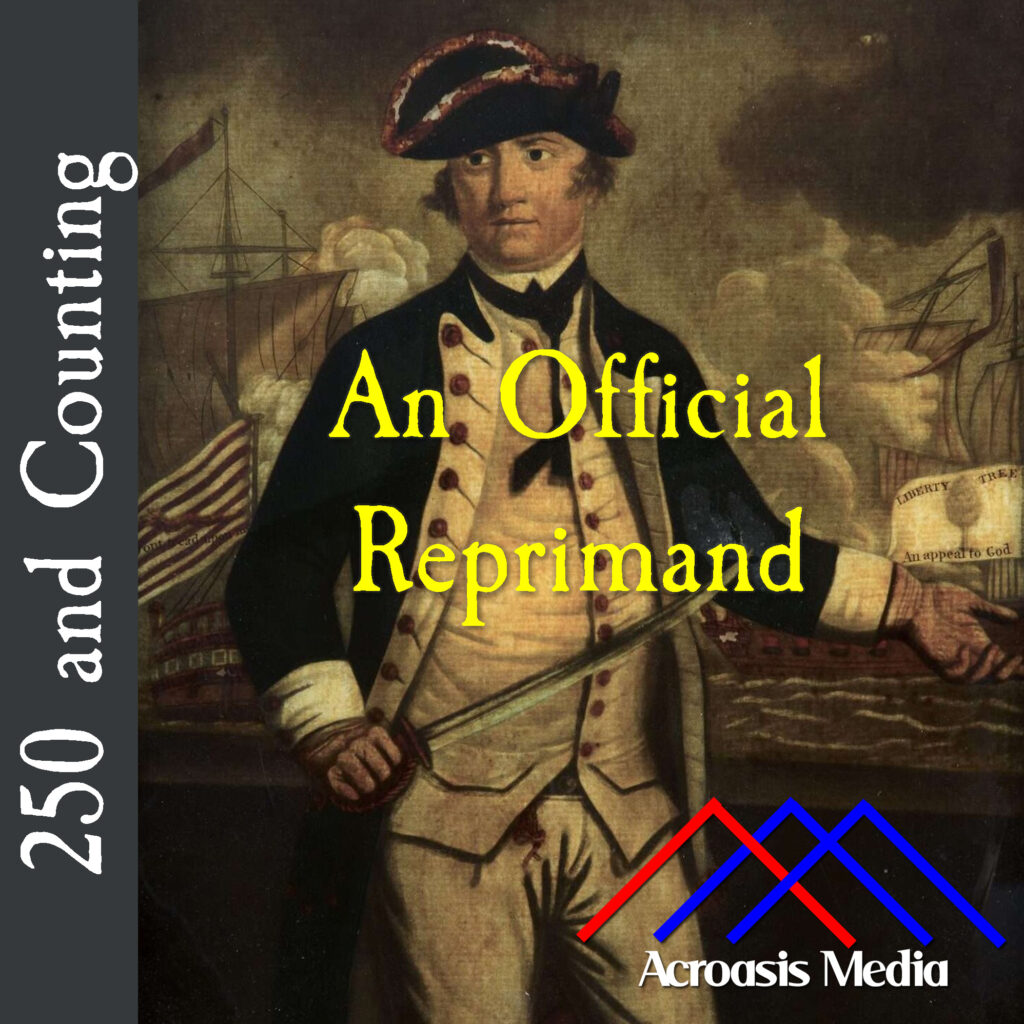
We’ve visited Esek Hopkins in the past, when we told you about the transgressions he committed that led to today’s activity.
To be fair, when Hopkins chose to engage in the raid on Nassau, the reaction in Congress was mixed, especially at first. John Hancock was happy that the Continental Navy had seized badly-needed war supplies from the British, but members from the Southern colonies were upset by this failure to follow orders. The whole situation became politically quite complex. Part of the problem was that privateers were easier to hire than Continental Navy sailors, and here we had a guy behaving like a privateer. This could only make the problem harder to solve, because privateers wound up getting paid more.
The debate went on for several weeks, with John Adams, Samuel Adams, Benjamin Franklin, Richard Henry Lee, Robert Treat Paine, and John Paul Jones (who was at Nassau) coming to the defense of Hopkins. Regardless, in the end he was formally censured. In the long run it wound up worse than if he’d simply lost his command, because he had to return to his ship disgraced and with the respect of his officers lost.
Nathanael Greene was among the first to step up when the shooting started at Lexington and Concord. This is almost certainly because a British official seized a vessel owned by Greene and his brothers.
After the Intolerable Acts were enacted in 1774, Greene organized a militia unit called the “Kentish Guards.” Despite his leadership, he was not selected as an officer in that militia because he had a limp he’d acquired in childhood (there are no records extant showing why this was the case.)
However, when the war broke out, Greene was selected to lead the Rhode Island Army of Observation and head to Boston. That company was involved with the battle at Bunker Hill but Greene wasn’t there for it; he was visiting home at the time.
Later that month, the Continental Army was established, and he became Brigadier General Nathanael Greene. Greene remained with the Boston-based forces after the siege of that city ended, but he rejoined Washington shortly thereafter in New York. As we note in today’s episode, Greene was ill with a severe fever when the Battle of Long Island broke out, but he was able to take command for the Battle of Harlem Heights in September, during the withdrawal from Manhattan. We’ll talk about that more in a few weeks.
John and Abigail Adams were one of the great love stories of the 18th Century, and for John to receive a letter from Abigail must have been heavenly, even if it happened nearly every day.
To be sure, Abigail didn’t always have good news with regard to whatever might be happening at home, and today’s letter is no exception to that. But Abigail was a woman with strong opinions and she wasn’t afraid to put them to paper and let John know what she thought. It was presumably her hope that John could sway the Congress to take on some of her ideas, and it’s entirely possible that he tried, but Abigail was a very progressive, forward-thinking woman and the men in Congress just weren’t realy for that level of social change.
Abraham Shepherd hails from Shepherdstown, West Virginia, but when he was born it was Mecklenburg, Virginia.
As near as I can put it together, there were originally two large tracts of land belonging to Shepherd families; one was over 200 acres and the other was a 750-acre plot of mostly farmland.
In 1776 there were five Shepherd brothers, whose father, Thomas, died in 1776. John Shepherd, one of those five, moved to Wheeling Creek (Ohio, not WV), then Limestone Kentucky, then Red Oak, which was in Adams County, about 50 miles east-southeast of modern-day Cincinnati.
Meanwhile, back in Mecklenburg, the town changed its charter and, in 1798, extended its corporate limits and changed its name to Shepherdstown, likely to honor Thomas Shepherd. Thus, in 1862 when the trans-Alleghany Virginia counties voted to secede from Virginia and become their own state, Shepherdstown was instantly one of the oldest towns in the state. That vote was challenged, and in 1866 the US Congress passed a resolution recognizing the transfer. Ultimately in 1870 the Supreme Court decided in West Virginia’s favor. Maryland also had something to say about who owned some of that land, which is why West Virginia has that peculiar hook in the northeast corner, but again the Supreme Court sided with West Virginia.
Last week, a Maryland legislator put forth a bill that would secede the Eastern Shore of Maryland from the rest of the state, but he somehow also included a county from Delaware and the part of Virginia that’s part of the Delmarva Peninsula and separated from the rest of the state by the Chesapeake Bay. How counties in three different states could become their own state, and whether the potentially affected counties in those states actually feel about such a move, is not known. I suspect that it’s largely a performative action on his part to protest gerrymandering, and he’s right in that many of Maryland’s districts have ridiculous shapes. But these days it’s much more complicated to just break away from another state, for political and fiscal reasons.
Andrew Pickens was a plantation owner whose property was near Seneca, South Carolina, which is almost as far west as you can go and still be in South Carolina.
As the Cherokee-American wars wore down, Pickens was able to sign peace treaties with the tribe, which was known as the Treaty of Hopewell.
Meanwhile, in the American Revolution, Pickens had to surrender the fort in the Ninety-Six District. He agreed to sit out the war as part of his parole, but when the British later destroyed most of his property, all bets were off. He led numerous campaigns in South Carolina and Georgia, making him popular enough the he was elected to the House of Representatives from 1781 through 1793.
It’s worth noting that some of his Revolutionary War battles were the basis of some scenes in the 2000 film The Patriot.
Andrew Pickens was one of only nine Representatives to vote against the Eleventh Amendment to the Constitution, which prevents states from sovereign immunity in lawsuits against them by citizens of another state. For example, under the amendment a private citizen from Virginia is allowed to sue the state of Tennessee, and Tennessee cannot claim that the person has no standing because they’re not a citizen of Tennessee.
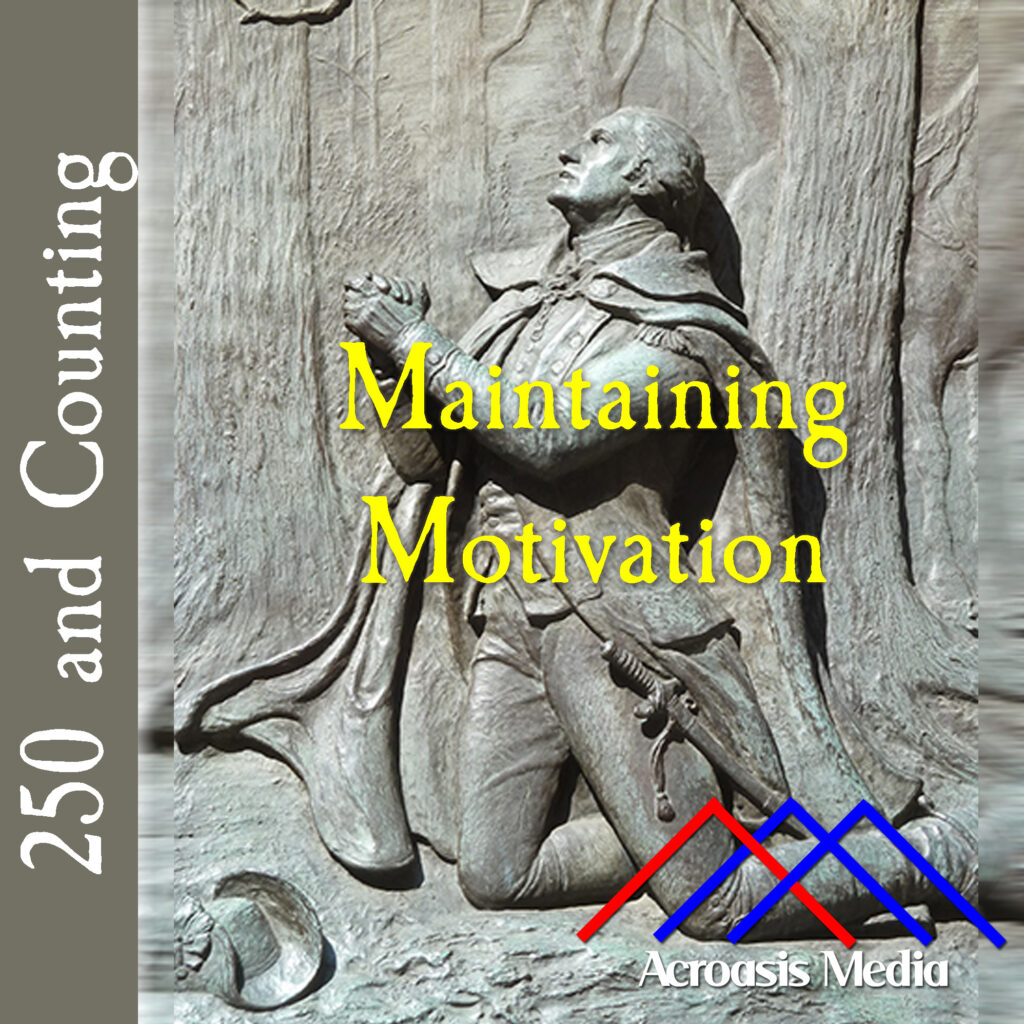
George Washington’s means for maintaining motivation in the Continental Army came from two directions: discipline and stirring rhetoric as a means of providing the troops with something to rally for.
And his Orders of the Day for this day seem to be focused simultaneously on both.
As noted elsewhere, Washington could be a stickler for protocol, and it shows in his Orders of the Day, which were usually written in the third person. But there was also some room—not a lot, but some—for a little floridness in his writing. For example, here’s an excerpt from today’s orders:
The Honorable Continental Congress having been pleased to allow a Chaplain to each Regiment, with the pay of Thirty-three Dollars and one third per month—The Colonels or commanding officers of each regiment are directed to procure Chaplains accordingly; persons of good Characters and exemplary lives—To see that all inferior officers and soldiers pay them a suitable respect and attend carefully upon religious exercises: The blessing and protection of Heaven are at all times necessary but especially so in times of public distress and danger—The General hopes and trusts, that every officer, and man, will endeavour so to live, and act, as becomes a Christian Soldier defending the dearest Rights and Liberties of his country.
In other words, God is here, we’re paying for him to be here, and God is someone you really don’t want to annoy, so get it together, please.
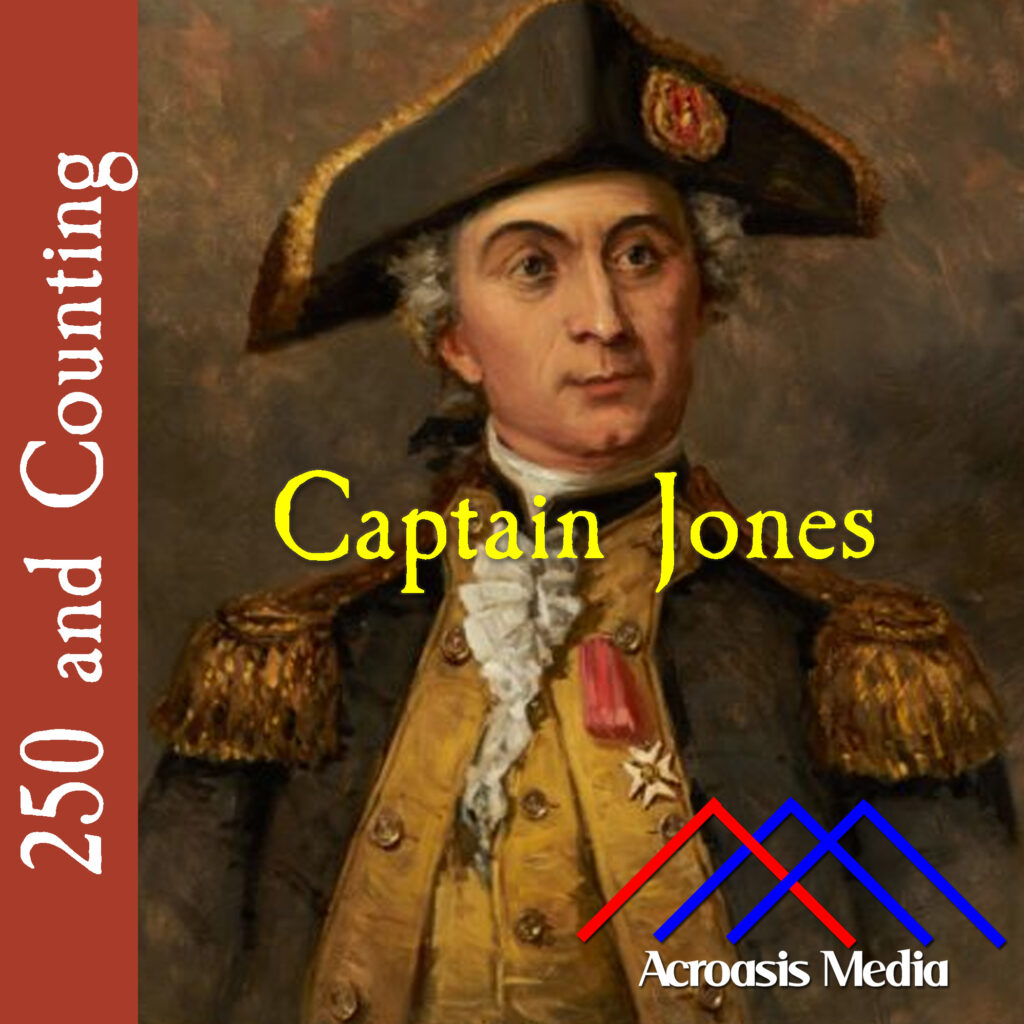
The career of John Paul Jones, or Captain Jones, as he became on this day, is marked by both brilliance and controversy.
Jones was born in Scotland and sailed on merchant ships before coming to America and joining the nascent navy here. Through the Revolutionary War, he was involved with several key battles, many times off the English coast rather than on this sise of the pond. This led to his having an international reputation.
But in 1787 he was left without a command, so he took on a position with the Imperial Russian Navy, rising to the rank of rear admiral. Unfortunately, he was forced to leave after being accused of raping a 10-year-old Russian girl. (He admitted to having sex with her, but not raping her, and he also claimed that he was not the one to have taken her virginity. Neither of these claims really helped his case.) The whole thing turned into a mess and Empress Catherine eventually exiled him for a minimum of two years.
Captain Jones moved to Paris and was eventually appointed as the US Consul to Algiers, but he died before he could begin that position. After his burial, the records were lost and so his specific location was unknown for many years. What was known was that his body had been preserved in alcohol and that he had a lead coffin. In 1905 he was located and an autopsy completed, which confirmed the original suspicion that he’d died of interstitial nephritis.
Captain Jones’ body was returned to the United States and he was re-interred in a bronze and marble sarcophagus at the US Naval Academy in Annapolis, Maryland.
I promised you a postscript for the Christopher French story, but let me offer up some broader context first.
In July 1776, French wrote to George Washington from Connecticut, where he was being held as a prisoner of war. The purpose of the letter was to request parole from his confinement.
Washington’s reply reads:
Sir: I am to acknowledge the receipt of your favor of the [the date is missing here but from other documents it was probably the 22nd] July, intimating your expectations of release on the 12th. of this month.
I have considered your Parole, advised with those whose Knowledge and experience gives weight to their Opinion, and otherwise endeavoured to inform myself how far your Construction of it is founded upon Justice, Reason or Usage; I do not find it warranted by either, My Duty therefore Obliges me to over rule your Claim as a matter of Right. As a matter of favor, Indulgence is not in my Power, even if your General Line of Conduct as a Prisoner had been unexceptionable.
I have therefore wrote to the Committee of Hartford, sent them a Copy of this Letter and hope you will, without Difficulty, conform to the Regulations already made with respect to Prisoners, by the General Congress.
It is probable a general Exchange of Prisoners will soon take place, it will then be a pleasing part of my Duty, to facilitate your return to your Friends and connections, as I assure you it is now a painful one to disappoint you, in an Expectation which you seem to have formed, in a full Persuasion of being right and in which on mature Deliberation, I am so unhappy as totally to differ from you. I am Sir etc.
This much you knew. Here’s the postscript. Christopher French wrote another letter subsequent to the one Washington responded to. In that letter, which Washington received on August 8, it appears that French withdrew his request. Washington immediately sent a second letter, responding to this one:
Sir: I was unwilling to determine hastily, upon your claim of a Release founded upon your Parole, and therefore delayed the acknowledgment of your favor of the 22d July, until I should fully inform myself. I had accordingly wrote you Yesterday, that I was so unhappy as to differ from you in the construction you had put upon it, but as there was reason to believe, a General Exchange of Prisoners might soon take place, I should chearfully facilitate your return to your Friends.
Last Night I received your favour of the 5th. August waving your Claim of a Release, which makes any farther Discussion of that matter unnecessary. Your other proposal, of being exchanged for Major Meigs or Col. Allen, will meet with no Objection from me; should you write to General Howe on the Subject the Letter shall be chearfully forwarded and his Answer returned.
Should any Difficulty arise in the Exchange, I am doubtful, how far I should be authorized, without consulting the Congress, to grant you an Indulgence similar to that of Major Meigs, which I have been informed was allowed in consequence of his saving the Life of a British Officer, either nearly connected with, or much esteemed by General Carlton.
However, you may assure yourself Sir, that both Duty and Inclination lead me to relieve the unfortunate and that I agree with you, that your long and early Captivity gives you a very just Claim to special Notice, and I shall be happy in furthering your Wishes, as far as my Station will admit. I am Sir, etc.
In short, Washington was happy to be relieved of the burden of refusing the initial release, but also still more than willing to cooperate should a prisoner exchange take place.
We didn’t spend a whole lot of time talking about John Morton, who comes up as part of today’s episode, and he does have an important part in the quest for Independence.
John Morton’s father died the same year he was born. John had very little formal schooling; most of what he learned, he learned from his stepfather. They had such a good relationship that John named one of his sons after his stepfather.
Despite his relative lack of education, John Morton was able to advise his neighbors and advocate for them when needed, and help them keep their books. In 1774, while serving as Speaker of the Pennsylvania Assembly, he was voted to be a delegate to the First Continental Congress held in Carpenter’s Hall in Philadelphia. On November 4, 1775, he was elected to the Second Continental Congress which was held in the State House, later renamed Independence Hall.
In 1776 and 1777, John Morton became Chairman of the Committee of the Whole and was heavily involved in writing the Articles of Confederation, the new nation’s first form of government. Sadly, in March of 1777 John contracted tuberculosis and died on April 1, making him the first of the 56 signers of the Declaration of Independence to die.