This day in American History, 250 years ago.

  • James Warren Likes Privateers–October 20, 1775

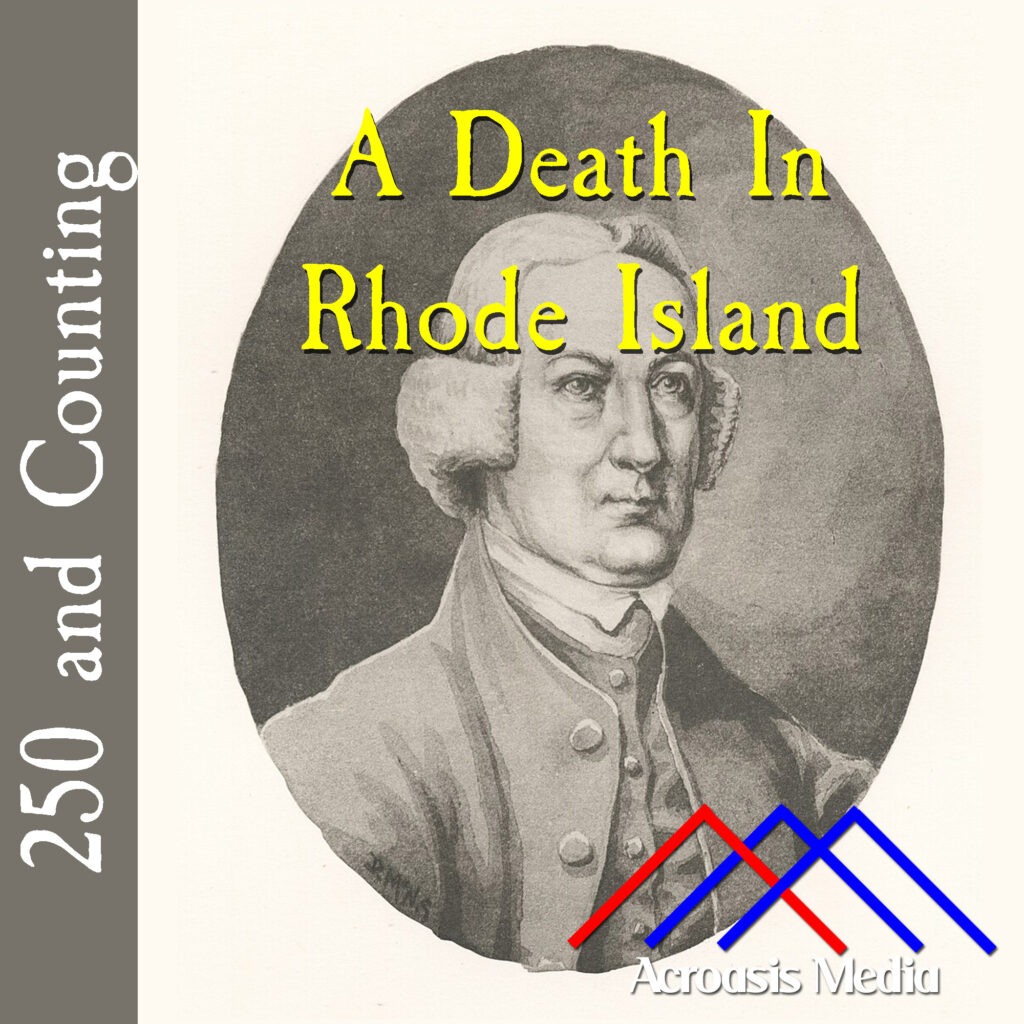
    Cover art for October 20, 1775: James Warren by John Singleton Copley - ABC Gallery, via Wikimedia Commons

    In the immediate aftermath of the destruction of Falmouth (then Massachusetts, now Maine), naturally there was a great deal of concern when it came to defending our shores from the British Navy.

    After all, the Brits had the most powerful navy in the the world, and the Americans…well, they’d barely gotten started putting theirs together. A couple of the colonies had started their own navies, but we had a long way to go.

    James Warren, in his capacity as a member of the Massachusetts Provincial Congress, wrote a letter to John Adams outlining his concerns, and coming up with solutions until we could get our Navy into good fighting shape.

  • Keeping The British At Bay–October 19, 1775

    Cover art for October 198, 1775: "1775 Map of Charleston Owned by Henry Laurens - American"

    There were two events marked today. One of them involves the continuation of a ban on exports of weapons to America. This was something that had to be formally declared every few months.

    Meanwhile down in South Carolina, a brief fight between two ships in the Charleston Harbor got local leaders thinking about the best way to keep the harbor protected. Their solution: set it up that the only way you can get in or out of Charleston harbor is by ensuring that you remain within range of Fort Johnson’s guns.

  • Washington Gets Some Relief–October 18, 1775

    Cover art for October 18, 1775: the Battle at Lexington, Amos Doolittle (engraver) and Ralph Earl (artist). via the New York Public Library and the Library of Congress.

    George Washington was a pretty smart guy. He knew exactly what his army needed, in all aspects. He had a handle on discipline, on supplies, on tactics and any number of other things. Washington surrounded himself with people who were smart, too. This went a long way toward ensuring his success.

    So when his army started to fall apart because some basic needs weren’t getting met, Washington took action. He knew that sending another letter to Congress wasn’t going to help. So instead he met with them directly. And like a dog savaging a toy, Washington grabbed Congress in his (not wooden!) teeth and shook them in a figure-eight.

    Metaphorically, of course. And while he didn’t get everything he sought, he managed to get the important stuff done and the rest of it…well. The rest of it, at least he knew he’d been heard. And he’d live to fight another day.

  • Manley About The House–October 17, 1775

    Cover art for October 17, 1775: a wood block portrait of John Manley, ca 1782. Artist unknown. From the Peabody Essex Museum via Wikimedia Commons.

    Okay, first off, it’s only appropriate that I apologize for the stupid title. I really shouldn’t write when I’m low on sleep.

    Manley’s beginnings were murky (e.g. his year of birth is approximate) but he was a quick study and it’s no wonder that George Washington selected him as one of his first captains in the Revolutionary War. Just a few months later he was promoted to Commodore.

    Manley spent a couple of years harassing and capturing British ships, until he himself was captured. After nearly a year of imprisonment he was released. It was at that time that he became a privateer. A few years after that he re-joined the navy and remained there until his death in 1793.

  • The Burning of Falmouth–October 16, 1775

    Cover art for October 16, 1775: detail of a 1782 engraving depicting the burning of Falmouth. From the Library of Congress Photographs and Prints Collection via Wikimedia.

    To be clear, the actual burning of Falmouth took place on October 18, but the events that led directly to it happened on this day.

    Captain Henry Mowat had been captured by patriots in Falmouth some time earlier. When he returned, he brought five gunships with him. When he demanded that the locals swear allegiance to King George III, he gave the command that laid waste to the town.

  • Reinforcements Arrive in Quebec–October 15, 1775

    Cover art for October 15, 1775: Fort St. Jean (near the right edge) around the time of the siege. Watercolor, pen and ink by James Peachey.

    Fort St. Jean was a relatively soft target compared to Boston. Plus, it wasn’t as well fortified because the British weren’t holed up there. Sooner or later something would come along to break up the stalemate.

    On this day, a couple of somethings arrived, from Fort Ticonderoga and Crown Point. The big guns that Montgomery had hoped for finally arrived. And not long behind that, Montgomery was able to take Fort Chambly, which wouldn’t have been a huge deal had its commander not forgotten an important detail while he was high-tailing it out of there.

  • John Dabney Terrell Sr.–October 14, 1775

    Cover art for October 14, 1775: photo of John Dabney Terrell Sr. via findagrave.com

    Programming Note: Mike came down with a case of electronic laryngitis, so you’re getting me again for today’s episode. But Mike wrote it, so there’s that.

    John Dabney Terrell Sr. was…not one of our best and brightest Americans, but the work he did will lead us to a bigger story some time down the road. Much of what he did laid down the foundation for the event that became known for the Trail of Tears.

    As if that wasn’t bad enough, he was a slave owner who put some of his slave property (ugh, but that was the legal term) in his son’s name to avoid losing them in a pending lawsuit against him.

    That he did all this and chose to be buried in a very Native American fashion is kind of amazing.

  • Happy Birthday to the US Navy!–October 13, 1775

    Cover art for October 13, 1775: The Continental ship ALFRED, oil, by W. Nowland Van Powell. Meant to commemorate the official commissioning of the ship on December 3, 1775.

    It’s Cake and Candles for the US Navy, born this day in 1775.

    The Continental Congress initially authorized the purchase and retrofitting of two ships. But before long they saw the wisdom of having a navy, and soon many more ships were purchased, and commissioned into service.

    The Continental Navy, to be honest, didn’t have a huge impact on the war. Many ships were lost to British attacks, weather, or accidents. What it did have a big impact on, however, was the War of 1812. The seamen who fought in the Revolution were well-seasoned officers by the time that war came along.

    It’s also worth noting that the Continental Navy was disbanded after the Revolution, but a few years later the US Navy was officially established. However, given the continuity of tradition and the fact that today was the day that Congress authorized the purchase of the vessels, the Navy decided in 1971 that October 13, 1775 was the date of its official establishment.

  • Lyman Beecher–October 12, 1775

    Cover art for October 12, 1775: Portrait of Lyman Beecher by James Henry Beard, ca. 1842.

    Although Lyman Beecher could be considered famous just for being the father of several prominent writers and ministers, he also had some achievements in his own right.

    Beecher first became known for a sermon which was published shortly afterward on the evils of duelling. Because it was in the wake of Alexander Hamilton’s death, it proved quite popular.

    Beecher next turned his eyes to intemperance, which is what intoxication was called at the time. It was a concern throughout America in the mid 1820s, so he delivered and published a half-dozen sermons which sold very well in America and in Europe. Those sales continued well into the 1870s.

    By the time Beecher arrived at Lane Seminary in the early 1830s, slavery was coming to the fore as an important social topic. While he was an abolitionist at heart, his public stance was with colonization: the freeing of slaves and then moving them to start a colony in West Africa. (This is where Liberia got its start, incidentally.) Unfortunately, a multi-day public debate about colonization morphed into a discussion of abolitionism, and many students left the school altogether in protest.

    Shortly after that, his views on changes in the church led to accusations of heresy, which he successfully defended. However, the seminary was left gutted and he moved back to New York to live with his son Henry in Brooklyn, where he remained until his death.

  • The Great Carrying Place–October 11, 1775

    Cover art for October 11, 1775: "Carrying the bateaux at Skowhegan Falls", drawn by Sydney Adamson; halftone plate engraved by CW Chadwick, 1903.

    Benedict Arnold and Company are still on the move toward Quebec. Over a three-week period they’ve moved fewer than 90 miles, with only…300 to go. Today they’ve reached The Great Carrying Place, a 13-mile walk alternating between woods and knee-deep mud, all while carrying everything they’ll need to get to Canada.

    Back in the Colonies proper, General Gage is being replaced by General Howe. Gage was largely responsible for the Siege of Boston, especially since they weren’t able to break that siege. And then Bunker Hill came along. Sure, the British won but at great cost—a Pyrrhic victory. Once word got back to Britain about that, Lord Dartmouth appointed Howe within a couple of days. Of course, it took several weeks for the news to get back to America, and on September 26 he learned he was being replaced. By this days’ end, Gage was on his way back to Britain.