It’s been 333 days since Lexington and Concord, when the British were forced to retreat to Boston and were bottled up there by Colonial forces.
It’s been a week since the British said “enough” and decided to effect their departure from the city as soon as the weather cooperated.
But today, the day finally came.
It took about five hours to launch over a hundred ships, carrying thousands of soldiers, women and children from the city.
It was Washington’s first major win and the last time the British did anything of importance in New England. The war began to move south, to New York, New Jersey, and Pennsylvania. Virginia and the Carolinas also had their share of action, as we’ll see in the coming months.
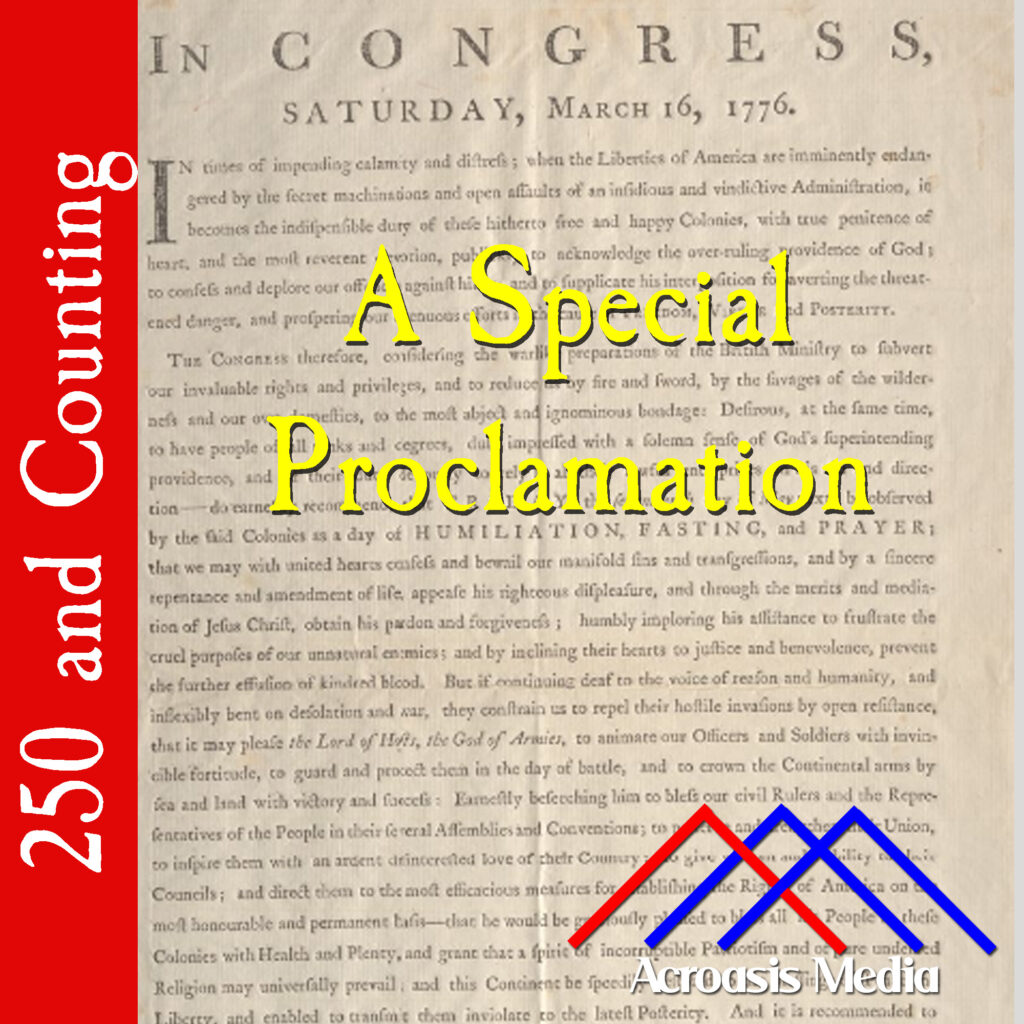
As we noted back in July, a day of prayer, humiliation and fasting wasn’t new to the Continental Congress. (Go back to that episode’s show notes to see my explanation of the word “humiliation” in this context.) And, as Mike notes in the episode, it wasn’t even close to the last for this Congress.
That’s neither good nor bad; it probably gave everyone the opportunity to simply stop and contemplate matters. Tensions were rising high by now, and it would have been easy to make a rash, emotion-based decision. So why not take a moment to ensure that whatever deity you subscribe to is inclined to help you?
I don’t frame it that way to be provocative; we all too often hear rhetoric suggesting that all of the Founding Fathers were good Christians. In fact they ran the gamut from orthodox Christianity, through rationalistic theism, through Deism. Thomas Jefferson once edited a Bible which removed references to miracles and the divinity of Jesus. Even among the “orthodox Christian” crowd, one could find Quakers, Lutherans, Dutch Reformed, Anglicans, and Presbyterians. One of our first episodes featured a Jewish Patriot. And even though he didn’t appear to practice publicly, Alexander Hamilton was raised Jewish as a child.
The point here is that when you’re in hopeless times—and fighting off the British was considered a lost cause in those days—you take the comfort where you can. Whether that’s in God, Buddha, Krishna, Zeus, Mohammed or another human being, it’s not wrong to give yourself some form of contemplation.
Georgia delegates to the Second Continental Congress numbered exactly one until around this time. That would be Dr. Lyman Hall, who didn’t believe it was ethical for him to represent the entire colony when he knew that feelings were largely divided back home.
Then came the Battle of the Rice Boats, on March 2 and 3. After that, it seems, things moved very quickly for Georgians: the Royal Governor, who’d been in and out of custody, fled to a nearby warship, the Provincial Congress was left in charge, and they immediately began making plans to raise a more formal army than the militia that fought in the Battle of the Rice Boats, and Georgia delegates were sent to the Continental Congress with actual instructions.
In addition, pieces were put in place to write a constitution for Georgia, a good first step toward the document that was created later in the year and adopted the following February.
There’s a ninth season episode of The Simpsons called “Sideshow Bob’s Last Gleaming” in which Bart’s nemesis, Sideshow Bob, steals a nuclear bomb and threatens to detonate it unless the town disables all of its television broadcasts. He delivers this ultimatum via a Jumbotron screen. Before ending the transmission, he says, “By the way, I’m aware of the irony of appearing on TV in order to decry it…so don’t bother pointing that out.”
And to a certain extent, that’s what happened today in 1776 as well. The Colonies were protesting British oppression, but in order to do that successfully, they had to briefly resort to British tactics.
It’s an unfortunate truism that the “good” side often has to resort to the “bad” side’s means of doing things to achieve an objective. On the other hand, the difference between the “good” and the “bad” side is that the “good” side is willing to undo the thing they did.
I cited The Simpsons above, but I’m sure you could come up with your own specific television episodes in which this is what happens. (I’m sure you can because another one just came to mind, but I’m not sharing it.)
First: let me apologize for the slight change in sound quality for today’s episode. I’m not in my usual recording space and I’m not especially happy with the equipment I brought. At worst you’ll have to put up with it just one more time.
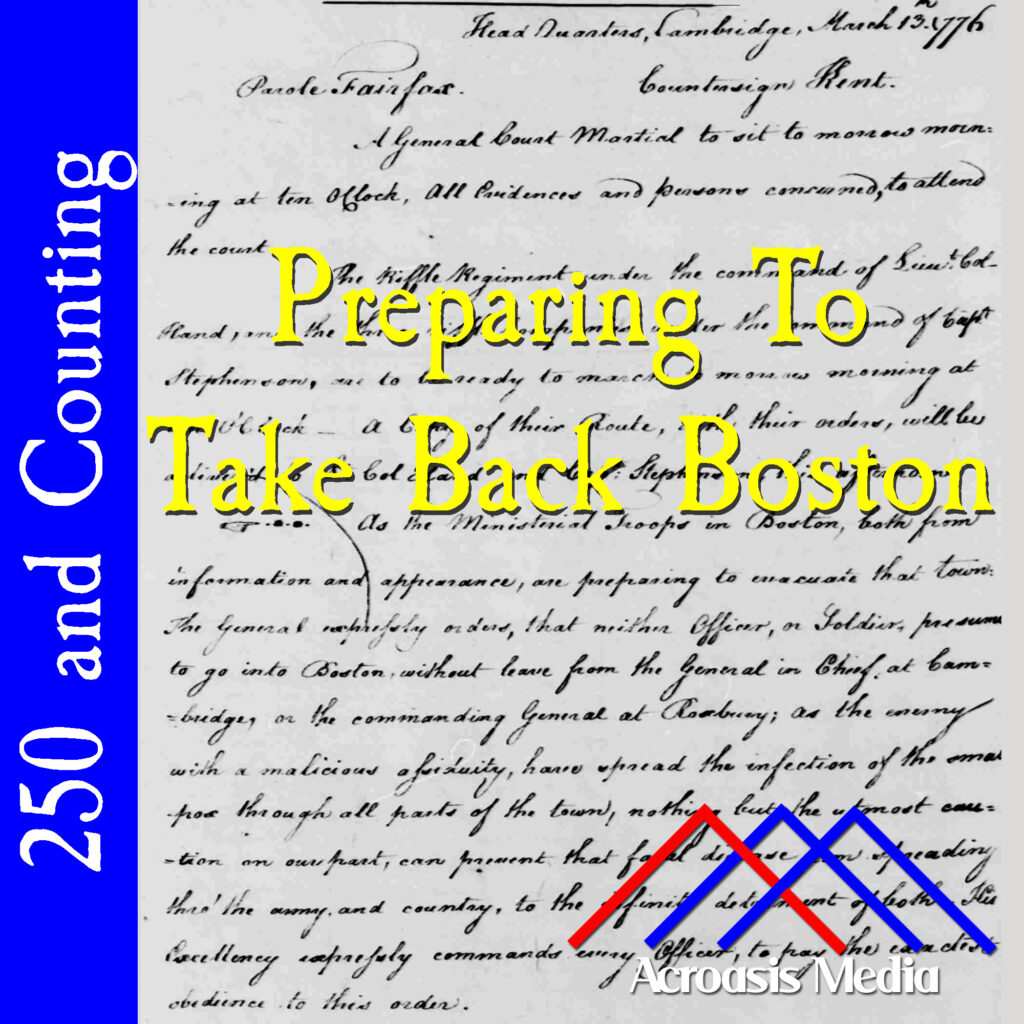
Next: George Washington was a gentleman through and through, so the fact that his general orders sometimes focused on the Continental soldier behavior shouldn’t be a surprise. In today’s episode he concerns himself specifically with that, but for two reasons. One is for the health and safety of the troops, but the other is because the Bostonians have been through enough, and he doesn’t want the Continental Army–the people supposedly on their side–to look like villains.
In the meantime he’s already standing down a big chunk of soldiers and sending them to New York, where the next big battle is going to be, he thinks. (Again, he’s right, but he didn’t realize it at the time.)
Of course it’s coincidental, but it’s kind of cool that we’re able to bring you this episode during Women’s History Month and the same week as International Women’s Day.
Believe it or not, Mike and I have struggled with the fact that there’s very little representation of anyone from this era who isn’t a white male. We’ve managed to touch on a few women and African-Americans from time to time, but after 435 episodes (including today) we’re probably still in the single-digit range.
Mike doesn’t concentrate very much on the newspaper notice that appeared in Baltimore this day; he gives us a little perspective on some of the ripples created by events we’ve talked about so far. Sometimes the women’s history angle comes from the things that are mundane in print, but vital to the success of the war.
It doesn’t make up for the lack of representation, but we hope it helps.
The focus today up in Cambridge, while waiting for the British to hightail it out of Boston, was getting the men ready to move to New York, and putting together Washington’s personal guard.
Washington didn’t really need a personal guard in Cambridge, at least not much of one, because he was in the driver’s seat while he was there. The British were bottled up, and he was the stopper. But to move to New York and then defend that territory? Well, that was another project entirely. New York had more access points, more deepwater harbor, and more territory overall to defend. This wasn’t like keeping the British locked up on the peninsula that was the entirety of Boston. And while Washington probably considered it a bit of vanity at first (that’s a guess on my part) to even have a group of men dedicated to being “Washington’s personal guard”, he likely began to understand the inevitability of needing the guard as the Continental Army’s Commander-in-Chief.
For a guy who’s technically on the wrong side of history, Crean Brush was a pretty interesting character.
Mike mentions in the episode that Brush was jailed for some time during the Revolution, but time didn’t allow him to tell you how Brush managed to get out of jail. I’m not going to spoil it, but the truly fascinating story can be found in this article by Eric Weiser. This article was one of those serendipitous finds that turned up when I went looking for a picture of Crean Brush. It’ll take you about twenty minutes to read, but I guarantee it’s worth your time, and I’ll give you your money back if you disagree.
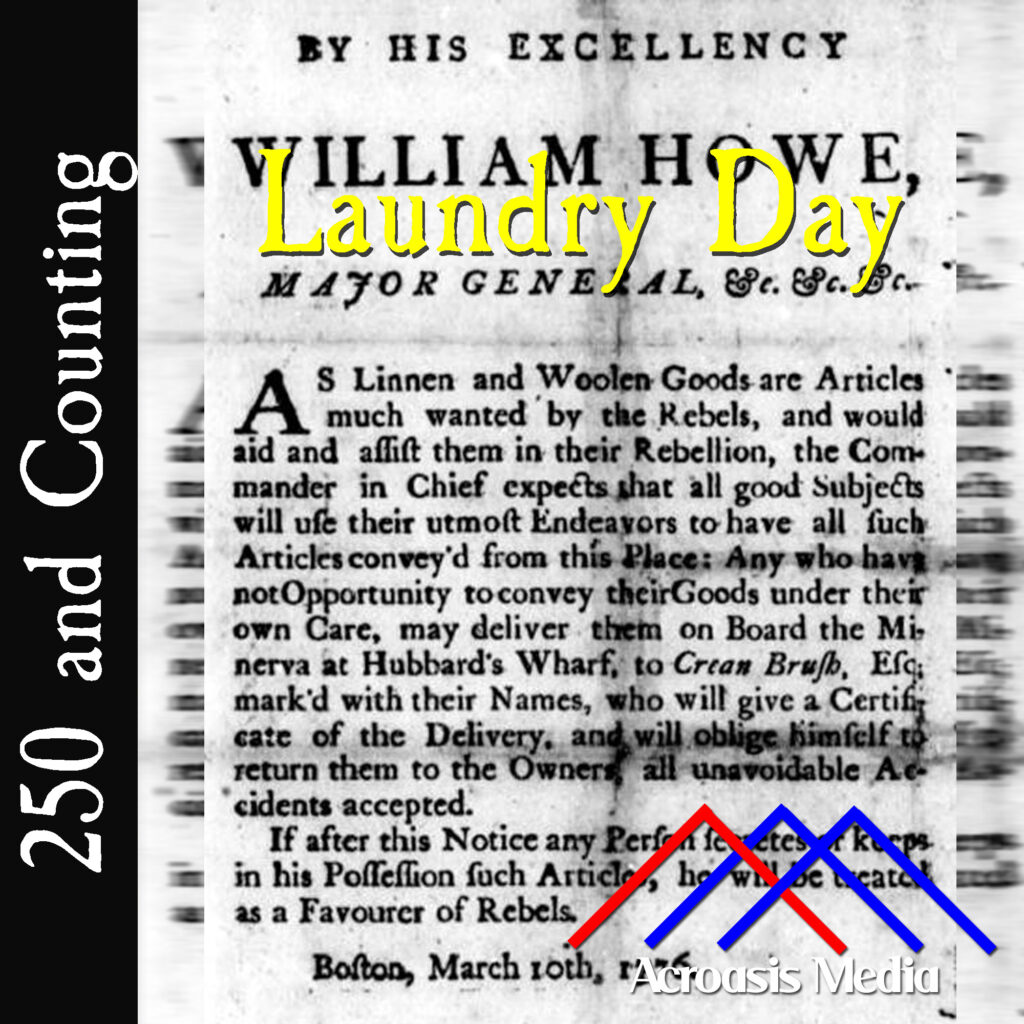
General Howe’s demand that people turn their linen and wool goods over to Brush sounds a little weird on its surface, but once you look a little closer you’ll see that it’s more petty than anything else. That said, there was a pragmatic angle to it as well: the material could be used to keep their troops warm and/or bandage any wounded British.
The occupation of Dorchester Heights, just across the river from Boston, was perhaps the final step that George Washington needed to end the siege that had gone on for nearly a year.
Of course, it wasn’t just occupying Dorchester Heights; Washington could have pretty much done that at any time. It was occupying them with a terrifying speed, thanks to Rufus Putnam (the guy in today’s cover art, by the way) and his clever plan for assembling the defenses there. And thanks also have to go to the big cannons that had been brought down from Ticonderoga. These guns had the range that Washington needed to not only shoot at Boston if he needed to, but to fire upon British ships in Boston Harbor.
Howe had a couple of moves left, but it was nearly over.
When Samuel Tweedy moved from Dutchess County, NY to Danbury, CT, it was a fortuitous time to do something like that. Danbury was undergoing an economic expansion as part of a post-war boom, which gave him extra opportunities to gain access to trade and manufacturing that he never would have seen back in New York, which was a largely agrarian economy at the time.
Tweedy’s marriage to Ann Burr had both social and economic benefits, since Danbury was rather tight-knit as a community, and his having Ann for a spouse gave him an “in” where some of that was concerned.
One of Danbury’s biggest products was hats, and Samuel Tweedy established his own business with the assistand of his father-in-law. He immersed himself in the craft of making hats, and ultimately established himself as a man capable of building smaller-scale workshops dedicated solely to producing unfinished hat blanks, which could then be sold to hatmakers. Since an efficient shop could only turn out a few dozen hat blanks in a week, having several shops meant that Tweedy could turn out more blanks than anyone else. Tweedy’s shops also specialized in making hat blanks with fur linings. And Tweedy benefitted from protective tariffs, which reduced the number of British imports when it came to hats.