Tag: 1775 births

  • September 24, 1775: Captain Nathan Heald

    Cover art for September 24, 1775: Photograph of Nathan Heald, date unknown.

    It could be argued that Captain Heald’s biggest claim to fame is that he was on hand for the disastrous outcome at Fort Dearborn, but at least he doesn’t eat the blame for it; it just happened to be the guy who was there.

    On the bright side (such as it is), the events at Dearborn were soon overshadowed by President Madison declaring war on the British, thus beginning the War of 1812. Heald and his wife, who were both injured at Fort Dearborn, were released back to the Americans. Heald was promoted shortly thereafter and given a disability discharge in 1814. And isn’t that always the way.

  • September 22, 1775: Philip Milledoler

    Cover art for September 22, 1775: Portrait of Philip Milledoler By James Peale - Private Collection, ca. 1830

    Philip Milledoler was a minister and the fifth president of Rutgers University (Rutgers College, then), but it’s a little more complicated than that.

    Milledoler took a moribund college and transformed it into the intellectual powerhouse it is today. But how it happened is at the heart of our story.

  • September 14, 1775: John Henry Hobart

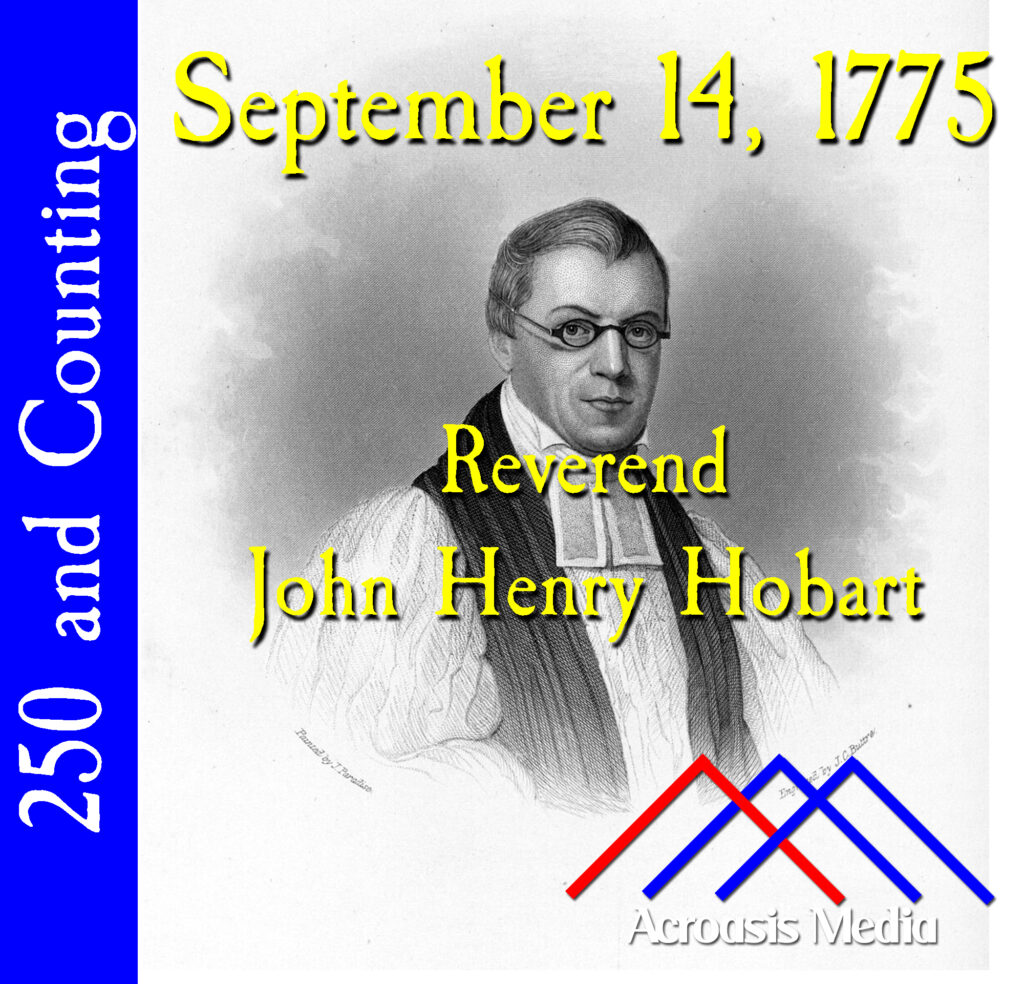
    Cover art for September 14, 1775: Painting of John Henry Hobart by J. Paradise, engraved by J.C. Buttre, approximately 1830

    John Henry Hobart was born on this day in 1775, and he came that close to dying on the same day in 1830, on September 12.

    We read once that, statistically, men tend to die before “big” dates, e.g. birthdays and major holidays, while women tend to die afterwards. In Claude’s family anyway, it does have a ring of general truth to it.

    Go figure.

    Although Hobart was an Episcopalian minister (and later Bishop), he was the pastor to Elizabeth Ann Seton, our first American saint. (Seton converted to Catholicism in 1805.)

    While Hobart was quite active in the New York City area, he also felt the need for higher education in the western reaches of the state, and established Geneva College (later Hobart College) in the Finger Lakes region. By the time he died, he’d established a church in most major towns in New York and begun missionary work among the Oneida Indians.

    It’s not 100% clear what caused his death, but it was likely a chronic intestinal infection that affected his health in later years.

  • August 27, 1775: Frederick Graff

    Cover art for August 27, 1775: an 1804 portrait of Frederick Graff, painted by James Peale. Note the Center City Waterworks in the background.

    Frederick Graff feels like one of those guys who gets so little credit for what he did, you wind up feeling pretty badly for him.

    But the fact is, if not for him, over three dozen cities in the US wouldn’t have adequate water systems. So good on Frederick! Hoist your favorite beverage in his honor! (Though, in this case, it really should be water.)

  • August 20, 1775: George Tucker

    Cover art for August 20, 1775: Photo of George Tucker, 1845. Photographer unknown, uploaded to Wikimedia Commons from the University of Virginia Library.

    Lots of prominent early Americans weren’t Americans to begin with. For instance, the first President of the United States who was actually born in the United States would be Martin Van Buren, our eight president.

    But while most of these folks were born on the North American continent, the subject of today’s episode was not. He was born in Bermuda. So while George Tucker was still a British citizen by birth, he didn’t come to America until he was twenty years old, making him an honest-to-goodness immigrant.

    But let’s not hold that against him. As you’ll learn today, Tucker had a long and varied career as a politician, an educator and an author.

  • August 18, 1775: James Elliot

    Cover art for August 18, 1775: Grave marker for James Elliot and his wife Lucy. via Find-A-Grave.com

    James Elliot was born in 1839 (like the stone says over there), in Massachusetts. Later on he became a legislator for the state of Vermont, which was neither a state nor even a colony when he was born; it was still disputed territory between New York and New Hampshire.

    Although Elliot was too young to participate in the American Revolution, his political fortunes waxed and waned…but mostly waxed.

  • July 21, 1775: Isaac McKim

    Cover art for July 21, 1775: The McKim School, now a community center in eastern Baltimore. This is a public domain photo (via Wikipedia), and while it looks a little dreary here, it's actually quite nice.

    We know: when an episode is a biography, we typically use a portrait of the person born on this day 250 years ago.

    But this time around is special: the artwork on today’s episode is a building that was erected by the subject of the episode. The McKim Free School is now the McKim Community Center, and it’s just around the corner from McKim Park. In fact, between the time recording this episode and writing this, I learned that the McKim Center was a stop on the Underground Railroad, and while the neighborhood itself is officially called Jonestown, the residents refer to themselves as the McKim Community Association.

  • July 19, 1775: John Andrew Shulze

    Cover art for July 19, 1775: photo of John Andrew Shulze, date and photographer unknown. via Wikimedia Commons.

    John Andrew Shulze was the sixth governor of Pennsylvania and a member of the Muhlenberg political clan. So this was a guy with some heavy firepower behind him, and he managed to use some of it in righteous ways.

    Shulze wasn’t completely successful with all of his endeavors, but even when he failed, he laid the groundwork for someone after him to succeed at it.

    After retiring from his job as governor, he was a delegate to the Whig Party’s first convention in 1839 and was president of Pennsylvania’s Electoral College in 1840, when William Henry Harrison became President of the United States.

  • July 8, 1775: Judge William Davies

    Cover art for July 8, 1775: Picture of Judge William Davies. Creator unknown, via findagrave.com

    N.B. While it’s Mike recording today, I write this part and I’m still a little under the weather, so I’ll be brief again.

    It’s Cake and Candles today for William Davies, born in Savannah on this day in 1775. Davies enjoyed careers in both the legal and political fields, and appeared to do well in both of them.

    Also, my brain might be addled by the drugs the doctor gave me, but my calculation has him dying at the age of 54, so Mike was a little off, there. That’s probably why he teaches History and not Math.

  • July 1, 1775: Cephas Thompson

    Cover art for July 1, 1775: Self-portrait of Cephus Thompson, 1830.

    Fun Fact: I say “Cephas Thompson” several times during this podcast, mostly because it’s fun to say.

    He wasn’t a formally-trained painter, but he had a good eye and some natural talent, and during his career he painted over 600 portraits, with roughly a fourth of those made entirely in Bristol, Rhode Island.

    Even after retiring from the itinerant artist life, he continued to work in Middleborough, Massachusetts until his death.