Tag: American Revolution

  • Battleship, Please–November 9, 1776

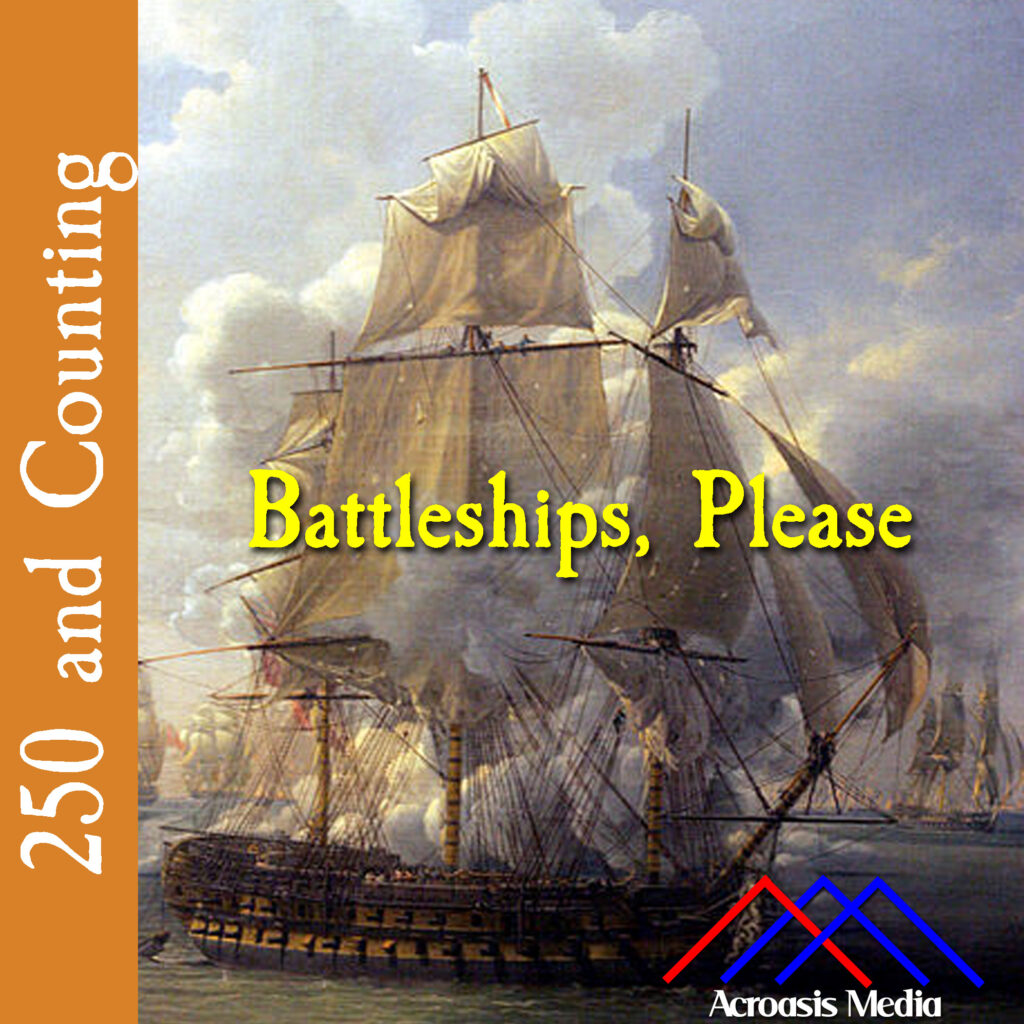
    Cover art for November 9, 1776: The HMS Hercules, a man-of-war that was said to be quite similar to the America. Painted by Louis-Philippe Crépin, 1803.

    It needs to be asked why Congress didn’t give as much attention to having a Navy as much as it did an Army.

    It’s possible that it was really just a matter of proximity; there were active battles or troop movements going on all the time, plus we were fighting on several fronts (New York/Canada/the Cherokee tribes). Meanwhile the British Navy was too big to comprehend, plus there wasn’t as much engagement. And perhaps the sheer size of the ocean was daunting.

    But the British Navy made it tougher for America to get supplies from other nations, not to mention transport of people from one place to another.

    At any rate, as I noted during the episode, it took about six months for work on the America to get started, and when John Paul Jones arrived in Portsmouth, NH to take command in June 1779, he found that she was in no way ready to sail: there was almost no planking or decks, they were short on iron for fasteners, there was no provision for rigging and sails, and because Master Builder Hackett hadn’t worked on such a large ship before, Jones discovered problems with the design that would have made the ship much more difficult to handle. Fortunately, there was another shipwright available who, while also inexperienced with that size a boat, was able to grasp Jones’ concerns quickly and could oversee his changes.

    Jones’ old gunner, a Mr. Gardner, then joined him and was able to take charge of mounting all of the guns on the ship, from building the carriages to setting up the fittings for the magazines.

    As a result of all this work, the America was ready to launch in the fall of 1782. As it happened, the launch itself was also problematic because of her size in relation to the waterway between the island and the main shore opposite her stern, so the only safe way to launch the ship was to pay out a series of ropes, breaking each one in turn until she was completely waterborne.

    It had been nearly six full years since the America was commissioned, and in November of 1782 she was handed over to the Chevalier de Martigne, who was a French naval officer. The ship thus became a gift to King Louis XVI to replace the recently-lost (and similar size/design) Le Magnifique, which ran aground in Boston Harbor and was wrecked.

    Sadly, she was only used for about two years and then the record dries up until 1786, when it’s recorded that the ship is in the port of Brest and literally rotting away, and therefore recommended for breaking up.

    I should note here that most of my research for this episode and my show notes came from an article written by Robert W. Neeser for the US Naval Institute (soft paywall), along with materials from AmericanRevolution.org and the National Parks Service’s website.

  • A Move Southward–November 7, 1776

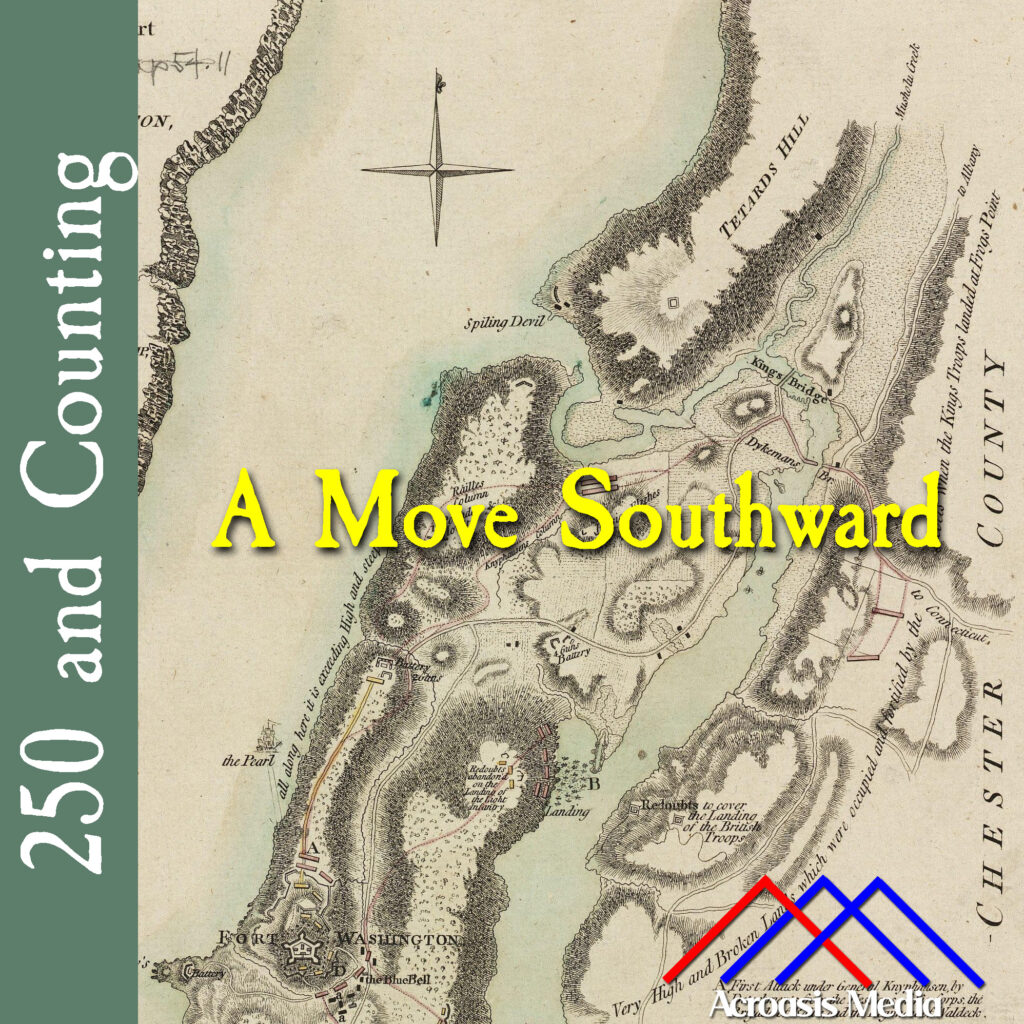
    Cover art for November 7, 1776: Contemporary map of northern Manhattan. Fort Washington is at bottom left; Kingsbridge is just above the "w" in "Southward". via Boston Public Library Digital Collection.

    It was pretty well-known by this point that General Howe’s objective was to occupy New York and then move northward through the Hudson Valley.

    General Washington had issued a discretionary order to General Nathanael Greene to abandon the fort and remove its garrison, which then numbered about 3,000 men, to New Jersey.

    Colonel Robert Magaw, the acting commander of the fort, refused to abandon it, believing his troops would be able to defend it from the British. This stubbornness pretty much cost him his ability to participate in the rest of the war, as he was captured when the British finally moved in.

    Magaw was paroled later on but not permitted to leave Manhattan until the war was over. And Britain held Manhattan the entire time, so Magaw was basically out of a job when it came to the Continental Army, and may explain why there are no locations named after him. The site where his home in New Carlisle, PA is now a coffee shop/café and there is a plaque nearby marking the café as a stop on the Patriot’s Path.

  • Quo Vadis, General?–November 6, 1776

    Cover art for November 6, 1776: a cannon mounted to a rock, retrieved from a Continental Army campsite, located at Battle of White Plains Park.

    White Plains, New York, has the feel of a suburban town that urbanized when nobody was looking. A little over 60,000 people live there, but during the day it’s estimated to have about a quarter million people working there.

    Nevertheless, they haven’t forgotten their place in American history, and there is a space that marks where much of the Battle of White Plains took place in 1776. It’s a very suburban zone dropped between two urban zones, with a series of retail stores stretching for about a half-mile just 1000 feet away in one direction, and the Bronx River Parkway about 500 feet in the other (with the Bronx River itself another hundred feet away).

    There are lots of historical plaques explaining what happened and when, but without these (and the cannon you can see in the cover art photo), you’d never know that a fierce battle once took place on these grounds.

    Battle of White Plains Park is a lovely place to visit, but be forewarned that there is no off-street parking, no restrooms and the park closes at dusk because there’s no lighting. On the bright side, you can get all that just the other side of Central Avenue.

    Now that I think about it, there’s probably no reason you couldn’t park your car at the McDonald’s and just walk down.

  • Howe Moves, And A Church Mystery–November 5, 1776

    Cover art for November 5, 1776: The second Grace Church in Rye, NY. Artist and specific date of creation unknown. via Christ's Church archives.

    I do enjoy it when coincidental stories come together.

    We did mention a couple of days ago that this was a period of relative lawlessness in the downstate New York area, and the murder of Reverend Ephraim Avery is a definitive example of this.

    Avery’s murder was never solved, but apparently it was the stuff of much gossip and speculation. I actually learned about this incident while looking for something else and I stumbled over the story of the dedication and Evensong event which marks the 250th anniversary of the Reverend Avery’s death.

    If you’re in the area, the memorial dedication will be followed by a catered dinner in the Parish Hall and a presentation by a local historian discussing Avery’s live and legacy. Everything starts at 6:00 tonight. The suggested donation is $20/person or $50/family.

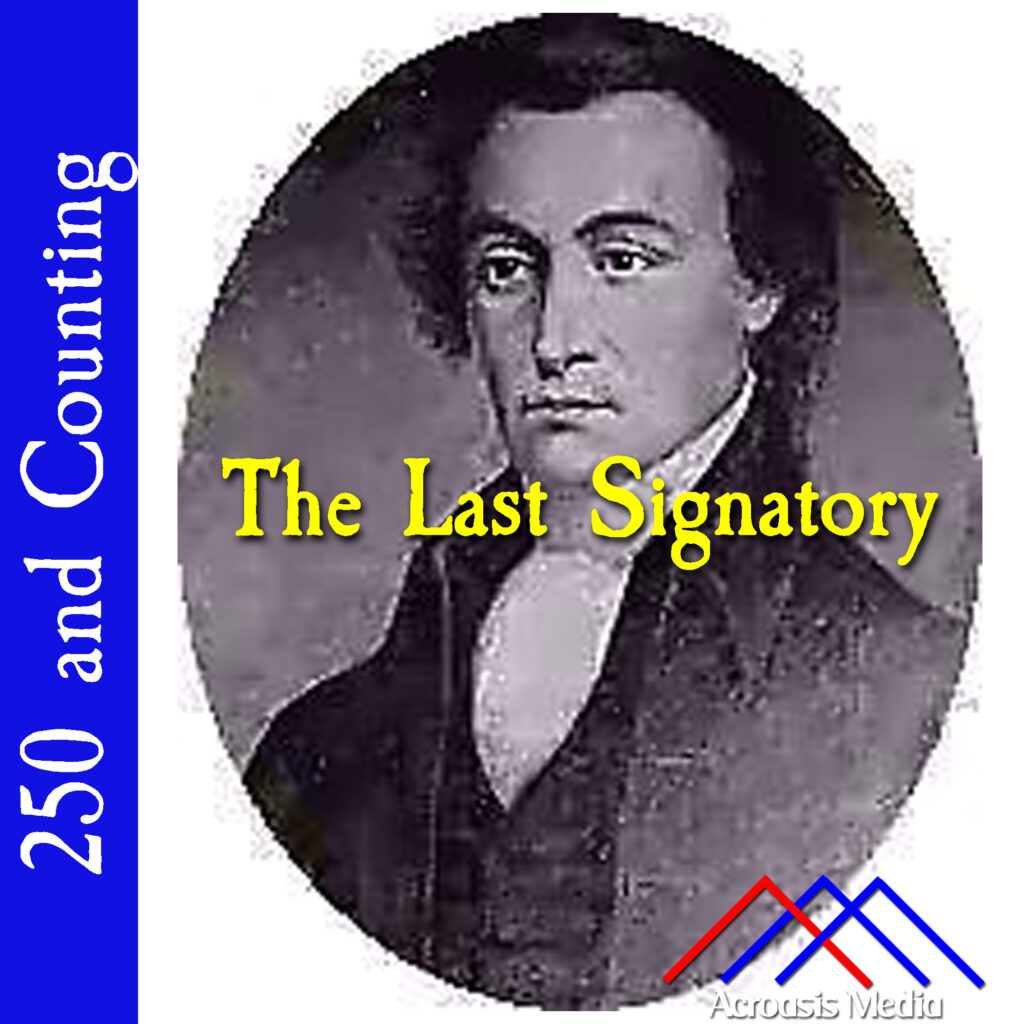
  • The Last Signatory–November 4, 1776

    Cover art for November 4, 1776: image of Matthew Thornton from a 19th-century steel-line engraving printed on paper, artist unknown. Via Wikimedia Commons.

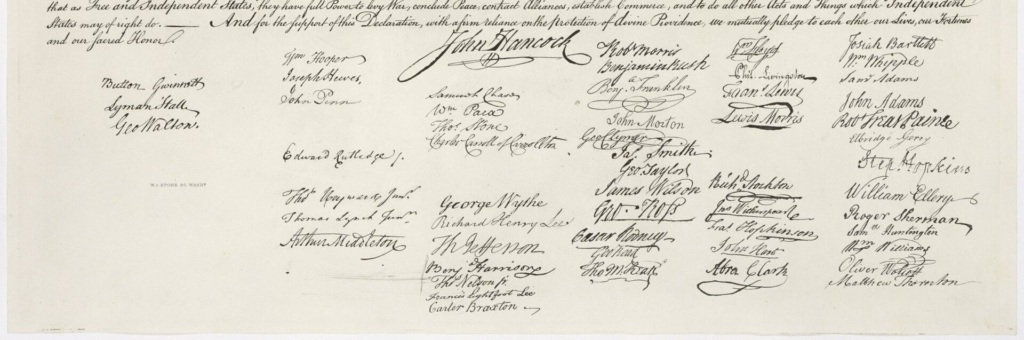
    The curious thing about Matthew Thornton’s being the last person to sign the Declaration of Independence isn’t why it took so long for him to get it done.

    He wasn’t appointed to the position until after all the debate had taken place, so it was rather gracious of the Continental Congress to let him sign in the first place. But, they were holding that “all-in” attitude, so he may not have had a choice.

    And because of all the doings and goings-on in the New York area, travel from New England to Philadelphia was dangerous for most civilians, never mind the ones who are out there representing the rebellious government. So sure, he gets a pass for taking his time getting to Pennsylvania.

    No. The part I don’t get is, if he could pick any space to put his signature, why he put it where he did. Now, all the others signed their names as a colonial/state group, e.g. Button Gwinnett, Lyman Hall and George Walton were all from Georgia, so their names appear together. Josiah Bartlett and William Whipple are also from New Hampshire and they’re together. But Samuel Adams signed immediately below Whipple, so there wasn’t any space for Wharton to squeeze his name in, so it’s at the bottom-right of the document.

    But look at that gigantic space at the bottom left! Why did he group himself with the Connecticut crowd? Did he not want to be thought of as a Georgia man?

    It’s a mystery.

  • Demont Gives Up Fort Washington–November 2, 1776

    Cover art for November 2, 1776: William Demont('s ghost), as depicted in the Scooby-Doo Show, Episode 116, "The Spirits of '76". Image nicked from Scoobypedia.

    William Demont was a traitor in much the same way that Benedict Arnold was, but Washington chose to keep this story a little quieter, largely for morale reasons.

    So how does he make it into an episode of Scooby Doo?

    It’s worth remembering that as we approached the Bicentennial, America was absolutely immersed in the whole Spirit of ’76 and showed great interest in that era. (Frankly it’s sort of what we were hoping would happen again when we first came up with this show. Anyway.) The American Colonial Era was a constant focus in media, from Philadelphia turning into a major tourist location to Red, White and Blue everything everywhere. So the fact that a Scooby Doo episode offered up a history lesson didn’t really seem out of place. Here’s what happened in the story:

    Mystery, Inc. visits Washington DC but the weather turns rainy and they duck into the Splitsonian Institute. Oddly, the museum has practically no visitors and a guard explains that it’s empty because it’s haunted. Then the guard reminds them that it’s nearly closing time.

    Shaggy sees a tableau with a sign in front of it: “Traitors of American History”, with wax figures of Benedict Arnold, William Demont and Major André. (Demont is the only one wearing civilian clothes, even though he was in the Continental Army.) As everyone moves on, Scooby sniffs at Demont’s statue but is pushed away by its leg.

    Hijinks ensue, etc etc and the gang eventually reveal that Major André isn’t a ghost but an accomplice of the other two men. William Demont is unmasked and turns out to be Mr. Wilit, an employee who actually sleeps in the museum. And Benedict Arnold winds up actually being one of the guards. The three men replaced the wax dummies with themselves; their plan was to use a drill to cut through the basement wall to the US Mint next door, so they could steal the money therein. What they didn’t know is that the money they were going to steal had no treasury seal, no serial numbers and no signature printed on them yet, so they were worthless.

    See? History lesson and a little bit of civics/economics to boot.

    Also, for what it’s worth, John Stephenson voiced all three of the “ghost” characters and two others besides in this episode. However, Frank Welker (who also voices Fred) provided the voice for Mr. Wilit, the man in the Demont mask.

  • Retreating North–October 31, 1776

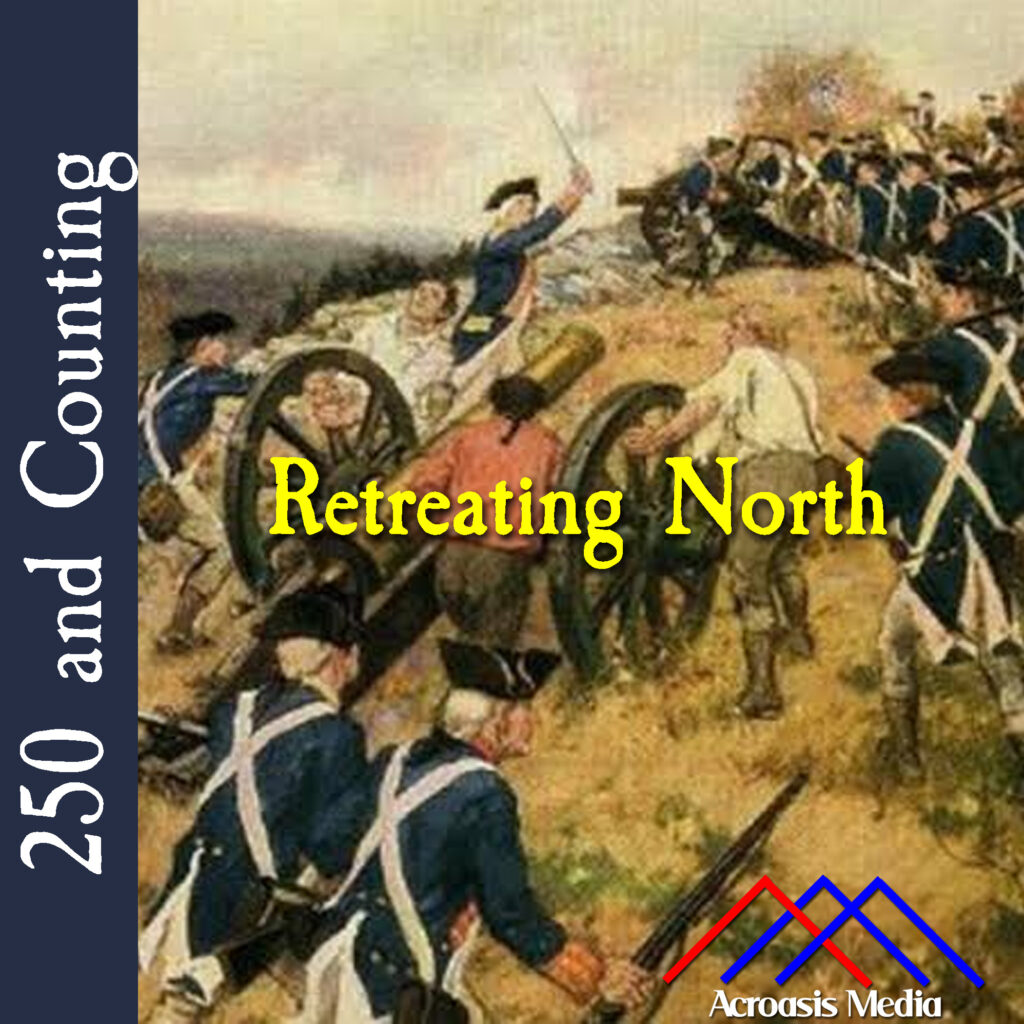
    Cover art for October 31, 1776: "The Battle of White Plains," originally designed as a commemorative postage stamp by Edmund F. Ward in 1926. Ward finished the larger oil painting in 1932. via White Plains Public Library.

    When George Washington retreated his men under cover of darkness from White Plains to North Castle, he expected General Howe to follow.

    Howe didn’t take the bait.

    So the two men sat there for a couple of days, each hoping to draw the other one out. The fact was, Howe wasn’t all that interested in pursuing Washington’s army, so he turned his attention elsewhere in the end. Stay tuned; we’ll get there in a couple of days.

    This was a good news/bad news situation for the Continental Army. Good, because they coulld take a breather from near-constant fighting since mid-August; bad because Howe’s troops weren’t stretching themselves thin with occupying territory they’d won.

  • The Morning After–October 29, 1776

    Cover art for October 29, 1776: detail of a wood engraving by Benson John Lossing of Chatteron's Hill, 1851. via the Huntington Library in San Marino, CA.

    The Battle of White Plains was long, and it was complicated, and once things settled down, both armies needed a little time to regroup and figure out what happened.

    It was clear that, despite the relative gains for the British, the casualties were comparable (at worst) to those of the Americans. General Howe’s aim in not pursuing matters further was to await the arrival of reinforcements. Could he have have gotten the job done without them? Maybe; the Americans were outnumbered but they were still formidable fighters despite their relative lack of training.

    George Washington, on the other hand, was trying to re-organize in order to safely retreat and fight another day. But things in Downstate New York aren’t quite over yet, and we’ll be returning here in a couple of days. Stay tuned.

  • Battle of White Plains–October 28, 1776

    Cover art for October 28, 1776: detail of a 19th century painting of Johann Rall, painted by George Whiting Flagg, based on an earlier sketch by John Trumbull. via the Old Barracks Museum in Trenton, NJ.

    The Battle of White Plains, like so many others we’ve described, was technically a victory for the British, but the overall cost and/or final result leaves everyone wondering whether the win was worth it.

    As we’ve noted repeatedly, the objective of all this activity in New York was for the British to take control of the Hudson Valley and the river all the way up to Canada, thus cutting New England off from the rest of the colonies and, in theory, making it impossible for Connecticut, Rhode Island, New Hampshire and Massachusetts to get any supplies without Britain’s permission. (Remember, Vermont and Maine weren’t states yet.)

    And while the British won in Brooklyn, and then Manhattan, and again today at the Battle of White Plains, George Washington’s movements just kept moving the goalposts just a little further away. Washington probably should ahve moved west to get away from the British and regroup, but he chose instead to move north, essentially forcing the British to chase him again rather than just move in and do whatever they wanted to do.

    As we move into the last couple of months of this podcast, we will return to this activity a few times before we’re done. So, stick around!

  • New Command for John Paul Jones–October 27, 1776

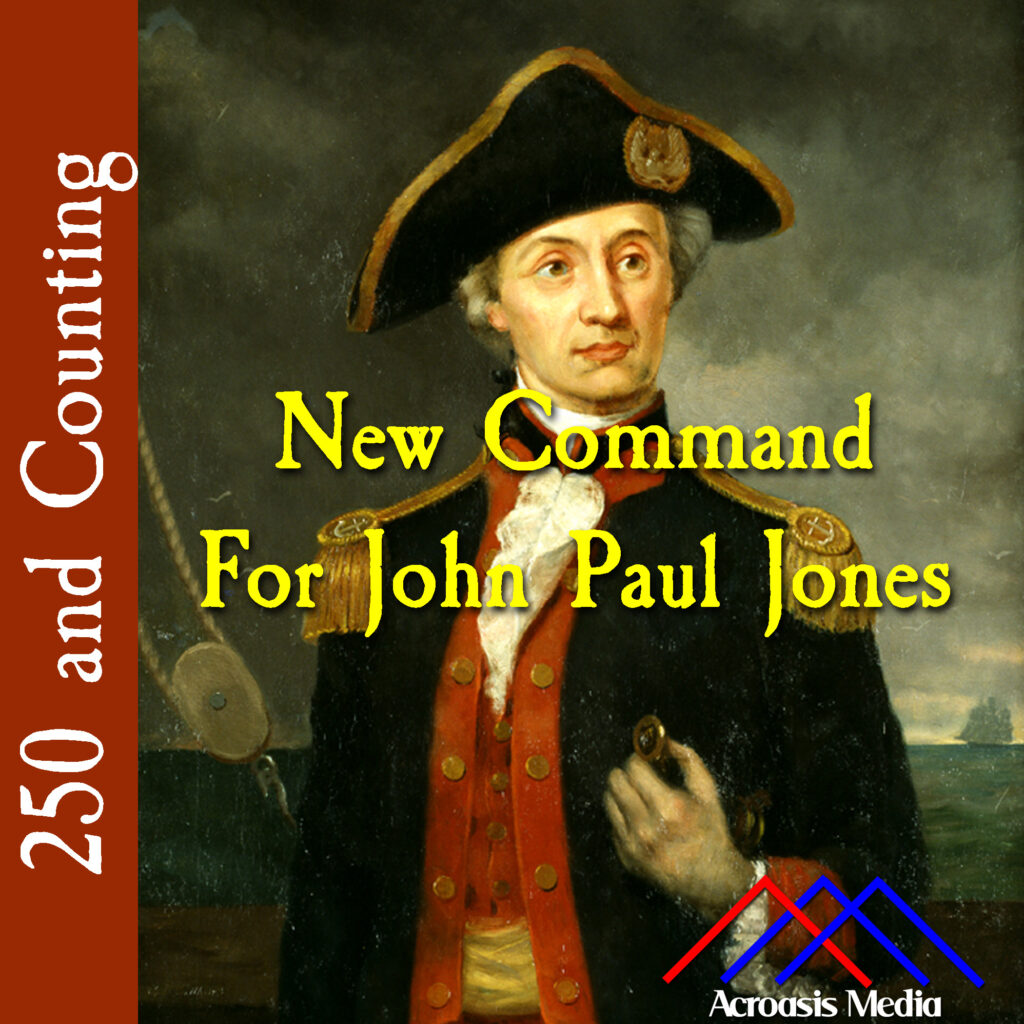
    Cover art for October 27, 1776: portrait of John Paul Jones by George Matthews, ca. 1890, based on a 1781 portrait by Charles WIllson Peale. via the US Senate Collection.

    John Paul Jones (Mike would have me note it’s not the guy from Led Zeppelin) led a relatively short life, but it was certainly eventful.

    Jones was born in Scotland and became a sailor at age 13, where he served on multiple merchantmen, including a few slave ships. Jones fled to the Virginia colony to avoid arrest after killing a mutinous subordinate and joined the Continental Navy in 1775. Less than a year later he was the captain of the USS Alfred, which is the subject of today’s episode.

    After Jones’ successes in France, he harassed British merchant ships in the Irish Sea, and he made a couple of attempts to deeply sabotage the ships in Whitehaven, but his efforts weren’t successful.

    In 1779, while still in Europe, Jones took command of the Bonhomme Richard and continued to give the British a hard time in their own waters, sometimes with mixed results. This was the ship he was commanding when he was said to have uttered the phrase “I have not yet begun to fight!”, which is pretty gung-ho, but unfortunately apocryphal.

    Jones was left without a command in 1787, so he entered in o the service of Empress Catherine of Russia. He experienced some successes, but was undercut by an ambitious underling who deliberately mis-translated his letters to the Empress. Two years later, Tadeusz Kościuszko, a veteran of the American Revolutionary War, suggested that he leave Russia and serve another nation. Not long thereafter he was accused of raping a young girl and left the country despite the evidence being rather thin. He returned to Paris but couldn’t get a foothold in society.

    In 1792 Jones was appointed the US Consul to negotiate with Algiers for the release of American captives. Unfortunately before he could do this, he was found deat at home. The cause of his death was interstitial nephritis, an inflammation of part of the kidney which is sometimes symptomless. Nowadays it’s most often caused by reactions to certain medications but is easily treated. Jones was 45 when he died and in significant debt, largely because he hadn’t been paid for some of his endeavors. He was buried in a cemetery specifically for Protestants who weren’t native Frenchmen, but the grave was either unmarked or the marker stone was taken. It took until 1905 to locate his coffin. Today his remains are interred in a sarcophagus at the US Naval Academy in Annapolis, Maryland.