
Tag: American Revolution

  • British Forces Gather in NY–July 29, 1776

    Cover art for July 29, 1776: letter from John Adams to Abigail written on this date. Via Massachusetts Historical Society.

    The presence of the British in Staten Island wasn’t a big mystery, but within a month after they first arrived, the number of ships in New York Harbor was well over 100, and still growing.

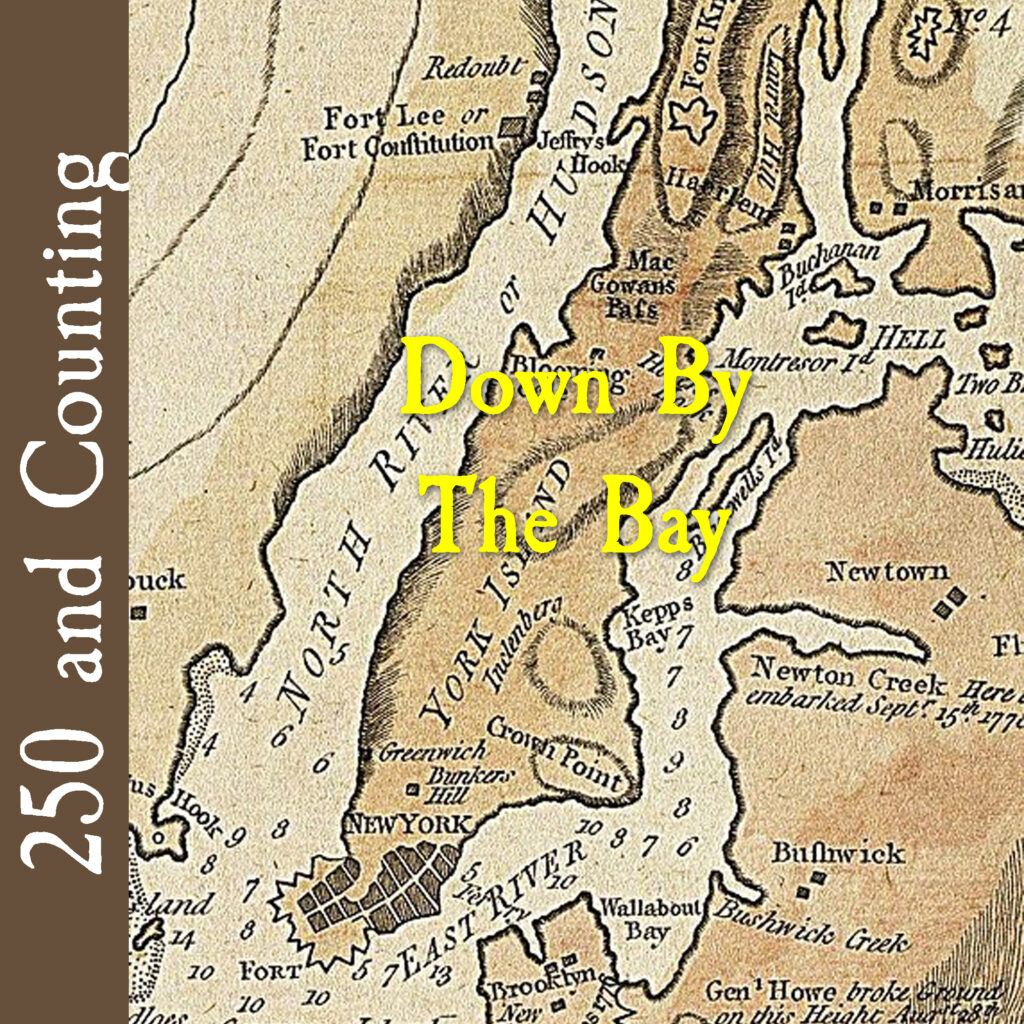
    And, as George Washington suspected (along with many others), the British began moving up the rivers surrounding Manhattan, working their way up the Hudson River in the effort to use New York as a wedge between New England and the rest of the colonies. Specifically, if supplies couldn’t get through, then it weakens both sides of the line.

    As for New York itself, part of Washington’s problem was that he didn’t know if the British plan was to take New York City (still a small chunk of Manhattan Island at that time), or to move through Long Island. As a result he had to hedge the bet a little bit and send troops in both directions, spreading the Continental Army rather thinly. This may have forced the British to do something quite similar, but they still had Washington vastly outnumbered.

  • Cleaning Up The Act–July 28, 1776

    Cover art for July 27, 1776: An anonymous engraving used to depict colonial-era medical practices.

    Hygiene in the Continental Army was practically nonexistent. As you can imagine, things got pretty ripe around camp, especially in the summer.

    And when people don’t take good care of such things, they’re probably going to wind up sick. Getting sick when you’re supposed to be on duty likely means that you’re going to do your “business” fairly close to where you’re working, This, in turn, is going to have the effect of getting other people sick while simultaneously perpetuating your own illness. This was especially true when such things took place too close to the water source, thereby contaminating that as well.

    Ain’t we got fun!

    There were a few people—the Officer grade men, primarily—who may not have known anything about bacteria, but they were able to see what and who was where, and connect the dots, so they began to take steps to help keep illness down.

    Did it help? Probably not right away, After all, the soldiers were still a rather undisciplined group, and maintaining hygiene in the Continental Army was pretty low on their personal priorities. If we had to guess, things probably abated a little bit, but didn’t really improve until the men that Silas Deane, et. al. came over and got things on track.

  • Credit From France–July 27, 1776

    Cover art for July 27, 1776: Portrait of Silas Deane by William Johnston, 1766. via silasdeaneonline.com

    Getting arms and credit wasn’t an overly tough task for Silas Deane. But it wasn’t because the French liked us so much; it was because they were still a little salty about the French and Indian War. So they were willing to do almost anything to embarrass the British.

    As a delegate to France (essentially a secret envoy until the word of Independence got out), Deane got a lot of stuff done, especially since he needed to do it in secrecy. The reason for this was that the French (and the Spanish, for that matter) needed some plausible deniability should arms get intercepted. So items were sold through a gray market, and if something didn’t make it to America, that wasn’t on King Louis; that was some smuggler working on his own and without formal authorization from those guys pointedly looking the other way.

    Once Independence became a more public topic, Ben Franklin and Arthur Lee crossed over to France to join Deane. The three of them managed to recruit foreign officers to assist the American troops, including Marquis de Lafayette, Baron Johann de Kalb, Thomas Conway, Casimir Pulaski, and Baron von Steuben. The officers were rather unpopular among the men, at least at first, and Deane got the blame somehow. In late 1777 he was recalled back to America.

    While in America he was accused by Arthur Lee of financial impropriety. Unfortunately for him, his financial records were still in France because he thought he’d be coming back soon. Ultimately this charge was dropped, and he was permitted to return to France to settle his affairs; when he arrived, however, he discovered that he was nearly broke because many of his investments had plummeted, and some of the merchandise he’d sent to America had been captured by the British.

    Further damaging his reputation was a letter he’d written in 1781 that had been intercepted, suggesting that the American cause was doomed, and perhaps some kind of rapproachement with Britain was indicated. So on this side of the ocean, people thought his actions to be treasonous. It wasn’t until 1789 that Silas Deane even attempted to return to America; unfortunately he fell ill during the trip and died at sea.

  • The Schuyler Is Falling–July 24, 1776

    Cover art for July 24, 1776: portrait of Philip Schuyler by John Trumbull, 1792. Currently housed at the New York Historical Society.

    Philip Schuyler was part of a prominent New York family, enough that if you have any familiarity with that state’s history, you realize that the Schuyler name keeps popping up, especially during and shortly after the Revolution. (Similarly, the names Schermerhorn and Burr also manage to crop up a lot; Burr is probably the most famous name of the three but there are more Burrs than just Aaron.)

    Schuyler was born in Albany but moved to New Rochelle when he was eight years old, shortly after his father died. He fought in the French and Indian War, and was sent to England for three years afterward to help settle some expenses related to the war.

    Philip Schuyler was elected to the Second Continental Congress but left to become a general in the Continental Army, where he was involved with the failed invasion of Quebec. His health forced him to turn command over to General Montgomery, and in 1777 he returned to Congress.

    Later in life, he served as a Semator in the First US Congress, but lost his bid for re-election to Aaron Burr. (See? Popping up everywhere.) He did return to the Senate a few years later, and remained there until he resigned due to his health.

    Schuyler died at the Schuyler Mansion in Albany on November 18, 1804, four months after his son-in-law, Alexander Hamilton, was killed in a duel (by Aaron Burr) and two days before his 71st birthday. He is buried at Albany Rural Cemetery in Menands, New York, about 500 feet away from President Chester A. Arthur. It’s really a lovely place to visit and see the graves of several notable figures, not all of whom were “big” names historically unless you like to deep-dive into such things.

  • Ain’t No Party Like A Long Island Party–July 23, 1776

    Cover art for July 23, 1776: "Raising the Liberty Pole," painted by Frederic Augustus Chapman and engraved by John C. McRae, 1876.

    Huntington, New York, is coincidentally quite close to where I grew up. And frankly, I had no idea that they could celebrate the way they did on this day in history.

    In addition to being its own little town, Huntington was determined not to let the British take any more of Long Island than they already had. They’d gotten word that the inhabitants of New York City had determined not to oppose the British. This kind of makes sense, since there were lots of Loyalists there still. But a man named John Sloss Hobart, who was one of the Sons of Liberty in the area, headed a committee that was designed to secure the disaffected, to remove or destroy any grain, and, if necessary, lay Brooklyn to waste.

    This effort ultimately failed, and unfortunately their absence from the Huntington area near the end of August meant that British soldiers were making landfall about 50 miles east of Huntington with no militia to meet them. Since Huntington had the bulk of the militia in the area, the British could act as they wanted, further hastening the fall of Long Island that summer.

    Many Patriots had to get out of town, so they headed across the Long Island Sound to Connecticut for the duration.

    But for all that, Huntington, NY remains proud of their heritage, and they even took the time this past weekend to reenact the event, demonstrating the firing of weapons, showing off 18th Century crafts and trades, and offering tours of the Arsenal. And yes: they blew up an effigy of King George III. I guess they still know how to party in Huntington.

  • When Accusation Is A Confession–July 22, 1776

    Cover art for July 22, 1776: General Lee on Horseback, Engraved by Johann Michael Probst, 1790. via Library of Congress.

    That Charles Lee turned out to be giving information to the British is one of those things that feels obvious in retrospect.

    As Mike notes during the episode, Lee was passed over for command of the Continental Army, and even though he was still in a position of importance and command, things like that can eat away at some people.

    Now, by most accounts, and through review of existing documents, Lee generally acquitted himself well in the Southern Department and in New York, although at the time of his capture there he was writing a letter to General Horatio Gates complaining that George Washington was somehow deficient.

    However, his attitude toward the Continental Army continued to deteriorate after his release in 1778. He was held partly responsible for the outcome of the Battle of Monmouth, likely because he was rather capricious with his actions. Because he behaved insubordinately afterward, Lee was court-martialed (at his demand) and found guilty, but given the very light sentence of a year’s suspension from the army. Before the year was out, however, he wrote an angry letter to Congress that resulted in his termination of service.

    It wasn’t until the 1850s that the New York Historical Society discovered a manuscript Lee had written while he was a prisoner of war. It was addressed to both Richard and William Howe, and outlined a plan by which the British could defeat the Continental Army. Whether Charles Lee is specifically guilty of treason is still debated among historians, though he’s commonly been presented as a villain in popular culture of the past 80 years or so.

  • Testing A Turtle–July 21, 1776

    Cover art for July 21, 1776: line drawing of "Bushnell's American Turtle" (detail), date unknown. Via Library of Congress.

    David Bushnell came up with the idea for the Turtle submersible only days after Lexington and Concord. He’d been working on several different experiments he’d conducted at Yale College, and found a way to integrate them into a single device to use against the British.

    The Turtle was revolutionary (heh) in a couple of ways: first, nobody had successfully created anything like it before, and more importantly, Bushnell (along with Isaac Doolittle) came up with the screw propeller as a means of maneuvering the vehicle. No water vehicle had ever used a propeller as a means of getting from one place to another, and while the design has been refined for various purposes and to improve efficiency, Bushnell’s propeller is easily recognizable today for what it is.

    It was pretty brilliant for its time, and in September we’ll see it in action, in New York Harbor.

  • Adams’ Model Treaty–July 18, 1776

    Cover art for July 18, 1776: The 1778 Treaty of Alliance with France, based on Adams' work of today. Via National Archives.

    Coming up with a model treaty wasn’t John Adams’ idea, but it turned out to be a very good idea that he was responsible for implementing.

    Once Adams had it in his head, he began to work on the model treaty along with the committee, and while it was intended to be used for commercial trade, it could be (and eventually was) adapted for soliciting military support in the form of weapons and other ordnance (rather than troops).

    Today’s artwork, incidentally, is the Treaty of Amity and Commerce from 1778 that the US signed with France. If you look closely you’ll see that the left side is in English and the right side is the French translation. This is just most of the first page, of course, but it’s interesting to see how such things were handled.

  • No Way, No Howe–July 17, 1776

    Cover art for July 17, 1776: Portrait of George Washington, ca. 1776 by Chales Willson Peale.

    That George Washington agreed to meet with Colonel James Patterson was a bit of a surprise.

    He’d turned down the opportunity to meet with his British counterparts on multiple occasions, but when asked if he’d meet with one of those men’s officers, Washington accepted the offer.

    Once the meeting was set, Washington was more gracious than most people would expect. Colonel James Patterson was rowed to the Battery dock in lower Manhattan from the British barge. At this point it was expected that he would be blindfolded to prevent him from gathering intelligence on Washington’s headquarters. Instead, he was brought to a different location without being blindfolded.

    Patterson met with Washington, Henry Knox, Joseph Reed and a few others, and it was clear that these officers were very deferential to the General, typically referring to him as “Your Excellency.” Again, protocols were important to Washington.

    After rejecting the Howes’ letter yet again, Patterson mentioned the benevolence of His Majesty, King George III (which was probably not the right thing to say to George Washington, but still), and explained that the Howes were there “to accommodate this unhappy dispute”.

    According to Knox’s letter to his wife, Patterson then explained that Lord Howe had broad powers of pardon, but Washington wasn’t interested. As far as the General was concerned, “the Americans had not offended, therefore they needed no pardon. This confused [Patterson].”

    Shortly thereafter, Patterson was escorted back to his barge, disappointed but sociable.

  • John Alsop Steps Out–July 16, 1776

    Cover art for July 16, 1776: John Alsop. Lithograph by Max Rosenthal created around 1885, based on an oil painting by an unknown artist, ca. 1765.

    John Alsop was born in 1724 in New Windsor, Orange County, in the British Province of New York. He was the son of John Alsop, Sr. and Abigail Sackett. His father was a lawyer in New Windsor and later New York City, where he was largely interested in real estate.

    As a young man he moved to New York City, where he entered the mercantile world with his brother Richard. The brothers became importers and merchants in cloth and dry goods. John became interested in civic and political activities. He was elected by New York County to serve in the Province of New York Assembly. He was one of the civic leaders that incorporated the New York Hospital Association and served as its first governor from 1770 to 1784. In 1757, his brother Richard retired from business and removed to Middletown, Connecticut.

    Early in the Revolution, the Province of New York Assembly could not reach a conclusion about the Continental Congress. As a result, delegates were selected by the revolutionary committees in each county. In 1774, Alsop, along with James Duane, John Jay, Philip Livingston, and Isaac Low, was named as a delegate. When the First Continental Congress convened on September 5, Jay presented their credentials, and the Congress accepted. Alsop arrived in Philadelphia on September 14.

    Alsop returned to the Second Continental Congress, and while he assisted in the war effort prior to the Declaration, he never lost his hope for reconciliation with Britain and he wound up resigning from the Congress rather than sign the Declaration. He did continue supporting the Continental Army, from his home in Newtown, NY until that town was overtaken by the British, then he continued to work from Manhattan. When they took Manhattan as well, Alsop fled to Connecticut and stayed there until 1783, when the occupation ended.

    Alsop died at his home in Newtown, Queens County, New York, on November 22, 1794, and is buried in Trinity Church Cemetery in Manhattan. His considerable fortune, which he managed to rebuild, was passed to his daughter and son-in-law after his death.