The focus today up in Cambridge, while waiting for the British to hightail it out of Boston, was getting the men ready to move to New York, and putting together Washington’s personal guard.
Washington didn’t really need a personal guard in Cambridge, at least not much of one, because he was in the driver’s seat while he was there. The British were bottled up, and he was the stopper. But to move to New York and then defend that territory? Well, that was another project entirely. New York had more access points, more deepwater harbor, and more territory overall to defend. This wasn’t like keeping the British locked up on the peninsula that was the entirety of Boston. And while Washington probably considered it a bit of vanity at first (that’s a guess on my part) to even have a group of men dedicated to being “Washington’s personal guard”, he likely began to understand the inevitability of needing the guard as the Continental Army’s Commander-in-Chief.
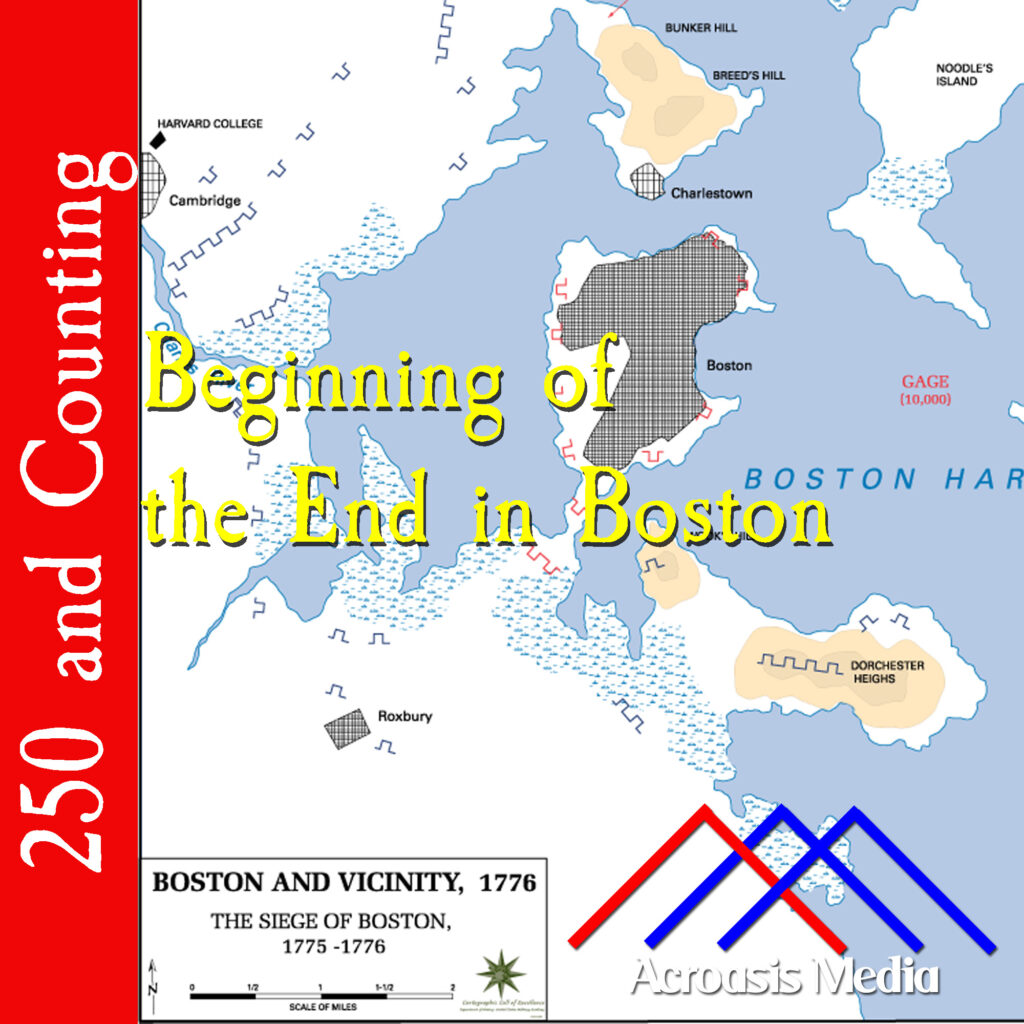
The occupation of Dorchester Heights, just across the river from Boston, was perhaps the final step that George Washington needed to end the siege that had gone on for nearly a year.
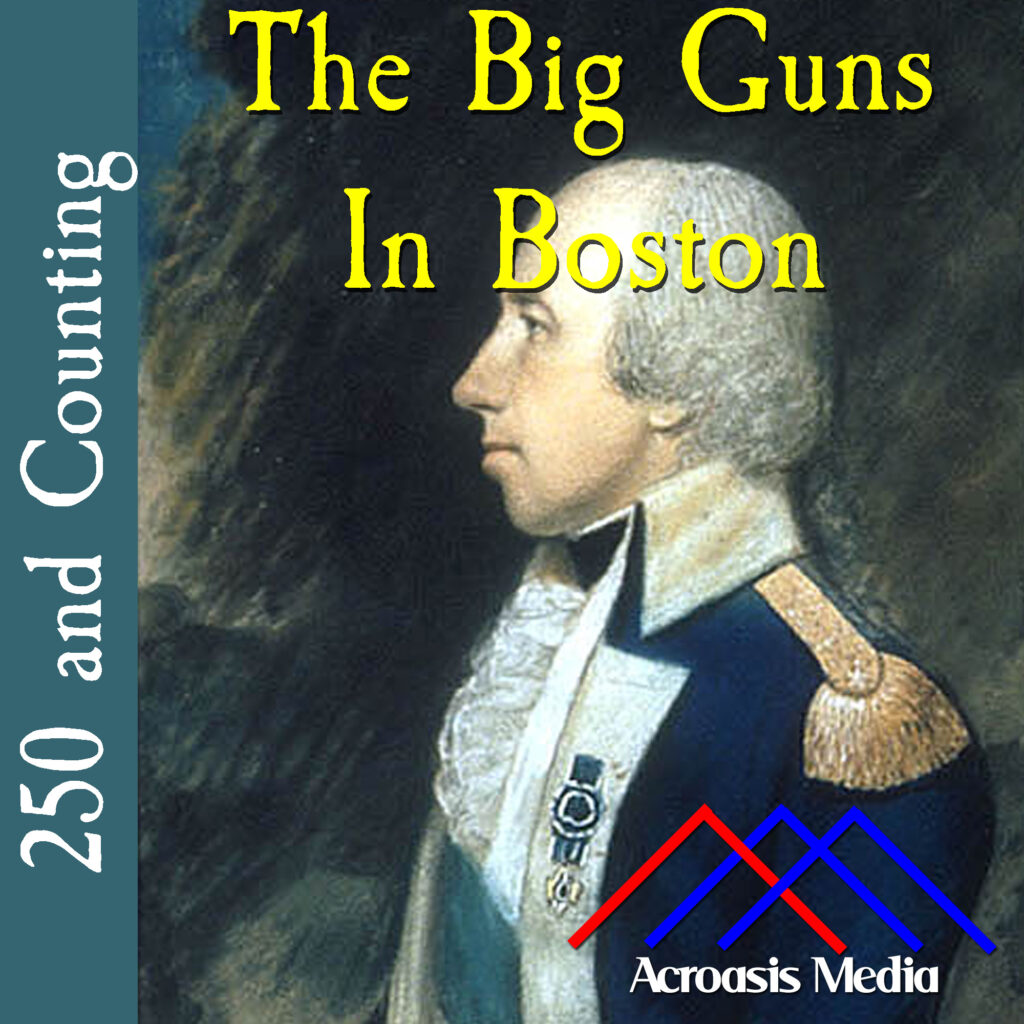
Of course, it wasn’t just occupying Dorchester Heights; Washington could have pretty much done that at any time. It was occupying them with a terrifying speed, thanks to Rufus Putnam (the guy in today’s cover art, by the way) and his clever plan for assembling the defenses there. And thanks also have to go to the big cannons that had been brought down from Ticonderoga. These guns had the range that Washington needed to not only shoot at Boston if he needed to, but to fire upon British ships in Boston Harbor.
Howe had a couple of moves left, but it was nearly over.
Colonel Henry Knox took about ten weeks to get from Ticonderoga to Cambridge rather than the two he anticipated. But his arrival meant the siege’s end in Boston would come soon.
Knox had brought something like 60 tons worth of material overland using hand-built sledges and carts drawn by oxen. The last leg of the trip is still a mystery, because Knox’ diary ends about two weeks early. What is known is that as he passed through the occasional town, people would line up to watch. So we know when he was where, but the usual stuff that ran through Knox’ head for that portion of the trip is gone.
Still, his arrival at Cambridge meant that Washington now had what he needed to fortify his position and do what he needed to drive the British out of Boston. After nearly a year, the siege’s end was actually in sight.
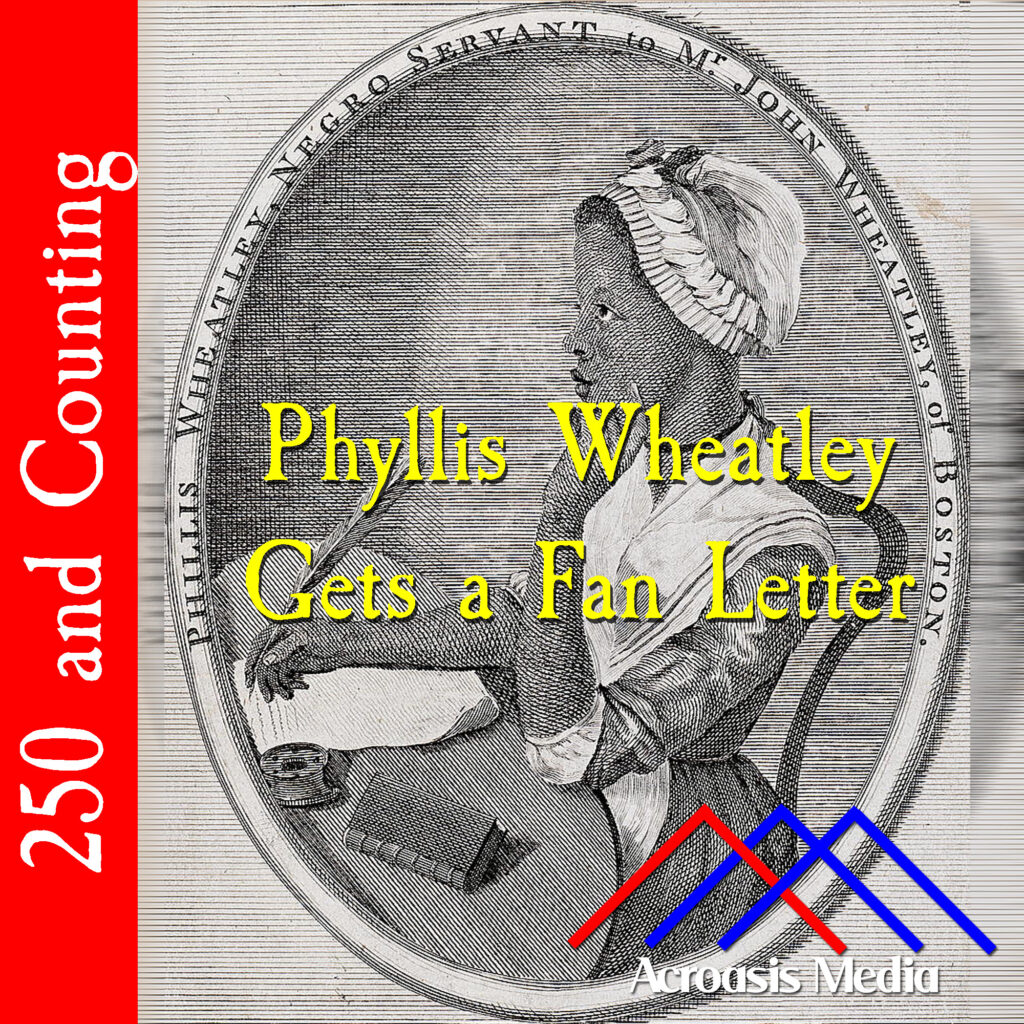
Phyllis Wheatley was an 18th century poet who was born in West Africa and sold into slavery as a small child, living with the Wheatley Family in Boston.
Phyllis wrote a book of poems which was published in 1773, after which she was emancipated. This makes her the first African-American author of a published book of poetry.
Phillis Wheatley married a grocer named John Peters around this same time. They had three children, but unfortunately all of them died quite young. Phyllis herself died in of pneumonia in 1784, not long after giving birth to a daughter, who also died that day.
Celestial choir! enthron’d in realms of light, Columbia’s scenes of glorious toils I write. While freedom’s cause her anxious breast alarms, She flashes dreadful in refulgent arms. See mother earth her offspring’s fate bemoan, And nations gaze at scenes before unknown! See the bright beams of heaven’s revolving light Involved in sorrows and veil of night!
The goddess comes, she moves divinely fair, Olive and laurel bind her golden hair: Wherever shines this native of the skies, Unnumber’d charms and recent graces rise.
Muse! bow propitious while my pen relates How pour her armies through a thousand gates, As when Eolus heaven’s fair face deforms, Enwrapp’d in tempest and a night of storms; Astonish’d ocean feels the wild uproar, The refluent surges beat the sounding shore; Or thick as leaves in Autumn’s golden reign, Such, and so many, moves the warrior’s train. In bright array they seek the work of war, Where high unfurl’d the ensign waves in air. Shall I to Washington their praise recite? Enough thou know’st them in the fields of fight. Thee, first in peace and honours,—we demand The grace and glory of thy martial band. Fam’d for thy valour, for thy virtues more, Hear every tongue thy guardian aid implore!
One century scarce perform’d its destined round, When Gallic powers Columbia’s fury found; And so may you, whoever dares disgrace The land of freedom’s heaven-defended race! Fix’d are the eyes of nations on the scales, For in their hopes Columbia’s arm prevails. Anon Britannia droops the pensive head, While round increase the rising hills of dead. Ah! cruel blindness to Columbia’s state! Lament thy thirst of boundless power too late.
Proceed, great chief, with virtue on thy side, Thy ev’ry action let the goddess guide. A crown, a mansion, and a throne that shine, With gold unfading, WASHINGTON! be thine.
I mention in today’s episode that William Augustine Washington lived on a Virginia plantation he’d inherited, and that his first house burned down.
The second house he moved to, on the same property but a mile away (yow!), was called Blenheim. Washington used some of the bricks from the original house to add on to the Blenheim house, but he also used a bunch of them to start on a house and barn on a separate property.
What a thrifty fellow!
For what it’s worth, Blenheim is still standing and is on the National Register of Historic Places. You may be able to see it from the street but it is privately occupied and not open to the public.
There were many reports from George Washington over the course of the Revolutionary war, but for the most part I think they were carefully crafted and frankly not always worthy of the reactions they proposed.
The careful craftsmanship does makes sense, though, because Washington was a diligent collector and reader of books. As an autodidact, he was constantly learning, and he was the teacher. It’s just a huge shame that when Washington died, his book collection was broken up and sold off. In recent years, author Kevin Hayes tracked down a huge portion of those books, largely to see what kind of notes he’d left in the margins, as he was prone to doing.
“Colonial Blacksmith, 1776”. Wood engraving, attributed to “Granger” though this may be the name of the collection.
While we’re talking about enlisting apprentices today, it should be noted that there was precious little difference between an apprentice and an indentured servant, except maybe their age. Thus, the rules that applied to apprentices when it came to enlistment could also be applied to indentured servants, especially inasmuch as some of those rules seemed designed more for them than apprentices.
Also: Mike mentioned James Mease and his ketchup recipe. To clarify, ketchup had been around for hundreds of years, originating in China (or Vietnam; it’s a little fuzzy). What Mease did was add a tomato base, giving us the ketchup that we’re used to putting on our cookout foods. The Chinese stuff, commonly called “kê-chiap” was a fish-based sauce.
Mease’s recipe involved brandy and spices; no sugar or vinegar. Here’s the recipe he published:
Slice the apples* thin, and over every layer sprinkle a little salt; cover them, and let them lie twenty-four hours; then beat them well, and simmer them half an hour in a bell-metal kettle; then add mace & allspice. When cold, add two cloves of raw shallots cut small, and half a gill of brandy to each bottle, which must be corked tight, and kept in a cool place.
*Mease called them “apples” because he was using the French word for tomatoes, “pommes d’amour” or “love apples.”
Letters from John Hancock to George Washington weren’t especially scarce, nor were letters going the other way. However, today’s letter takes on a few important topics for Washington that one hopes came greatly appreciated.
There was commendation that Washington had the foresight to send troops to New York, there was some good financial news, there was also good news in the realm of troop recruitment, and there was a warning about likely military action coming fairly soon.
All in all, it was a letter packed with information, and if we had to guess (because we don’t know), it was likely conveyed by courier rather than the postal system, which was still prone to interception by the British.
“Knox entering camp with artillery” by William H. van Ingen, c. 1831. via Library of Congress. Depicts Henry Knox on horseback with soldiers transporting a disassembled canon on a sled through the snow, winter 1775-76, following his famous capture of artillery at Fort Ticonderoga. Wood engraving, hand-colored.
The Noble Train of Artillery has finally arrived!
Given that it was over 150 miles from Ticonderoga NY to Cambridge, MA, and that it was wintertime, and that Interstate 90 was still over 150 years in the future, it’s pretty amazing that Henry Knox was able to move so much artillery so efficiently.
As Mike notes in the episode, the arrival date is largely a guess, since Knox’s diaries ended the last time we checked in with him, about two weeks ago when he was in western Massachusetts and, it appears, nobody else kept accurate notes on the event. There are, however, notes on the disposition of the materiel, so that makes this a pretty good guess. And it allowed the Continental Army to maintain the Siege of Boston until the British finally bailed out two months later.
(Pardon my brevity for this episode; as I write this my wife has spent the better part of the day in the hospital for a surgical procedure, and I’m too exhausted to be my usual clever self.)