
Tag: Siege of Boston

  • Reviewing Boston–March 18, 1776

    Cover art for March 18, ,1776: Statue of Artemas Ward at Ward Circle in Washington, DC. Photo by Wikipedia user GarrisonLeMasters, 2008.

    In the aftermath of the siege of Boston, it was incumbent upon George Washington and his men to re-enter the city and take stock of its condition.

    Mike brings up Artemas Ward in today’s episode, and I’m pretty sure that was the first time his name has come up in the course of this podcast. Ward was a major general during the Revolutionary War, among others, and an effective political leader when he wasn’t being a soldier. It was Ward who sounded the alarm on Bunker Hill, and who took command of the New England area once Washington led most of the troops down to New York City. ‘

    The statue in today’s cover art can be found in the center of a traffic circle in Washington, DC, where Massachusetts and Nebraska Avenues cross one another. Ward’s great-grandson donated four million dollars to Harvard on the condition that they build a statue of Artamis, and maintain his Shrewsbury home. Harvard apparently chose to purchase a statue but did not provide enough money to provide the general with a horse. Oddly enough, because it’s a traffic circle and therefore has no obvious way for a pedestrian to get to the center (i.e., no crosswalk), it’s quite difficult to get close enough to the pedestal to read the inscription:

    ARTEMAS WARD
    1727–1800
    SON OF MASSACHUSETTS
    GRADUATE OF HARVARD COLLEGE
    JUDGE AND LEGISLATOR
    DELEGATE 1780–1781 TO THE CONTINENTAL CONGRESS
    SOLDIER OF THREE WARS
    FIRST COMMANDER OF THE PATRIOT FORCES

  • The Siege Ends–March 17, 1776

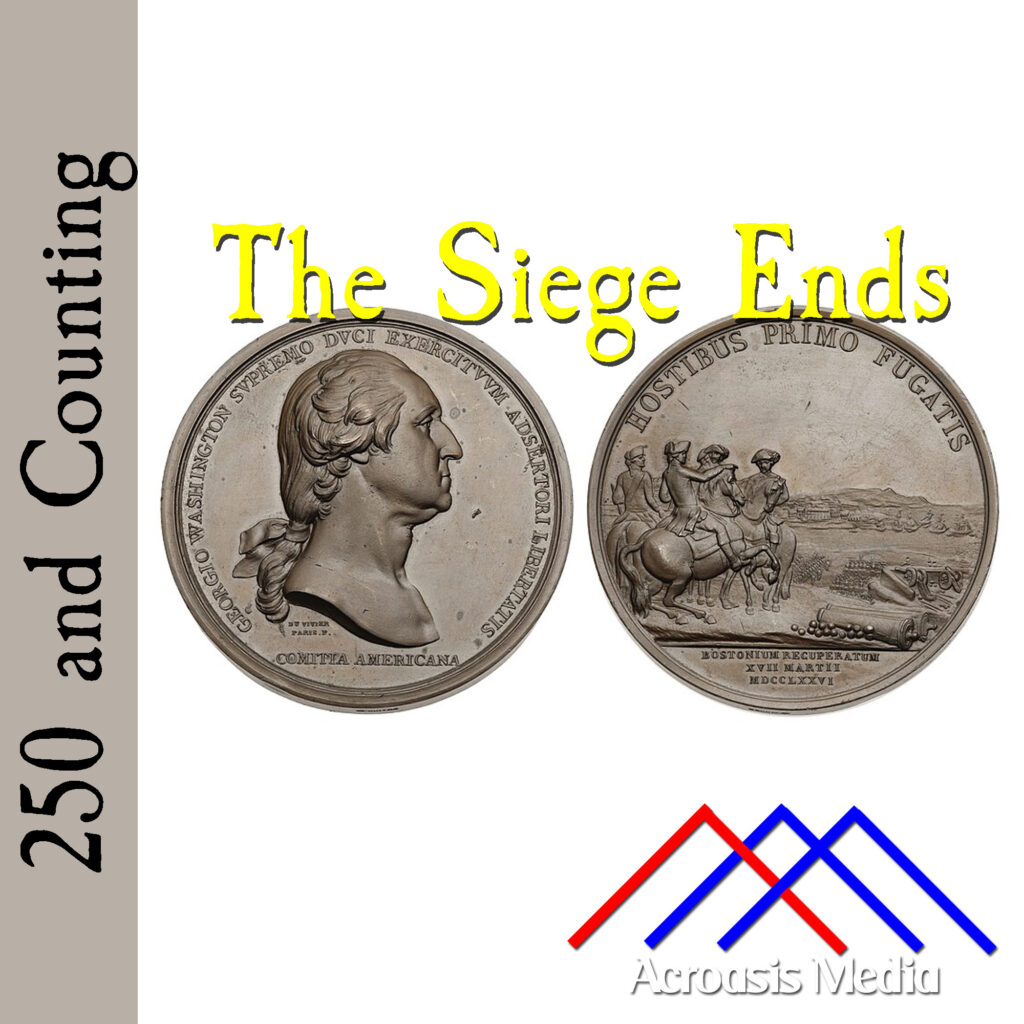
    Cover art for March 17, 1776: The first Congressional Gold Medal, given to George Washington in 1790 for his first victory of the war in Boston. 1776 Washington Before Boston Comitia Americana Second Restrike (Baker-48G) Image credit to Heritage Auctions

    It’s been 333 days since Lexington and Concord, when the British were forced to retreat to Boston and were bottled up there by Colonial forces.

    It’s been a week since the British said “enough” and decided to effect their departure from the city as soon as the weather cooperated.

    But today, the day finally came.

    It took about five hours to launch over a hundred ships, carrying thousands of soldiers, women and children from the city.

    It was Washington’s first major win and the last time the British did anything of importance in New England. The war began to move south, to New York, New Jersey, and Pennsylvania. Virginia and the Carolinas also had their share of action, as we’ll see in the coming months.

  • Preparing To Take Back Boston–March 13, 1776

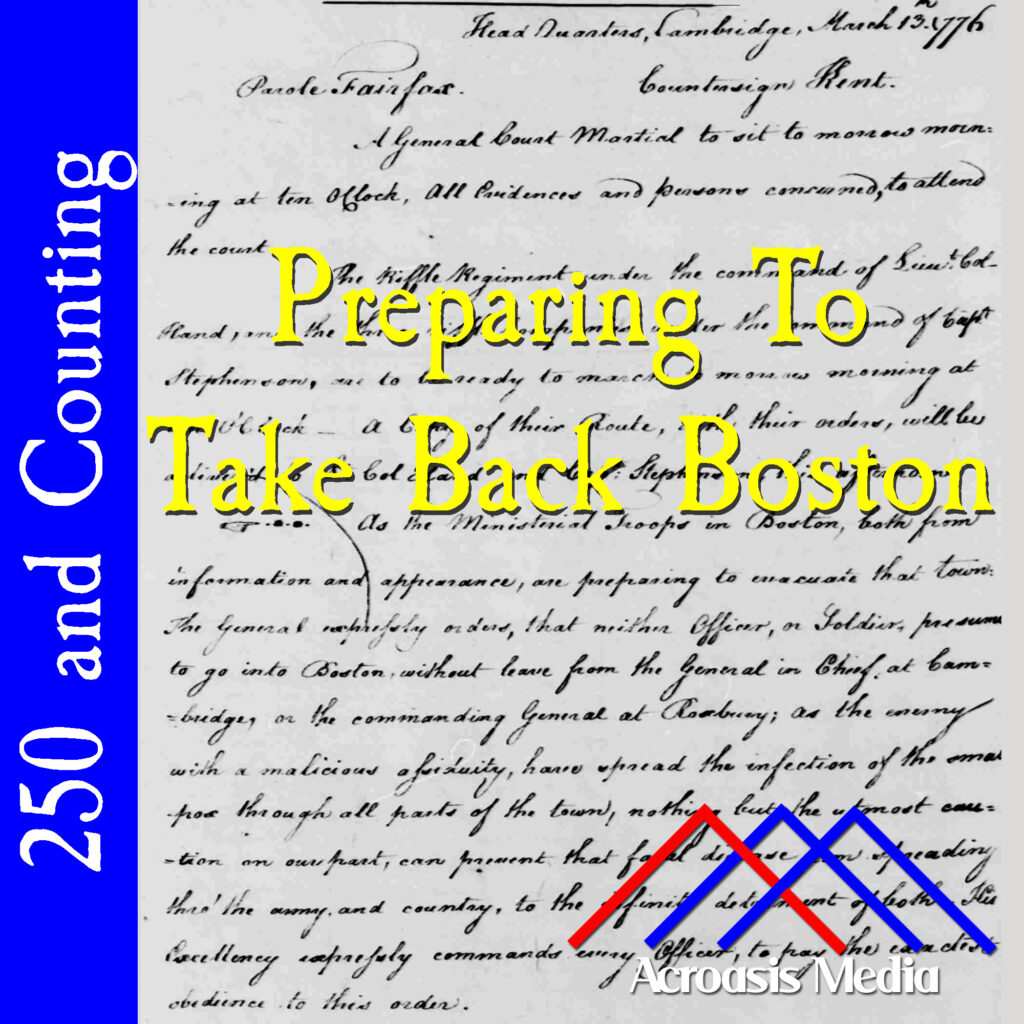
    Cover art for March 13, 1776: George Washington's General Orders for this day. via Library of Congress/National Archives.

    First: let me apologize for the slight change in sound quality for today’s episode. I’m not in my usual recording space and I’m not especially happy with the equipment I brought. At worst you’ll have to put up with it just one more time.

    Next: George Washington was a gentleman through and through, so the fact that his general orders sometimes focused on the Continental soldier behavior shouldn’t be a surprise. In today’s episode he concerns himself specifically with that, but for two reasons. One is for the health and safety of the troops, but the other is because the Bostonians have been through enough, and he doesn’t want the Continental Army–the people supposedly on their side–to look like villains.

    In the meantime he’s already standing down a big chunk of soldiers and sending them to New York, where the next big battle is going to be, he thinks. (Again, he’s right, but he didn’t realize it at the time.)

  • Getting Ready To Move–March 11, 1776

    Cover art for March 11, 1776: "The Evacuation of Boston". Engraving by Frederick Stuart, based on a drawing by Lambert Hollis.

    The focus today up in Cambridge, while waiting for the British to hightail it out of Boston, was getting the men ready to move to New York, and putting together Washington’s personal guard.

    Washington didn’t really need a personal guard in Cambridge, at least not much of one, because he was in the driver’s seat while he was there. The British were bottled up, and he was the stopper. But to move to New York and then defend that territory? Well, that was another project entirely. New York had more access points, more deepwater harbor, and more territory overall to defend. This wasn’t like keeping the British locked up on the peninsula that was the entirety of Boston. And while Washington probably considered it a bit of vanity at first (that’s a guess on my part) to even have a group of men dedicated to being “Washington’s personal guard”, he likely began to understand the inevitability of needing the guard as the Continental Army’s Commander-in-Chief.

  • Laundry Day–March 10, 1776

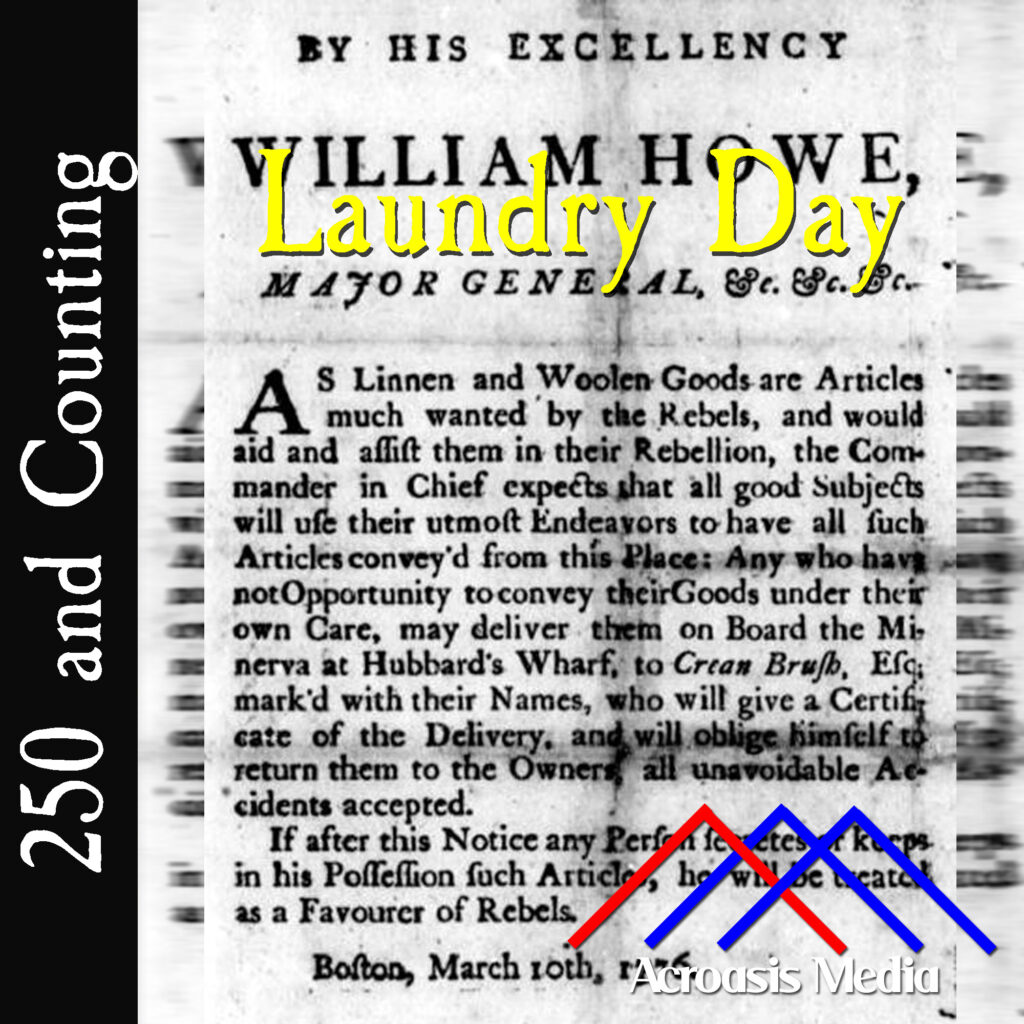
    Cover art for March 10, 1776: General Howe's proclamation regarding the collection of linen by Crean Brush. Via National Archives.

    For a guy who’s technically on the wrong side of history, Crean Brush was a pretty interesting character.

    Mike mentions in the episode that Brush was jailed for some time during the Revolution, but time didn’t allow him to tell you how Brush managed to get out of jail. I’m not going to spoil it, but the truly fascinating story can be found in this article by Eric Weiser. This article was one of those serendipitous finds that turned up when I went looking for a picture of Crean Brush. It’ll take you about twenty minutes to read, but I guarantee it’s worth your time, and I’ll give you your money back if you disagree.

    General Howe’s demand that people turn their linen and wool goods over to Brush sounds a little weird on its surface, but once you look a little closer you’ll see that it’s more petty than anything else. That said, there was a pragmatic angle to it as well: the material could be used to keep their troops warm and/or bandage any wounded British.

  • The Big Guns In Boston–March 9, 1776

    Cover art for March 9, 1776: portrait of Rufus Putnam by James Sharples, 1796. via the National Park Service.

    The occupation of Dorchester Heights, just across the river from Boston, was perhaps the final step that George Washington needed to end the siege that had gone on for nearly a year.

    Of course, it wasn’t just occupying Dorchester Heights; Washington could have pretty much done that at any time. It was occupying them with a terrifying speed, thanks to Rufus Putnam (the guy in today’s cover art, by the way) and his clever plan for assembling the defenses there. And thanks also have to go to the big cannons that had been brought down from Ticonderoga. These guns had the range that Washington needed to not only shoot at Boston if he needed to, but to fire upon British ships in Boston Harbor.

    Howe had a couple of moves left, but it was nearly over.

  • Beginning of the End in Boston–March 4, 1776

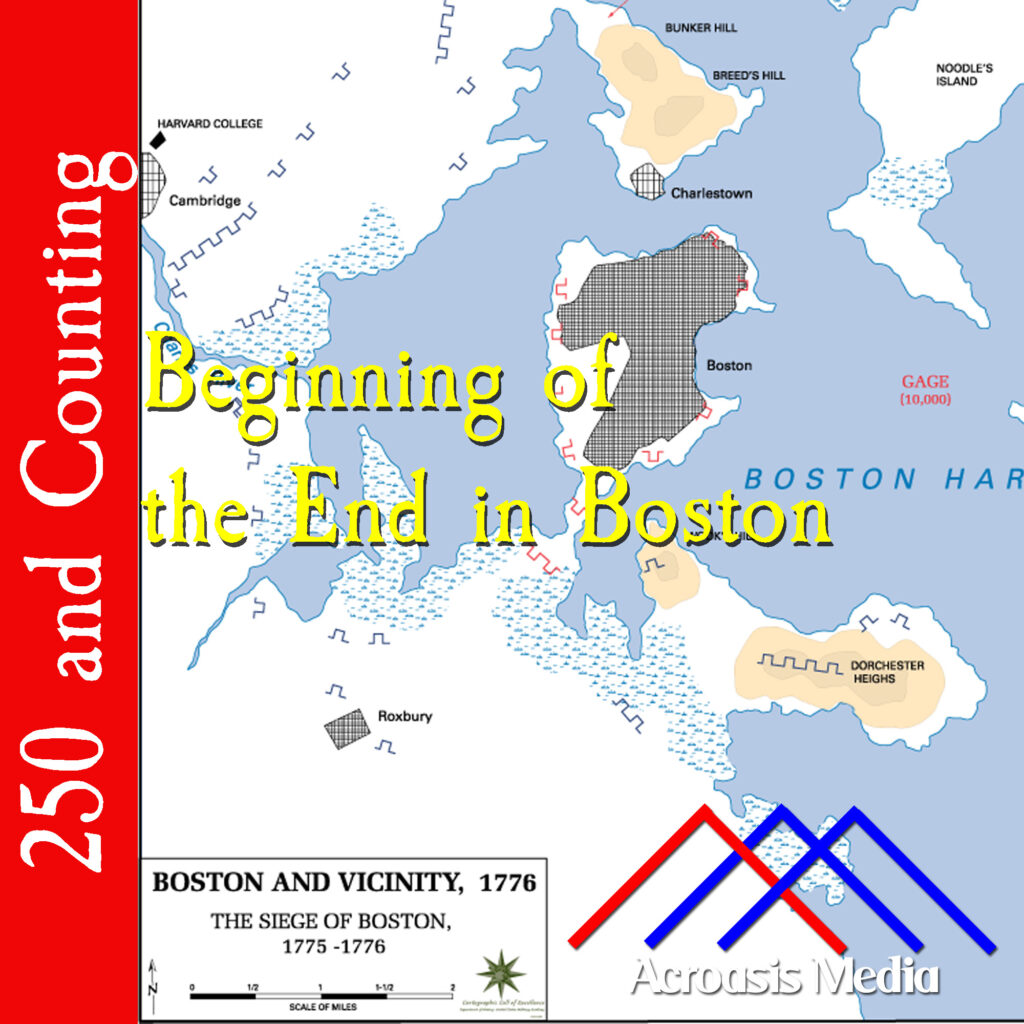
    Cover art for March 4, 1776: A map of the Boston area during the siege. from the History Department at the US Military Academy.

    Colonel Henry Knox took about ten weeks to get from Ticonderoga to Cambridge rather than the two he anticipated. But his arrival meant the siege’s end in Boston would come soon.

    Knox had brought something like 60 tons worth of material overland using hand-built sledges and carts drawn by oxen. The last leg of the trip is still a mystery, because Knox’ diary ends about two weeks early. What is known is that as he passed through the occasional town, people would line up to watch. So we know when he was where, but the usual stuff that ran through Knox’ head for that portion of the trip is gone.

    Still, his arrival at Cambridge meant that Washington now had what he needed to fortify his position and do what he needed to drive the British out of Boston. After nearly a year, the siege’s end was actually in sight.

  • The Noble Train Pulls Into The Station–January 26, 1776

    Cover art for January 26, 1776: "Knox entering camp with artillery" by William H. van Ingen, c. 1831. via Library of Congress.
    “Knox entering camp with artillery” by William H. van Ingen, c. 1831. via Library of Congress. Depicts Henry Knox on horseback with soldiers transporting a disassembled canon on a sled through the snow, winter 1775-76, following his famous capture of artillery at Fort Ticonderoga. Wood engraving, hand-colored.

    The Noble Train of Artillery has finally arrived!

    Given that it was over 150 miles from Ticonderoga NY to Cambridge, MA, and that it was wintertime, and that Interstate 90 was still over 150 years in the future, it’s pretty amazing that Henry Knox was able to move so much artillery so efficiently.

    As Mike notes in the episode, the arrival date is largely a guess, since Knox’s diaries ended the last time we checked in with him, about two weeks ago when he was in western Massachusetts and, it appears, nobody else kept accurate notes on the event. There are, however, notes on the disposition of the materiel, so that makes this a pretty good guess. And it allowed the Continental Army to maintain the Siege of Boston until the British finally bailed out two months later.

  • The Fate of War and Some Refugees–November 25, 1775

    Cover art for November 25, 1775: a manuscript map of Boston showing Point Shirley to the far right, away from the city. (It's under the "fu" in "refugees")

    It’s hard to emphasize just how remote Point Shirley is compared to the Boston. Let me try anyway. On most maps of Boston, Point Shirley isn’t even on the map. It’s so far to the east that it’s nearly in the ocean. I’m not sure it’s even possible to see Boston from Point Shirley.

    And given Point Shirley’s location at a place between the bay and the ocean, and the fact that it’s November, and you’ve got a cold, windy place where you’ve just dumped 300 sick, destitute people without provisions or a means of getting warm.

    Here’s a weird coincidence: if you look closely at this “manuscript” map from 1775, Point Shirley is at the center right. Need another hint? It’s just under the “fu” in the word “Refugees.” And if anyone got a big FU from the British, it was this group.

  • William Howe Makes An Odd Decision–October 22, 1775

    Cover art for October 22, 1775: a color mezzotint of British General Sir William Howe, 5th Viscount Howe, 1777, by Richard Purcell aka Charles Corbutt.

    After the Pyrrhic victory at Bunker Hill, the fact that General Gage was about to be replaced probably came as a surprise to nobody.

    That he was replaced by William Howe…well, that also probably wasn’t a surprise. Howe had experienced success in the Seven Years’ War. And while he was known to have shown some sympathy with the Colonies (he’d voted against the Intolerable Acts, for instance), it was thought that he could break the Siege of Boston.

    So Howe came to America and on October 11 he took over the job from Gage. He stayed in Boston with the besieged soldiers. And he had lots of ideas about breaking the siege, and eventually the Continental Army. What’s more, Lord Dartmouth had some creative ideas as well.

    But Howe chose something entirely different.