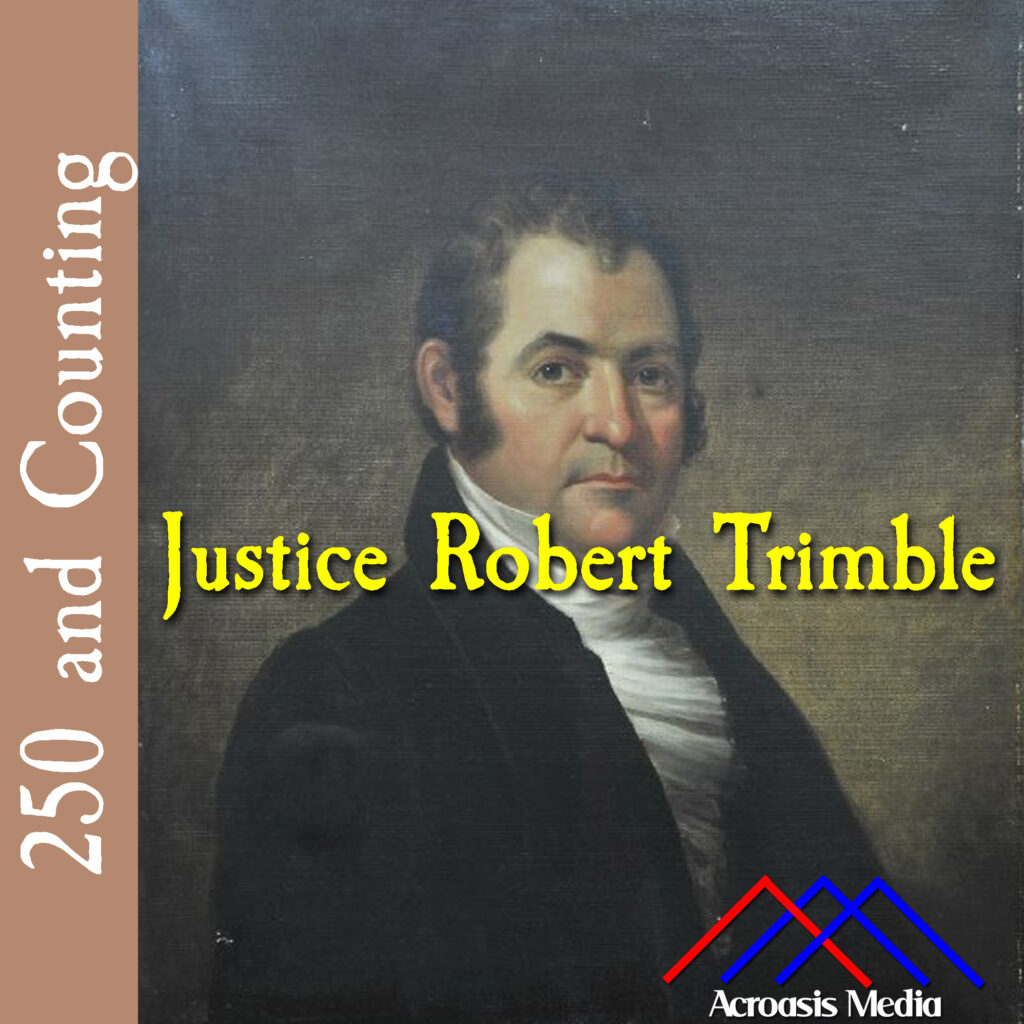
Robert Trimble was well-respected by his judicial peers, at least after he died. They said some very kind things about him them.
But I got a little curious to know whether he participated in any especially notable cases while he was on the Supreme Court. I couldn’t find any, but I did find it interesting that he generally voted with Chief Justice John Marshall almost every time. However, there was one case in which Marshall dissented from the majority opinion, choosing to write his own opioin “assenting” to the judgment in part, and dissenting in another part. In addition, Trimble wrote the majority opinion in the case.
The case was Ogden v. Saunders, and it determined the scope of a bankruptcy law in relation to a clause in the Constitution. In short, Saunders was a Kentucky citizen who demanded payment on a contract. Ogden was a Louisiana citizen who lived in New York and had declared bankruptcy in that state. He claimed that, under the New York bankrupcy law, he was no longer bound to the contract. The main issue was whether the New York law violated the Obligation of Contracts Clause of the Constitution. In short, did Congress have exclusive power to pass bankruptcy laws?
The Court’s response was that the Constitution’s clause prevented states from passing only laws that affected existing signed contracts; the states couldn’t pass laws that affected future contracts, because those contracts were bound by existing laws already. Short version: Ogden won the case because the New York law did not violate the Constitution.
What I found interesting about this is the way it echoed—yet also ran against—a decision from just a few years earlier: Gibbons v. Ogden (different Ogden, go figure), involving conflicting laws between Congress and New York, this time regarding steamboat regulation. In that one, the Court sided with Gibbons, stating that in matters of interstate commerce, the Federal law holds the greater power.
Podcast: Play in new window | Download | Embed
Leave a Reply