First: let me apologize for the slight change in sound quality for today’s episode. I’m not in my usual recording space and I’m not especially happy with the equipment I brought. At worst you’ll have to put up with it just one more time.
Next: George Washington was a gentleman through and through, so the fact that his general orders sometimes focused on the Continental soldier behavior shouldn’t be a surprise. In today’s episode he concerns himself specifically with that, but for two reasons. One is for the health and safety of the troops, but the other is because the Bostonians have been through enough, and he doesn’t want the Continental Army–the people supposedly on their side–to look like villains.
In the meantime he’s already standing down a big chunk of soldiers and sending them to New York, where the next big battle is going to be, he thinks. (Again, he’s right, but he didn’t realize it at the time.)
Of course it’s coincidental, but it’s kind of cool that we’re able to bring you this episode during Women’s History Month and the same week as International Women’s Day.
Believe it or not, Mike and I have struggled with the fact that there’s very little representation of anyone from this era who isn’t a white male. We’ve managed to touch on a few women and African-Americans from time to time, but after 435 episodes (including today) we’re probably still in the single-digit range.
Mike doesn’t concentrate very much on the newspaper notice that appeared in Baltimore this day; he gives us a little perspective on some of the ripples created by events we’ve talked about so far. Sometimes the women’s history angle comes from the things that are mundane in print, but vital to the success of the war.
It doesn’t make up for the lack of representation, but we hope it helps.
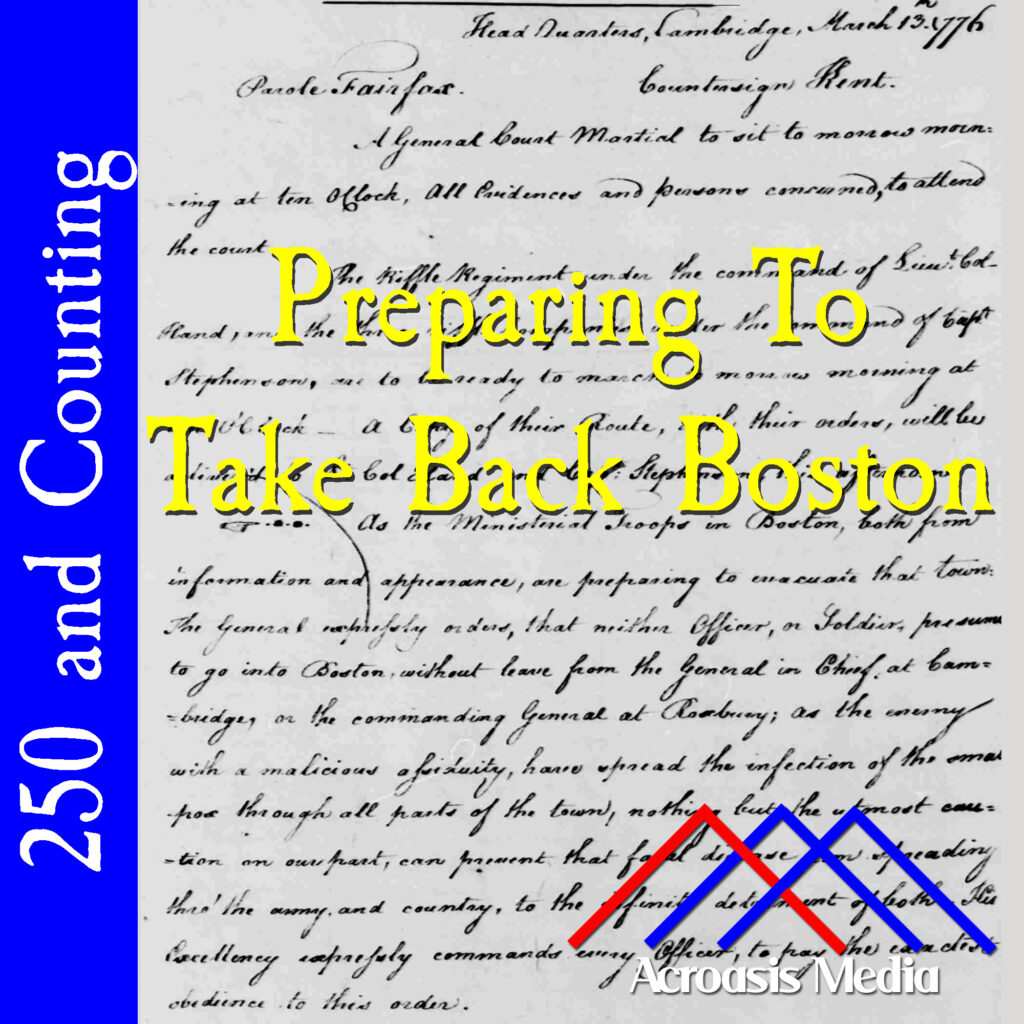
The focus today up in Cambridge, while waiting for the British to hightail it out of Boston, was getting the men ready to move to New York, and putting together Washington’s personal guard.
Washington didn’t really need a personal guard in Cambridge, at least not much of one, because he was in the driver’s seat while he was there. The British were bottled up, and he was the stopper. But to move to New York and then defend that territory? Well, that was another project entirely. New York had more access points, more deepwater harbor, and more territory overall to defend. This wasn’t like keeping the British locked up on the peninsula that was the entirety of Boston. And while Washington probably considered it a bit of vanity at first (that’s a guess on my part) to even have a group of men dedicated to being “Washington’s personal guard”, he likely began to understand the inevitability of needing the guard as the Continental Army’s Commander-in-Chief.
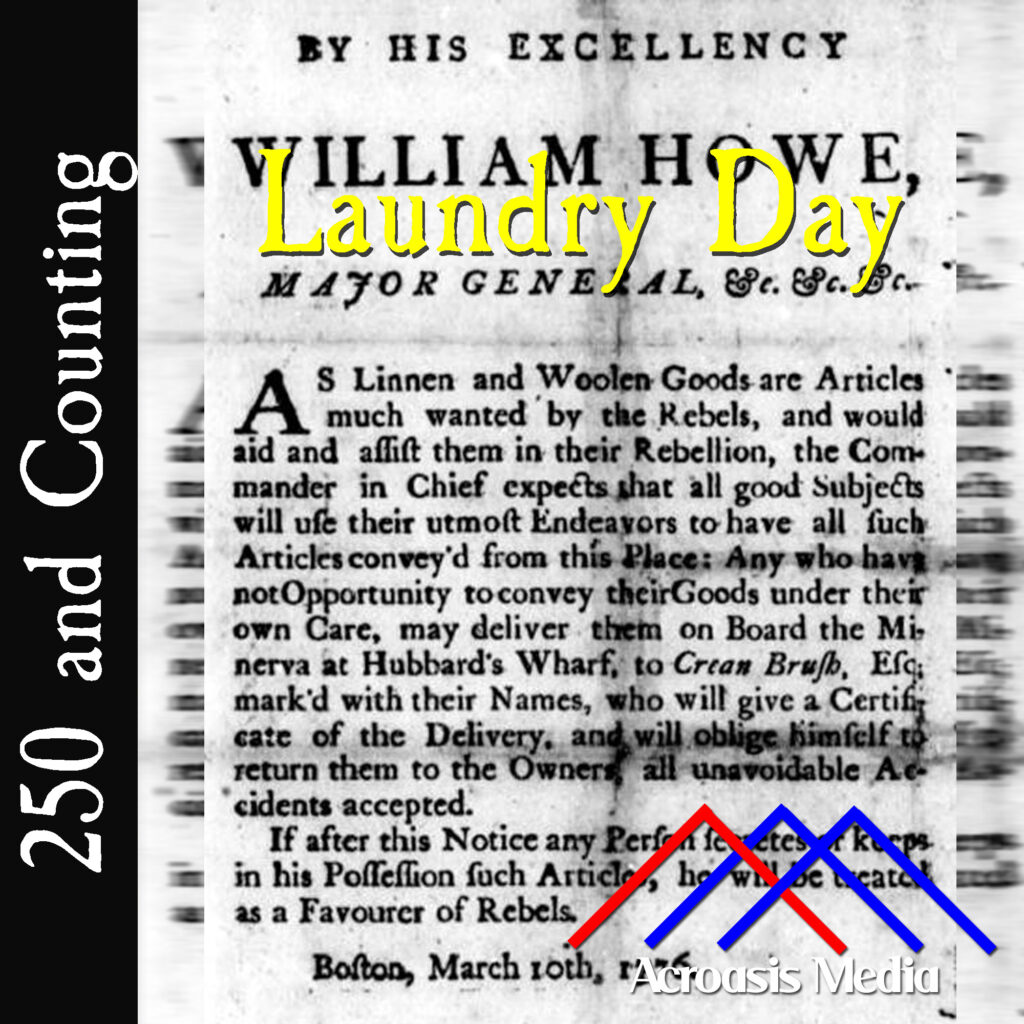
For a guy who’s technically on the wrong side of history, Crean Brush was a pretty interesting character.
Mike mentions in the episode that Brush was jailed for some time during the Revolution, but time didn’t allow him to tell you how Brush managed to get out of jail. I’m not going to spoil it, but the truly fascinating story can be found in this article by Eric Weiser. This article was one of those serendipitous finds that turned up when I went looking for a picture of Crean Brush. It’ll take you about twenty minutes to read, but I guarantee it’s worth your time, and I’ll give you your money back if you disagree.
General Howe’s demand that people turn their linen and wool goods over to Brush sounds a little weird on its surface, but once you look a little closer you’ll see that it’s more petty than anything else. That said, there was a pragmatic angle to it as well: the material could be used to keep their troops warm and/or bandage any wounded British.
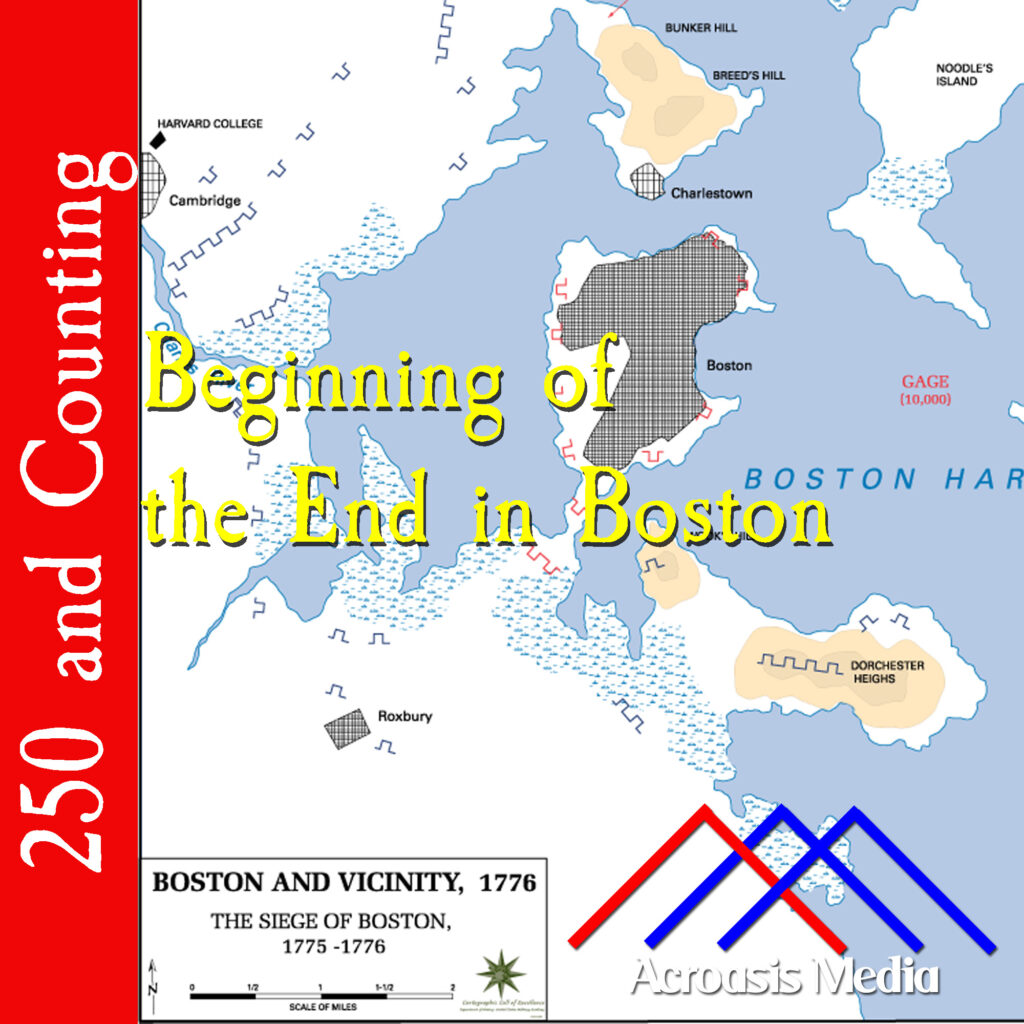
The occupation of Dorchester Heights, just across the river from Boston, was perhaps the final step that George Washington needed to end the siege that had gone on for nearly a year.
Of course, it wasn’t just occupying Dorchester Heights; Washington could have pretty much done that at any time. It was occupying them with a terrifying speed, thanks to Rufus Putnam (the guy in today’s cover art, by the way) and his clever plan for assembling the defenses there. And thanks also have to go to the big cannons that had been brought down from Ticonderoga. These guns had the range that Washington needed to not only shoot at Boston if he needed to, but to fire upon British ships in Boston Harbor.
Howe had a couple of moves left, but it was nearly over.
When Samuel Tweedy moved from Dutchess County, NY to Danbury, CT, it was a fortuitous time to do something like that. Danbury was undergoing an economic expansion as part of a post-war boom, which gave him extra opportunities to gain access to trade and manufacturing that he never would have seen back in New York, which was a largely agrarian economy at the time.
Tweedy’s marriage to Ann Burr had both social and economic benefits, since Danbury was rather tight-knit as a community, and his having Ann for a spouse gave him an “in” where some of that was concerned.
One of Danbury’s biggest products was hats, and Samuel Tweedy established his own business with the assistand of his father-in-law. He immersed himself in the craft of making hats, and ultimately established himself as a man capable of building smaller-scale workshops dedicated solely to producing unfinished hat blanks, which could then be sold to hatmakers. Since an efficient shop could only turn out a few dozen hat blanks in a week, having several shops meant that Tweedy could turn out more blanks than anyone else. Tweedy’s shops also specialized in making hat blanks with fur linings. And Tweedy benefitted from protective tariffs, which reduced the number of British imports when it came to hats.
Congress had a lot of military-related activities to tend to, and one of them was Isaac Melchior. (If you look him up you’ll see an alternate spelling of him as “Melcher.” We’re sticking with “Melchior” because we saw that first.)
March 7 was a Thursday, so the Congress was figuring out what do do about Melchior’s apparent insubordination the previous Saturday when he loudly and rudely insulted Congress in general, and John Hancock in particular, because he felt that the captaincy they’d offered him was inadequate.
They actually considered banning him from future service, but the next day decided that his apology was sufficient, so he was dismissed without further punishment. Later on, he served as a brigade major for General Richard Montgomery, so at some point he managed to earn some additional rank.
So in Isaac Melchior we have someone who is notable for his service to America, but whose historical reputation is tarnished because of his actions a week earlier. There’s a fictionalized version of this story in a book by Lars D.H. Hedbor called The Will: Tales From a Revolution—Pennsylvania, which is part of the “Tales from a Revolution” series. If you like historic fiction laid atop real-life events, you may enjoy these books.
The Pennsylvania State Rifle Regiment, also known as Miles’ Regiment, also known as the Pennsylvania 13th Regiment first came about when the Pennsylvania State Battalion of Musketry merged with Miles’ Reigment. We know it’s confusing, largely because there were so many names involved and that’s not even where the names ended.
Samuel Miles was their commander when they were first raised, and he was their commander in 1777 at the Battle of Long Island. It’s especially notable because he allowed himself to be captured by British troops who thought he was George Washington, a ruse that allowed the real George Washington and many of his troops to escape. It was nearly two years before he would be released in a prisoner exchange.
As for the regiment itself, that eventually got absorbed into the Continental Army in June of 1777, but they were still informally called the Pennsylvania 13th.
So here’s a fun story about Charles Carroll. As I’ve mentioned many times before, lots and lots of place names in Baltimore have strong historical connections and Charles Carroll is no exception.
There is, of course, a Carroll Street, which starts in the southeast neighborhood of Morrell Park. It doesn’t go quite through that neighborhood though; it gets broken up by a couple of blocks’ worth of houses and resumes again. There’s another break as a railroad right-of-way comes through—but there’s no train crossing; the road just terminates. Carroll Street resumes (we’re still in Morrell Park) on the other side, however, before it’s interrupted yet again.
Now as I understand it, this particular part of the neighborhood was wiped out completely by Hurricane Agnes in the early 1970s, so the rebuild was kind of haphazard. Plus, I-95 was first constructed through this part of Baltimore City around this time, so you have to jump almost 3500 feet before Carroll Street resumes again.
But now you’re not in a residential neighborhood; it’s series of warehouses and industrial buildings for a stretch until it gets back into a residential neighborhood known as Pigtown, so called because on Market days, pigs would be led through the streets to the market for sale and eventual slaughter. Carroll Street meets with Cross Street in that neighborhood, and that’s the northern terminus.
However.
There’s an elementary school in the area that’s also named after Charles Carroll. It’s not on Carroll Street (of course) but is about two blocks away, in Pigtown. Now, remember, Charles Carroll was a lawyer, or a “barrister” as the old-timey types like to say. So Elementary School #34 is officially “Charles Carroll, Barrister Elementary School”. Except everybody forgets the comma is there and says it like one long name. And chances are, they think there was a guy actually named Charles Carroll Barrister somewhere in history.
And wasn’t that a long walk for a short drink of water.
Colonel Henry Knox took about ten weeks to get from Ticonderoga to Cambridge rather than the two he anticipated. But his arrival meant the siege’s end in Boston would come soon.
Knox had brought something like 60 tons worth of material overland using hand-built sledges and carts drawn by oxen. The last leg of the trip is still a mystery, because Knox’ diary ends about two weeks early. What is known is that as he passed through the occasional town, people would line up to watch. So we know when he was where, but the usual stuff that ran through Knox’ head for that portion of the trip is gone.
Still, his arrival at Cambridge meant that Washington now had what he needed to fortify his position and do what he needed to drive the British out of Boston. After nearly a year, the siege’s end was actually in sight.