The riflemen in the Continental Army were a special breed of soldier. They weren’t subject to all the drudge work that most of the other soldiers had to endure.
The downside to this is, they knew it and they took advantage of it. So when one rifleman got himself in trouble, word got out and suddenly a relatively small problem turns into a relatively big one.
And while George Washington kinda-sorta recognized this stratification of soldiers, he didn’t do much to discourage it. He did, however, demonstrate more patience with the infantrymen than most people would give him credit for.
While today is perhaps the earliest documented instance of George Washington expressing concern for his captured troops, it certainly wouldn’t be the last. For years he worried about this, largely because the British didn’t always consider the Continental Army to be a genuine army, nor did they consider themselves to be “at war” with America; instead this was some kind of petty grievance that needed to be put down.
As a result, Washington was in frequent communication with his counterparts on the British side, and several people on the Colonial side, expressing his worry that his men were being treated poorly…or worse.
This. This artwork right here is why I’m reluctant to use A.I. to generate cover art. But this one came out too hilarious for me not to use, am I right?
George Washington worried about supplies for his troops pretty much throughout the Revolutionary War. Sometimes it was ammunition, as we discussed a couple of days ago, other times it was basic things like clothing and blankets.
Fortunately, there were people who heard his concerns and took action on behalf of the soldiers who were working to break us away from England.
As noted, two days ago we told you about how George Washington got the bad news that he didn’t have nearly as much gunpowder and ammunition as he thought he did.
It was on this day in history that he and his team of generals put their heads together and came up with some rather solutions. Some of them depended on deception while others depended on dumb luck. Fortunately things worked out quite well.
George Washington didn’t have a ton of military experience when he was named Commander-in-Chief of the Continental Army. But it’s clear that he gave the position a great deal of thought as he made his way from Philadelphia to Boston. When he arrived, he clearly had a lot of ideas about what an army should look like. Furthermore, he had ideas regarding the overall structure of things and the institutions that should be in place.
Shortly after officially taking the position, Washington began petitioning Congress for various titles and positions, and groups. And it appears that Congress recognized that his ideas had merit, because there was very little that they actively turned down. (Obviously, there were some things that they were unable to provide because of shortages here and there, but they were typically behind him.)
And today, Washington was able to get the ball rolling on two of them.
The Continental Congress thought they had a strong candidate in Dr. Benjamin Church as their Surgeon General. And while Church was a generally good doctor as such, and a loyal member of the Sons of Liberty, he wasn’t especially good at leading others to do the same. This eventually turned into a big problem that came to a head in October, when George Washington needed to step in.
Day Four of this thing and I’m still sounding kinda sexy. Or not, I have no idea.
A look through George Washington’s orders of each day gives us an interesting peek into his mind. This was a guy who definitely had his finger on the pulse of what was going on with his troops. But if there was something he didn’t know about, he also recognized that there were things he didn’t know, so he would endeavor to find out.
He was a strict commander; there are numerous accounts of his ordering courts martial for assorted men, with various punishments that we’d consider medieval today.
One of these was the “Wooden Horse.” As described by Francis Grose, in 1786, “The wooden horse was formed of planks nailed together, for as to form a sharp ridge or angle about eight or nine feet long; this ridge represented the back of the horse; it was supported by four polls or legs, about six or seven feet long, placed on a stand made movable by trucks [wheels]; to complete the resemblance, a head and tail were often added. When a soldier or soldiers were sentenced by a court-martial, or ordered by the commanding officer of the corps, to ride this horse… they were placed [on the plank] with their hands tied behind them, and frequently, to increase the punishment, had muskets tied to their legs, to prevent, as it was jocularly said, their horse from kicking them off…” (At right: a Spanish version of this device.)
Had enough? It was abandoned in the 1760s by the British because too many people had been permanently injured by it. However, its use persisted in the Colonies for another few years. Then it returned during the Civil War before being left behind permanently.
On June 15, 1775, George Washington was appointed Commander of the newly-formed Continental Army.
On July 2, Washington finally arrived in Cambridge after a few stops in Trenton, New York and presumably a couple of other places. What he found was a huge mess.
So on July 3, he officially took command and started the work of turning this ragtag crew into some kind of organized fighting force.
As you listen to today’s episode, it’ll become clear that Mike had way too much fun writing and recording this one. But then again, I wrote the title, so.
There are plenty of jobs out there that are kind of obscure, in the sense that it’s a job that somebody has, but you never really thought about. For instance, did you know that with some high-end perfumes, the labels are put on manually? Someone’s out there sticking the labels on the bottles, because either the bottles don’t go through the machinery politely, or the levels of quality are low when they’re applied mechanically. So it’s easier to have someone stick on the labels.
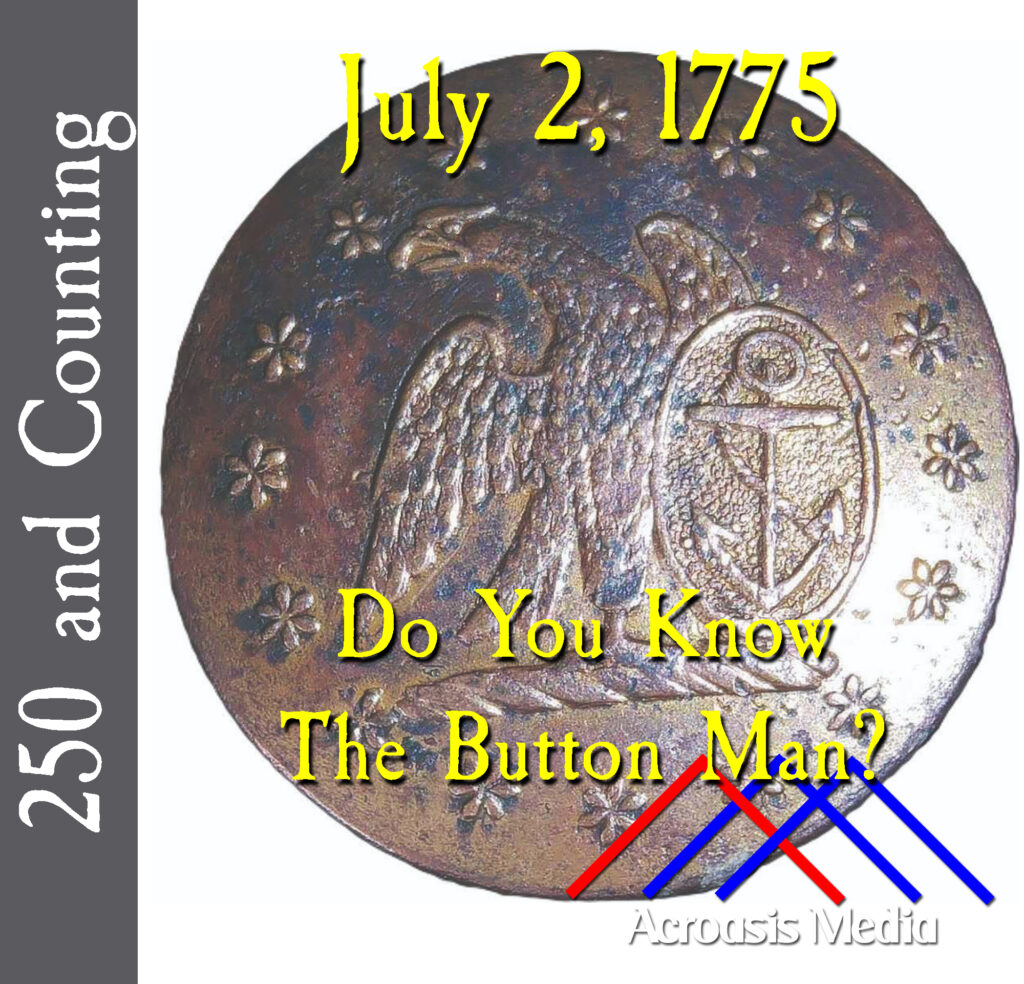
“Buttonmaker” is also a likely profession in this realm, largely because it is so automated these days. But back in the Colonial days, it was a specialty profession, especially since Aaron Peasley, the subject of today’s episode, refined the die sinking procedure used to make buttons then. And except for the specific means of creating the die (it’s done using electrical discharges nowadays), the overall technique hasn’t changed much.
But his talent didn’t end there. Listen in and see what else he did.
Additional note: the closeup photo of the button used in the cover art comes from a fascinating article written by 2ndLt. Kevin Rosentreter, USMC, who also took the photo.
Mike and I alternate on the writing and recording, but the final steps of the show, including the artwork and the show notes, are entirely my responsibility.
With the army being literally only a few weeks old, it was necessary to put together some regulations for this group, to ensure consistency throughout the Colonies.
Interestingly enough, as the rules were revised over the next several years, a pattern of using another army’s regulations as a template began to emerge. This isn’t necessarily a bad thing: take what works and build on it, yes?
A quick note about the cover art: it’s a recruitment poster from about that time, because a true Army Manual did not emerge until the third version was published in 1779.