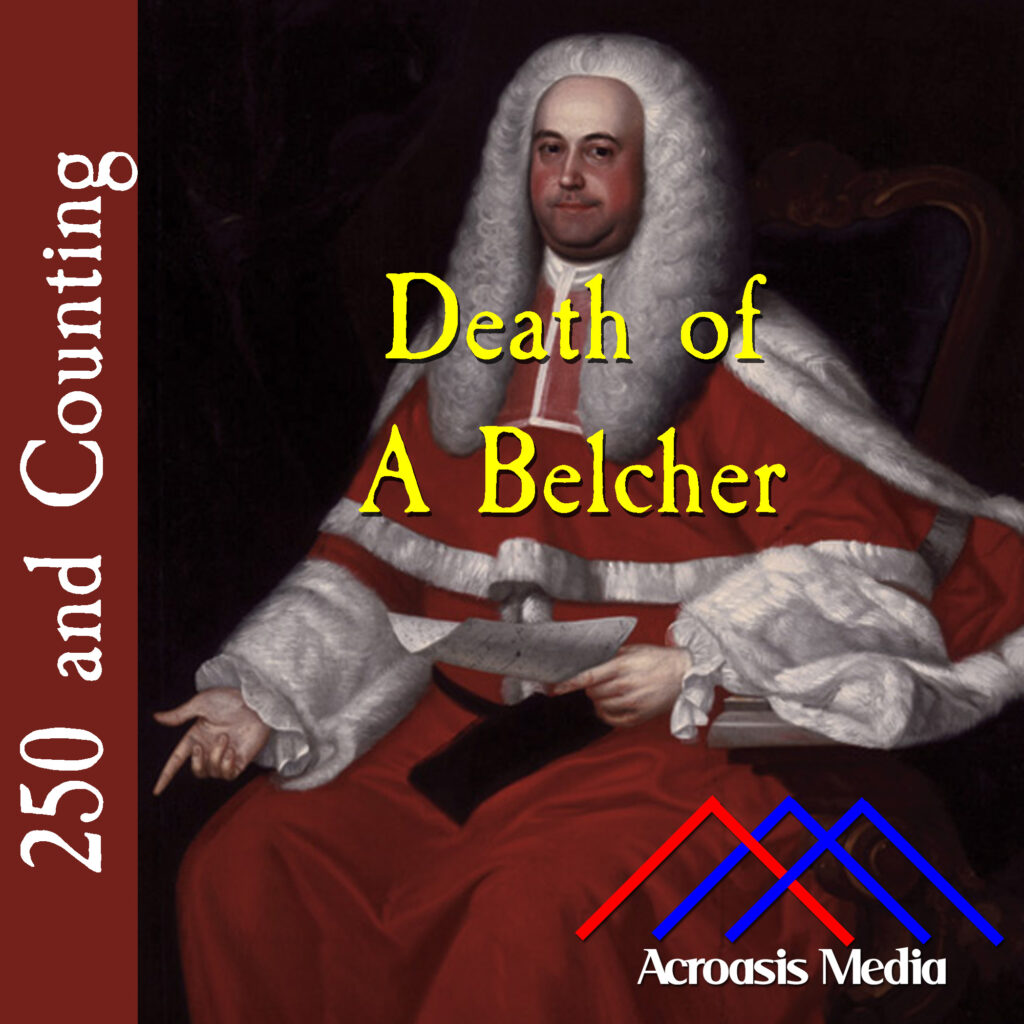
Jurist Jonathan Belcher was born in Boston. He was the second son of Jonathan Belcher and Mary Partridge,
Belcher entered Harvard College, where in 1728 he received a Bachelor of Arts degree in Divinity Studies. In 1730 he entered the Middle Temple, London, to read law, and in 1734 was called to the English bar.
In the meantime he had been admitted as a fellow-commoner to Trinity College, Cambridge, where in 1733 he received another master’s degree, this time in mathematics. He later received a third master’s degree from the College of New Jersey (now Princeton University).
In 1754, Belcher was sent to Nova Scotia to become the first Chief Justice of the Nova Scotia Supreme Court. Prior to Belcher’s arrival Nova Scotia had no formally trained law officers. This meant that he was not only interpreting the law there, he was oftentimes writing it.
Belcher also served on the Nova Scotia Council. On July 28, 1755, he published a document which concluded that deportation of the Acadians was both authorized and required under the law. This is the decision that got him in hot water.
From 1761 to 1763, he was also Lieutenant Governor of Nova Scotia, spending the last three years of that period as Acting Governor when Henry Ellis did not fulfill his duties. He negotiated the peace that led to the Burying the Hatchet ceremony in Nova Scotia.
Jonathan Belcher died in office in 1776, and is buried in the Old Burying Ground in Halifax.
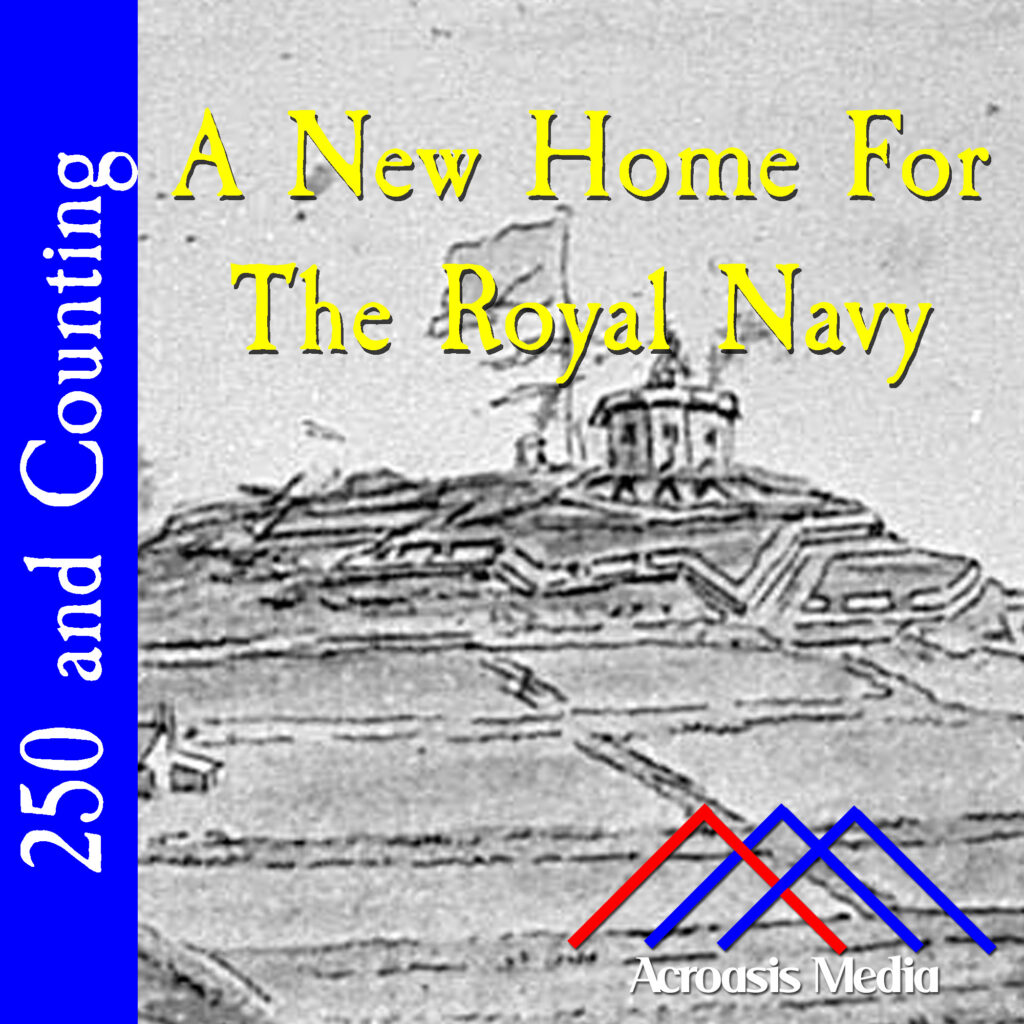
The image in today’s cover art is an engraving of Citadel Hill, around 1780.
Citadel Hill is a very popular historic site in Halifax, and while four forts have been built on this site, none of them have ever had to withstand a direct attack. In a couple of instances, structures near the Citadel were attacked, but never the building itself. It’s possible that the forts that were erected on the site served as deterrents.
The first Citadel was built in 1749. Fortifications were constructed on this hill to protect against raids by the French, colonial Akadians, and local tribes, especially the Mi’kmaq (pronounce it “MicMac”). By 1761 the fort was in ruins and a second, larger Citadel was built in 1776. This is the one in the artwork. While the garrison was always on alert, again it was never attacked, and by 1784 it was again in ruins. The third Citadel was built starting in 1796, when the old one was dismantled. This one was larger still and looked much like the current model, except it had more earthworks. During the War of 1812 some quick renovations were made in case the Americans attacked, but again the whole thing fell to ruin by 1825.
Construction for the current Citadel began in 1828. It was a huge masonry-construction star-shaped fort that took 28 years to finish. An incident in the nearby waters nearly dragged the Citadel into the American Civil War but again there were no attacks on the fort. Eventually it was restored by historians and in 1956 it opened as a historic site and home to the Halifax Army Museum. In the 1990s it was restored again to its 1869 appearance and is maintained as such.
The grounds of the Halifax Citadel are open year round. From spring to fall, a living history program features re-enactors portraying the 78th Highland Regiment (stationed at Halifax between 1869 and 1871), the 78th Highlanders (Halifax Citadel) Pipe Band, the Third Brigade of the Royal Artillery, soldiers’ wives, and civilian tradespeople. Parks Canada also hosts several re-enactment events each year by volunteers of the Brigade of the American Revolution and the two living history associations.
The Citadel’s role in the history of Halifax and North America is communicated through guided and self-guided tours, audio-visual presentations, and various exhibits. On average, the citadel sees over 200,000 visitors annually. A ceremonial firing of the noon gun is conducted daily by staff, and continues year-round, even when the site is closed to visitors. The artillery is also used for formal occasions such as 21-gun salutes.
The “Army Museum”, located in the Citadel’s Cavalier Block, displays a rare collection of weapons, medals, and uniforms exploring Nova Scotia’s army history. It is an independent non-profit museum, and staff work in close partnership with the Citadel staff and Parks Canada.
In July 2006, the Halifax Citadel celebrated the 100th anniversary of the withdrawal of the last British military forces from Canada. The Citadel hosted over 1,000 re-enactors from around the world. Approaching the Christmas season, Citadel Hill annually hosts a “Victorian Christmas”. Visitors are treated to crafts, carolers, and games, as well as a visit from Santa Claus.
Ghost tours are held at the fort in the weeks leading up to Halloween. Ghost tours! Nobody ever died in battle there, but we’re doing ghost tours. Fantastic.
So here’s a fun story about Charles Carroll. As I’ve mentioned many times before, lots and lots of place names in Baltimore have strong historical connections and Charles Carroll is no exception.
There is, of course, a Carroll Street, which starts in the southeast neighborhood of Morrell Park. It doesn’t go quite through that neighborhood though; it gets broken up by a couple of blocks’ worth of houses and resumes again. There’s another break as a railroad right-of-way comes through—but there’s no train crossing; the road just terminates. Carroll Street resumes (we’re still in Morrell Park) on the other side, however, before it’s interrupted yet again.
Now as I understand it, this particular part of the neighborhood was wiped out completely by Hurricane Agnes in the early 1970s, so the rebuild was kind of haphazard. Plus, I-95 was first constructed through this part of Baltimore City around this time, so you have to jump almost 3500 feet before Carroll Street resumes again.
But now you’re not in a residential neighborhood; it’s series of warehouses and industrial buildings for a stretch until it gets back into a residential neighborhood known as Pigtown, so called because on Market days, pigs would be led through the streets to the market for sale and eventual slaughter. Carroll Street meets with Cross Street in that neighborhood, and that’s the northern terminus.
However.
There’s an elementary school in the area that’s also named after Charles Carroll. It’s not on Carroll Street (of course) but is about two blocks away, in Pigtown. Now, remember, Charles Carroll was a lawyer, or a “barrister” as the old-timey types like to say. So Elementary School #34 is officially “Charles Carroll, Barrister Elementary School”. Except everybody forgets the comma is there and says it like one long name. And chances are, they think there was a guy actually named Charles Carroll Barrister somewhere in history.
And wasn’t that a long walk for a short drink of water.
The monument erected to honor Richard Montgomery outside St. Paul’s Chapel at Trinity Church. The inscription reads: This Monument is erected by the order of Congress, 25th, Janry, 1776, to transmit to Posterity a grateful remembrance of the patriotism conduct enterprise & perseverance of Major General Richard Montgomery Who after a series of successes amidst the most discouraging Difficulties Fell in the attack on Quebec. 31st, Decbr, 1775. Aged 37 Years.
We weren’t even a nation yet and Congress had already commissioned the Richard Montgomery Memorial. And while the memorial itself was completed rather quickly by the commissioned artist, the war interfered with its transport and it took nearly ten years to find all the pieces.
(Dirty Secret: they never found all of them; the urn at top center was a reproduction.)
Montgomery was generally known to be a good general even if his death was practically inevitable, given the circumstances. But that didn’t stop people from turning him into a martyr for the cause of Independence.
PS. Trinity Church’s website has a page dedicated to the monument, which aided my research for this episode. There’s a huge, fascinating segment dedicated to the 2011 restoration process for this memorial.
Painting of the Continental Congress by John Trumbull, created around 1819. This painting depicts a date several months after today. Trumbull was especially insistent on painting subjects from life whenever he could.
The Second Continental Congress Committees, several of them anyway, reported out on this day in 1776 and it was starting to become clear that the individual colonies had some needs when it came to defense.
There were issues with prisoners possibly being mistreated, word had gotten back regarding what had happened in Quebec on New Year’s Day, South Carolina had some need for sailors to defend the Charleston Bay…there was a lot going on, and while we view the large number of committees, with names that are either too obvious or a little silly, to be a bit much, we’re also viewing it through a modern-day lens.
Not that life was simpler—though it was, in a sense—but that the Congress was quite pragmatic and direct in the way they operated.
The Death of General Montgomery in the Attack on Quebec (detail), by John Trumbull, 1786.Montgomery was struck in the head by grapeshot, so it probably wasn’t nearly as tidy as this.
While hindsight is very much a 20/20 vision, it’s still worth exploring why the Battle of Quebec went so poorly for the American side:
While General Montgomery was clever enough to attack during a storm, he didn’t necessarily expect Nor’easter blizzard conditions, which made it tough for his men to see where they were going without lanterns…
…which meant that there were likely sentries who probably got curious about a bunch of lanterns coming their way.
Many of the men on the American side were literally on their last day of enlistment, so they probably weren’t motivated to give it their all.
In fact, only about 50 Americans (including General Montgomery) were killed, and 34 wounded (including Benedict Arnold), but over 400 men were missing or captured. “Missing” could easily mean “went home.”
Many of the Americans were probably unprepared for the relatively close quarters of fighting in a city, which meant that they were unprepared for attacks from above.
Now, I am by no means a military expert, but these are the things that stood out for me just based on a quick read of the situation. It was hubris, and a brand of short-sightedness that this particular city got deep into the heads of Montgomery and Arnold, and they refused to let it go.
The siege of Quebec was an event that was months in the making, and it was still just the penultimate act of the play.
Benedict Arnold and his troops thought they could get to the American side of the St. Lawrence River within 21 days; instead it took several weeks. Along the way they lost about a third of their troop strength. Some of the men died of illness en route, but most of them finally gave up altogether and headed home.
When they finally arrived they realized they didn’t have nearly what they needed to effect a decent attack on the city, so they had to hunker down and wait for supports to arrive. They were able to institute a couple of blockades, but that wasn’t nearly enough.
Finally General Montgomery showed up, and after an attempt at getting the city to surrender, they began the shooting. Unfortunately that didn’t do a lot of good, so the Continental Army had to settle for placing the city under siege. At this point, however, the clock was ticking because a big chunk of the Colonial soldiers were due to have their enlistments end on December 31. Something had to give, and soon.
Yarmouth, Nova Scotia was a frequent target of raids throughout the Revolution. Indeed, most of Nova Scotia was harassed from both land and sea by Americans. This had a huge impact on the maritime economy there. But all those attacks—mostly by American (and probably some French) privateers—inflicted lots of disruption on British supply lines the entire time.
On the downside, all these attacks pretty much put an end to any trade between America and Nova Scotia.
But the Raid on Yarmouth, as the event came to be known, was especially egregious both for its intensity and the lasting effect it had on its inhabitants.
The events at Lexington and Concord were only about a month in the rear-view mirror when it occurred to both the Americans and the British that the Canadian provinces were colonies, too, and that they might have some kind of interest in the activities going on further south.
Quebec, being perhaps the largest city close to the border, was the natural target for everyone involved. So it was always in the back of minds in the Thirteen Colonies, and in England. And slowly, each side began to think about either converting Canada to the American side, or defending Canada from American invasion.
And on this day in history, everyone moved a giant step closer to what eventually became the Battle of Quebec.
Robert Livingston now enters the picture in the broad tapestry of the American Revolution.
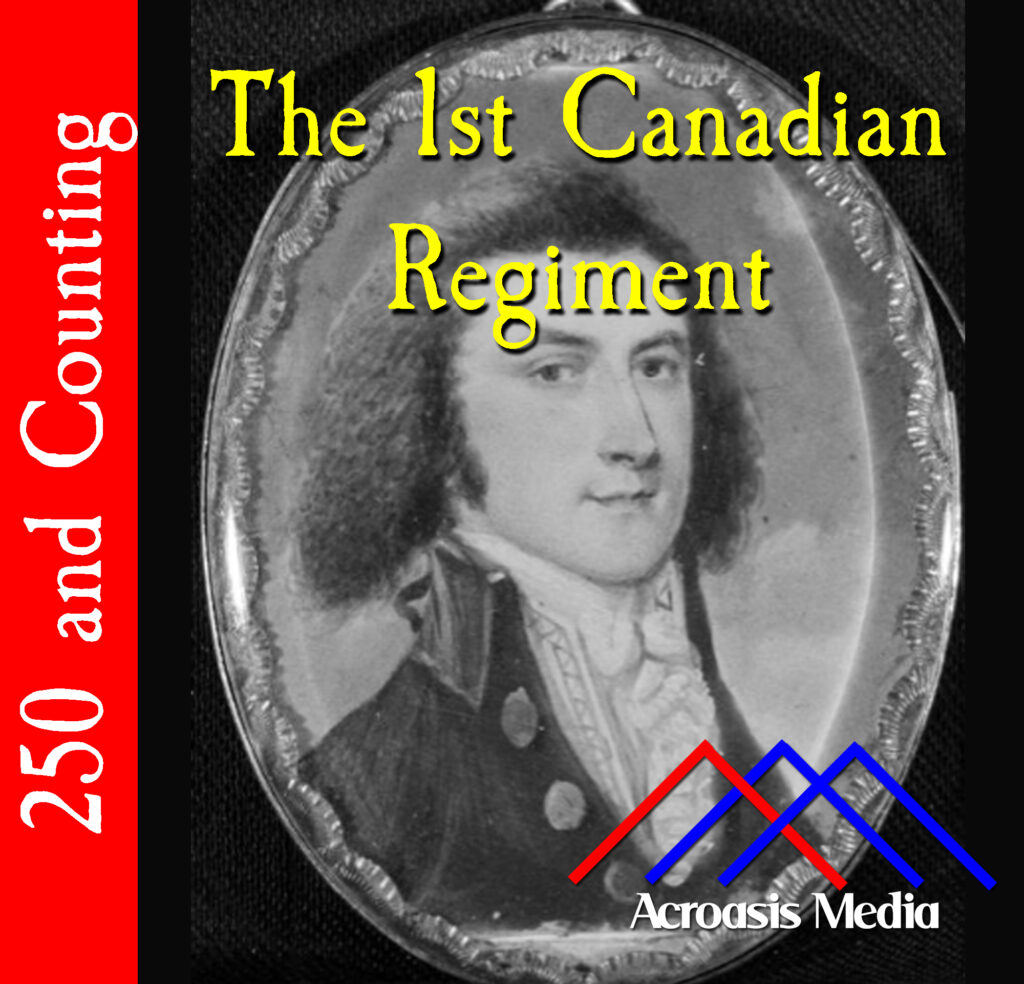
Given that the cover art today comes from an image from twenty years after the war; we can assume that he was quite young during the war, plus he held up pretty well in the interim.
At any rate, this isn’t the last we’ll hear from Robert Livingston; we’ll be back to visit him next month.