Category: Canadian History

  • The Siege at Ft. St. Jean Ends–November 3, 1775

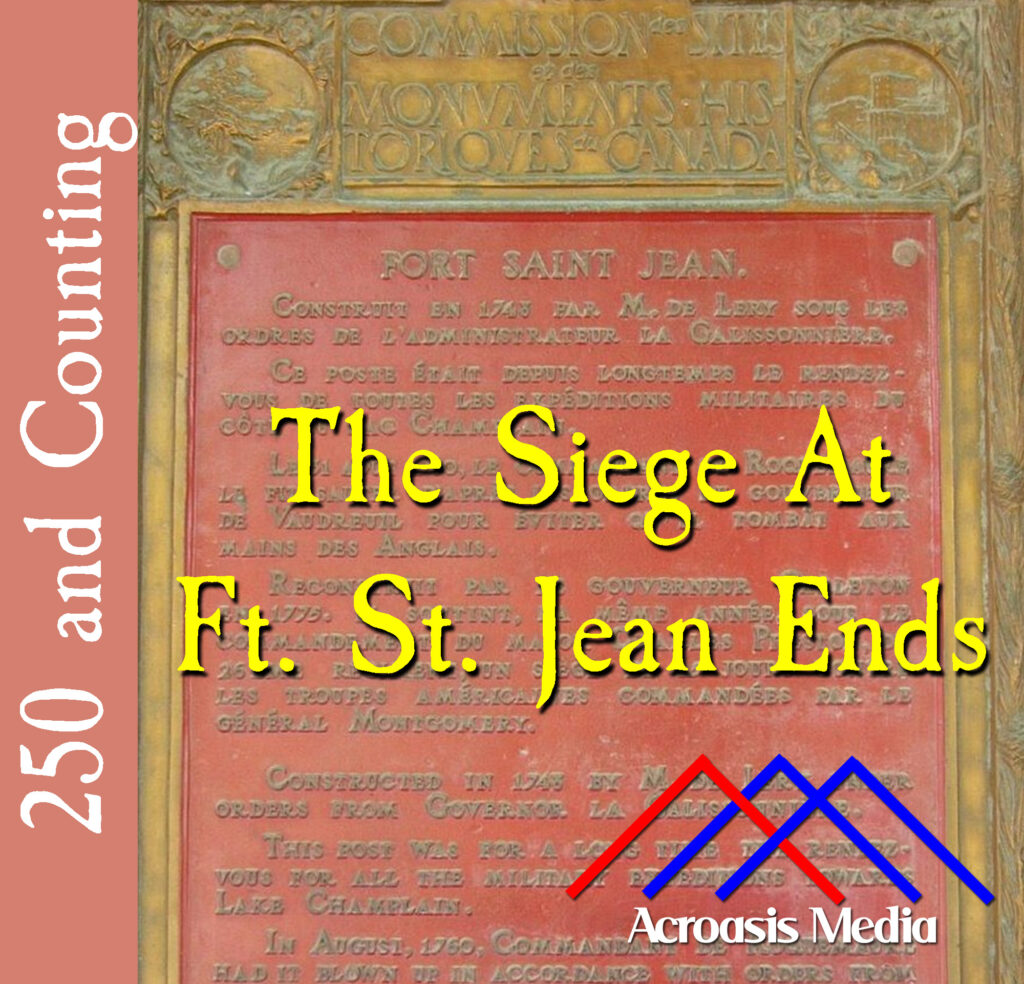
    Cover art for November 3, 1775: plaque commemorating the siege at Fort St. Jean in 1775, placed in 1926. via WIkipedia.

    If you’re scrutinizing today’s cover art and you’re having trouble reading the plaque, that’s because what you see is mostly in French. The bottom half, only part of which is visible here, is in English.

    The English part (which is a translation of the French part) reads:

    FORT SAINT JEAN

    Constructed in 1743 by M. de Léry under orders from Governor la Galissonnière. This post was for all the military expeditions towards Lake Champlain. In August, 1760, Commandant de Roquemaure had it blown up in accordance with orders from the Governor de Vaudreuil in order to prevent its falling into the hands of the English. Rebuilt by Governor Carleton, in 1773. During the same year, under the command of Major Charles Preston of the 26th Regiment, it withstood a 45 day siege by the American troops commanded by General Montgomery.

    So…yeah. The FORT withstood the siege, but eventually the soldiers within the fort gave themselves up.

  • Reinforcements Arrive in Quebec–October 15, 1775

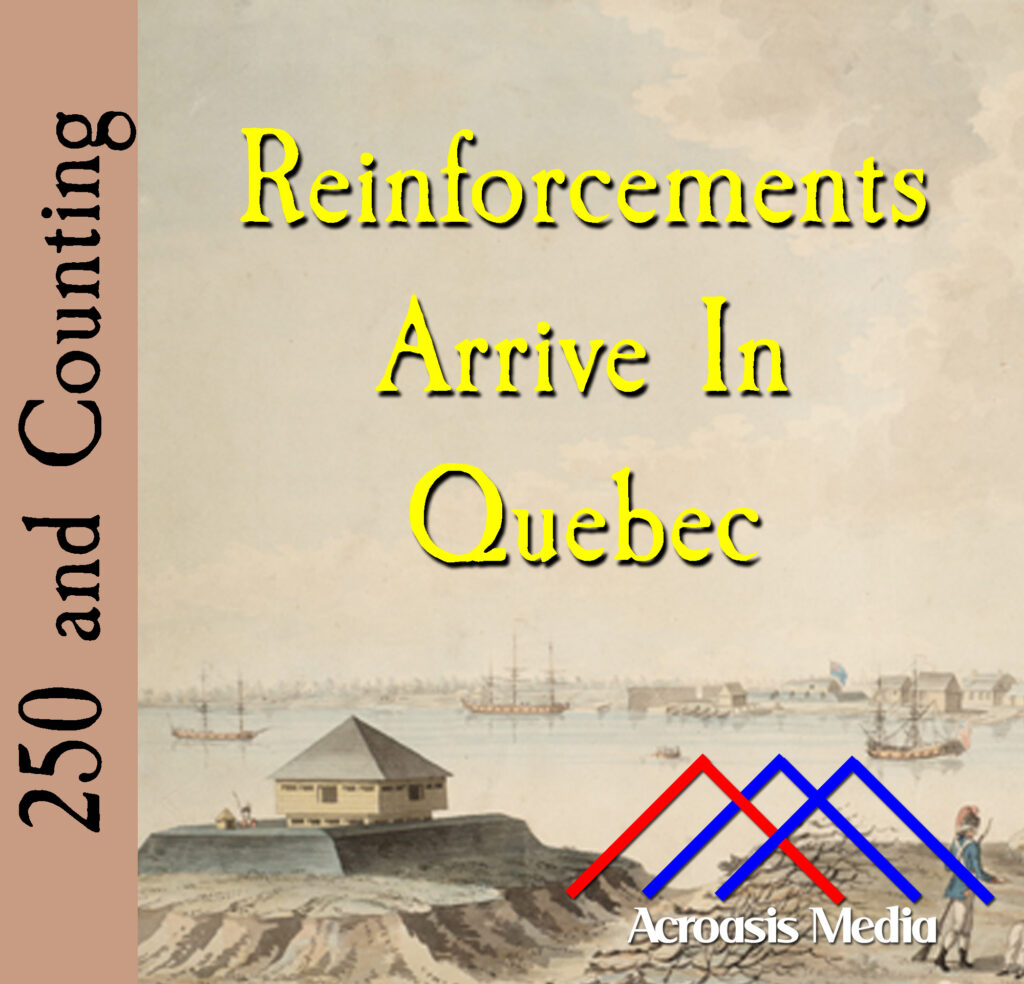
    Cover art for October 15, 1775: Fort St. Jean (near the right edge) around the time of the siege. Watercolor, pen and ink by James Peachey.

    Fort St. Jean was a relatively soft target compared to Boston. Plus, it wasn’t as well fortified because the British weren’t holed up there. Sooner or later something would come along to break up the stalemate.

    On this day, a couple of somethings arrived, from Fort Ticonderoga and Crown Point. The big guns that Montgomery had hoped for finally arrived. And not long behind that, Montgomery was able to take Fort Chambly, which wouldn’t have been a huge deal had its commander not forgotten an important detail while he was high-tailing it out of there.

  • The Great Carrying Place–October 11, 1775

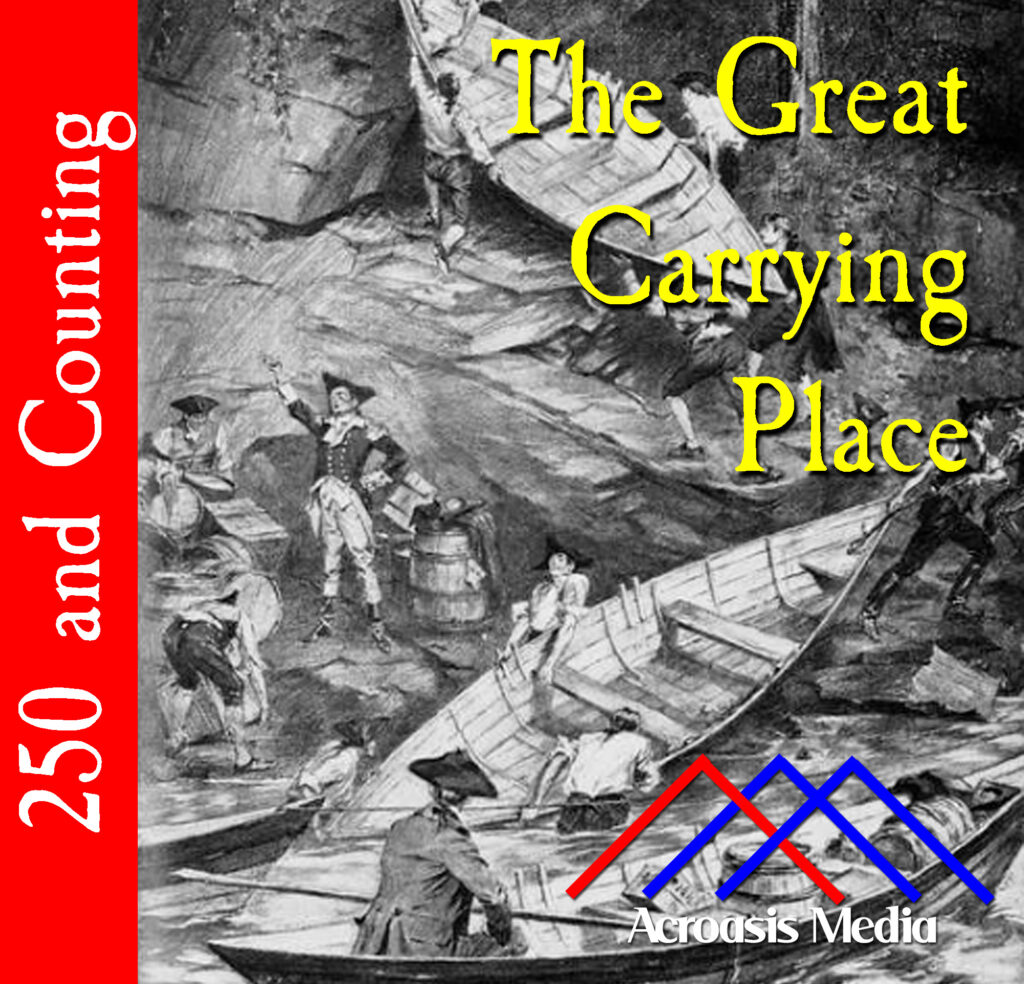
    Cover art for October 11, 1775: "Carrying the bateaux at Skowhegan Falls", drawn by Sydney Adamson; halftone plate engraved by CW Chadwick, 1903.

    Benedict Arnold and Company are still on the move toward Quebec. Over a three-week period they’ve moved fewer than 90 miles, with only…300 to go. Today they’ve reached The Great Carrying Place, a 13-mile walk alternating between woods and knee-deep mud, all while carrying everything they’ll need to get to Canada.

    Back in the Colonies proper, General Gage is being replaced by General Howe. Gage was largely responsible for the Siege of Boston, especially since they weren’t able to break that siege. And then Bunker Hill came along. Sure, the British won but at great cost—a Pyrrhic victory. Once word got back to Britain about that, Lord Dartmouth appointed Howe within a couple of days. Of course, it took several weeks for the news to get back to America, and on September 26 he learned he was being replaced. By this days’ end, Gage was on his way back to Britain.

  • October 5, 1775: An Arrest In Canada

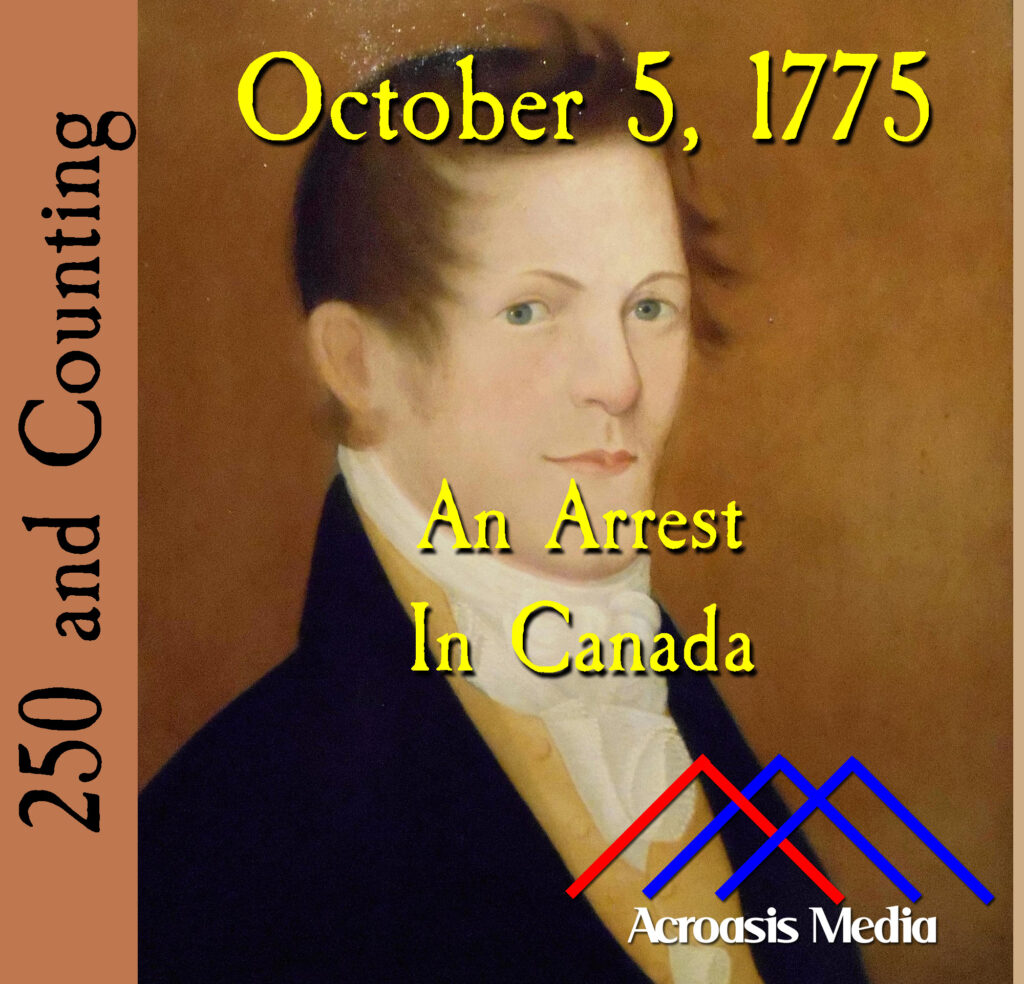
    Cover art for October 5, 1775: Oil-on-wood portrait of Thomas Walker

    Thomas Walker was born in England and emigrated to Boston in 1752. In 1763 he moved to Montreal and became a merchant.

    When the war broke out in the Colonies, both Walker and his wife’s sympathies remained with the Americans. So it was that he agreed to assist with the invasion of Montreal. The plan never got to the point where his task came in, but since he was known to be part of it, the word went out for his arrest.

    Walker didn’t give up quickly but he was caught by the British for his crime. A month later he was put on a ship bound for Quebec, but it was captured by the Americans and he was released. He returned to Montreal(!) but when an American delegation showed up in May 1776, he decided to return to America with them, and he re-established himself in Boston. Unfortunately we don’t know a lot about what happened to him after that except that in 1785 he petitioned Congress for reimbursement for lost income because of the war.

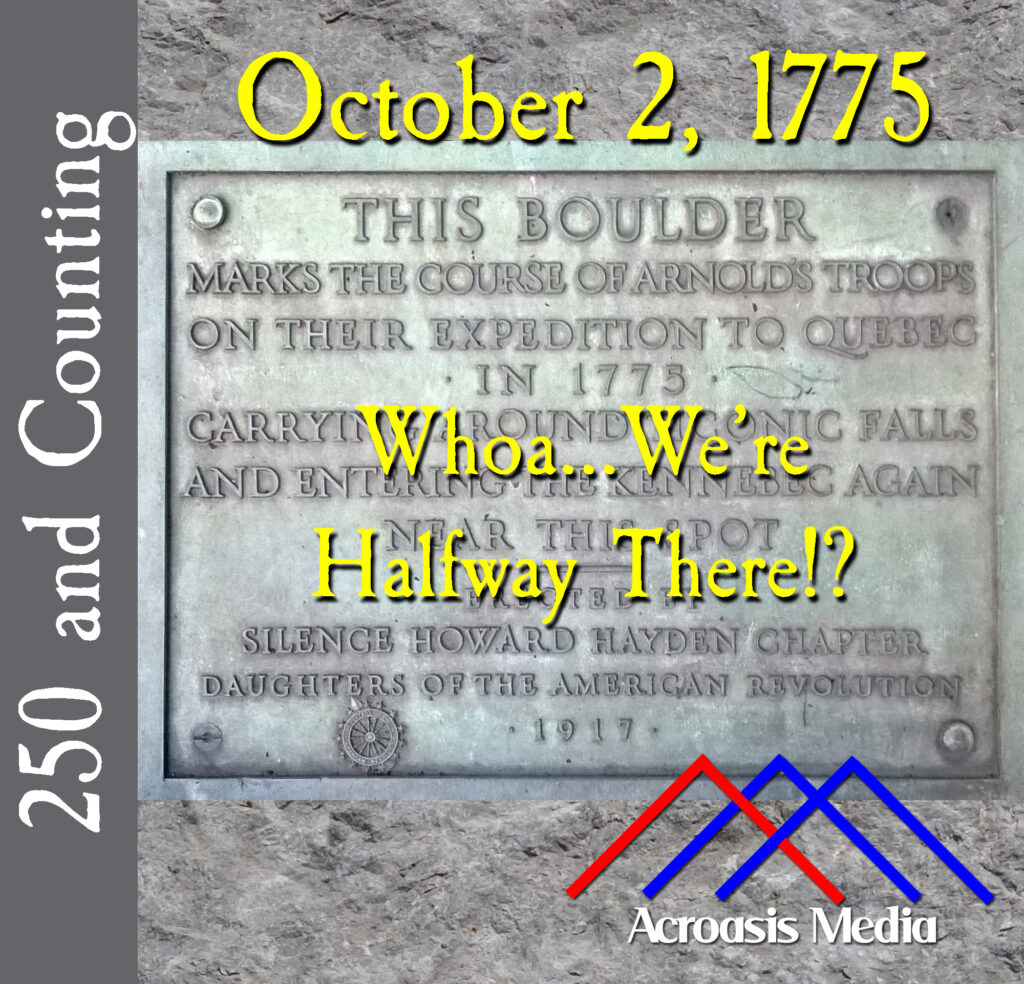
  • October 2, 1775: Whoa…We’re Halfway There!?

    Cover art for October 2, 1775: one of several markers commemorating stops for Benedict Arnold and his soldiers. This one is near Ticonic Falls, which is the modern name for Norridgewock Falls.

    It was not so very long ago that some of us sought directions from Mapquest. Then we printed them out in order to make a trip of some kind.

    It was only a little bit longer ago that we depended on physical maps to get places. In fact, if you’re a fan of the HBO show The Wire, you may recall a plot point that revolved around printed maps. A secret code led to a point on the map.

    Back in the 18th Century, maps were very important resources for the overland traveler. And if a map had a mistake on it, you could be hopelessly lost. It’s not as though you could pull into Ye Olde Gas Station and get directions.

    So the bad news for Benedict Arnold and Company is that the map he used to get to Quebec was terribly inaccurate. The good news is that it was largely incorrect from a distance standpoint. It could have genuinely been much worse.

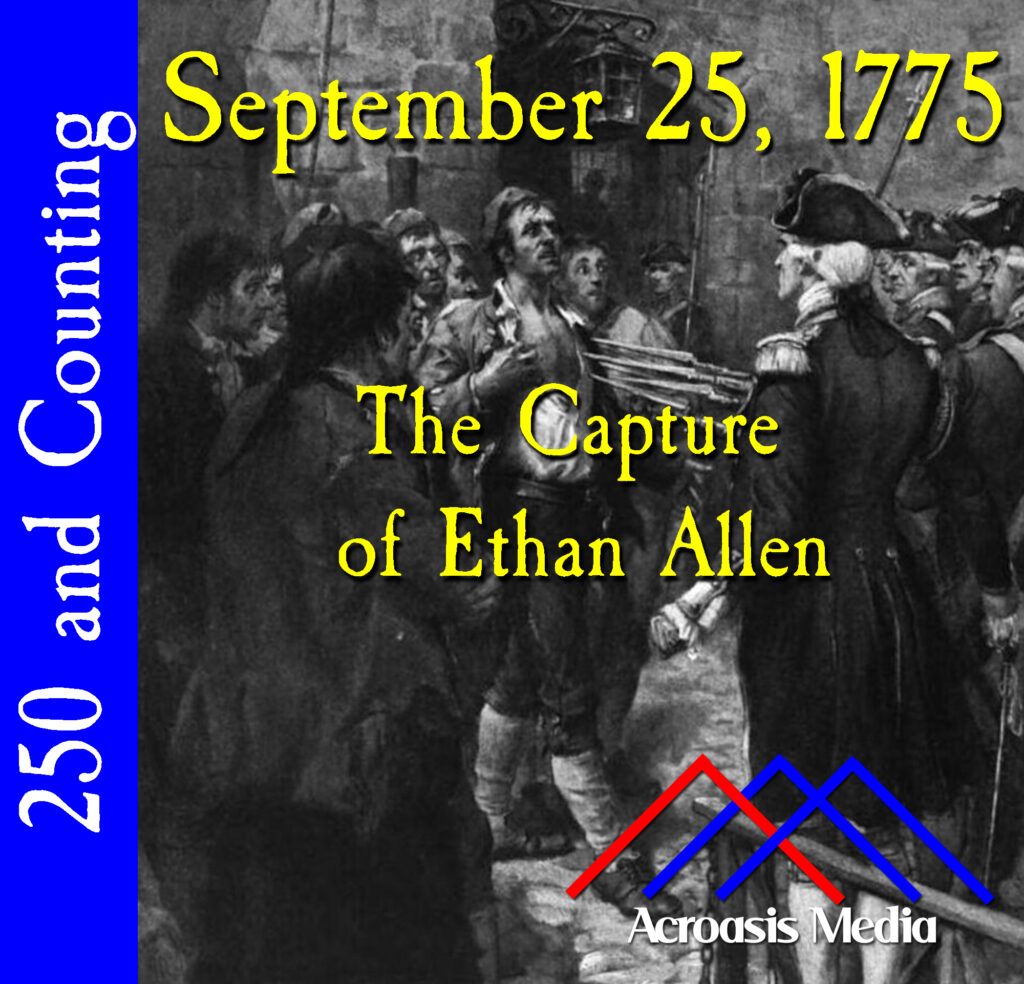
  • September 25, 1775: The Capture of Ethan Allen

    Cover art for September 25, 1775: Ethan Allen Before Prescott (cropped), engraving by H.C. Merrill, after creator F.C. Yohn, via the New York Public Library digital collection.

    And this, kiddies, is what happens when you don’t push the “publish” button. You get a late episode. At least the radio folks heard it today.

    BTW: Shout-out to Hillsboro’s News Hound, HBORO.com! Welcome aboard!

    Ethan Allen was part of the Green Mountain Boys and the whole contingent that went north to invade/convince Canada in the effort to get them to join us in the Independence movement. Allen was young and ambitious, and that may have contributed to his downfall here. Because while a plan to move in on Montreal fell apart and resulted in his capture, subsequent research has revealed that Allen may have acted on his own, and that there was in fact no plan.

    Also, for what it’s worth and in case you’re curious: there’s no genuine connection between Ethan Allen the man and Ethan Allen the furniture company other than that the company’s founders was making early-American style furniture at the time.

    Also worth noting that I keep having to backspace when I write “Ethan Allen” because as someone living in Baltimore I keep typing “Allan”. Thanks, Mister Poe.

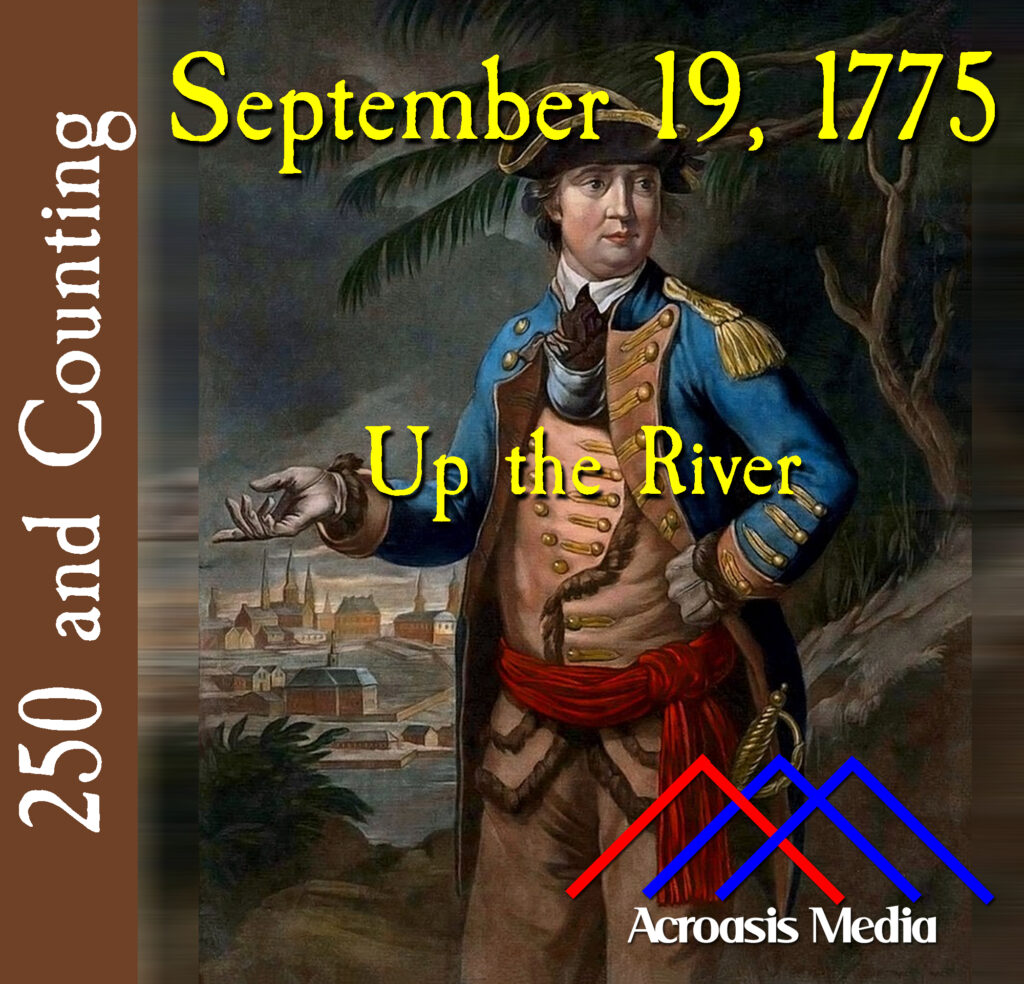
  • September 19, 1775: Up the River

    Cover art for September 19, 1775: Color Mezzotint of Benedict Arnold, 1776 by Thomas Hart. From the Anne S. K. Brown Collection at Brown University. URL at time of upload: http://dl.lib.brown.edu/repository2/repoman.php?verb=render&id=1194635475812500&view=showmods # Call Number: UMP1776mf-1 (ASK Brown Call No.)

    We think of “Benedict Arnold” and the word “Traitor” comes immediately to mind. The two are essentially synonymous. Say one, and you’ve said the other.

    But Benedict Arnold was quite loyal to the Independence cause in the early days of the war. In fact, he was often eager to show what he could do. And why he switched sides is quite complicated and can’t really be answered quickly.

    There were times when he felt that injustices were suffered upon him by other generals and by the Continental Congress. Some of them were real but others, imagined.

    He had two painful battlefield wounds in a leg that was already plagued with gout. Was it a psychological issue?

    Was it a midlife crisis, during which his politics shifted? Given that he married a very young, very pretty and very Loyalist woman named Peggy Shippen, maybe he just did it for the nookie.

    Peggy Shippen is actually the most common explanation.

    At any rate, in 1775 Arnold was still on our side and embarked on an expedition to Canada that turned out to be far more complicated than anyone suspected it would be.

  • September 11, 1775: One Siege Begins, Another Continues

    Cover art for September 11, 1775: "Siege of Boston" wood engraving (detail), created 1879, artist not cited. via the New York Public Library digital collection.

    As the winter of 1775 approached, George Washington had to think about the state of the siege of Boston. In short, housing and clothing thousands of men in a New England winter is a very different proposition than doing it in the summer.

    So Washington convened his War Council to discuss the possibility of breaking the siege by attacking the city from a different direction.

    Meanwhile up in Canada, General Philip Schuyler takes another run at Fort St. Jean.

  • September 9, 1775: Landfall in Newfoundland

    Cover art for September 9, 1775: Hurricane Igor makes landfall in Newfoundland in 2010. By NOAA - http://www.nnvl.noaa.gov/MediaDetail.php?MediaID=532&MediaTypeID=1, Public Domain, https://commons.wikimedia.org/w/index.php?curid=11560153

    The Independence Hurricane from September 2 is still going strong, and on this day it made landfall again, this time in Newfoundland, Canada.

    The devastation was immense, and perhaps would have been worse had it happened in modern times (we get it, there are satellites and stuff now). It remains Canada’s worst natural disaster and it’s still in the Top Ten chart for North Atlantic hurricanes.

  • September 6, 1775: Washington Appeals Directly to Canadians

    Cover art for September 6, 2025: the first page of Washington's letter to the Canadians. from Library of Congress.

    The Second Continental Congress tried appealing to the Canadian leadership in order to get support for the Independence cause, but they apparently weren’t biting.

    So George Washington tried a different tack: write to the Canadian people themselves. He reasoned that the folks in charge were mostly wealthy landowners who were doing all right financially under British rule. Maybe, he thought, the ordinary Canadian folks weren’t quite so happy with the King.

    He was not, unfortunately, correct in that assessment and nobody was swayed by his argument.