Category: American Revolution

  • A Furnace for Arms–January 2, 1776

    Cover art for January 2, 1776: the Mount Riga Ironworks Furnace in Salisbury, CT. via Wikimedia Commons
    The Mount Riga Ironworks Furnace in Salisbury, CT. There was more than one furnace at this location; this is the surviving one. It’s on the National Register of Historic Locations and a lovely place to visit if you’re in the northwest corner of the state.

    The Mount Riga Iron Furnace isn’t an especially unique artifact on the east coast of the US. In fact, as someone who lives in Baltimore, I get to see one of them regularly when I visit my mother-in-law, who lives about a half-hour’s drive away in a more rural part of the state. Unfortunately, that one (the Northampton Furnace is in bad shape because of its location close to a modern-day reservoir, so it’s in the water a lot of the time.

    But it got me curious enough to wonder what they did, and how they worked. In the oversimplified version, you layer the iron ore and limestone, along with the fuel, usually charcoal or coke, into a tall stack.

    Once the fire is lit, air is pushed into the bottom and forced upward, creating superheated air which gets it to about 4000 degrees. The ore melts down and the limestone collects the impurities in the ore.

    The limestone and impurities float to the top as slag, and the molten iron can be removed as pig iron. This is the raw material for making iron and (later on) steel.

    (Steel did exist in the 18th century, but it would be nearly 100 years before Henry Bessemer came up with the mass production process that made the Industrial Revolution possible.)

    Iron furnaces aren’t unique, but they’re not especially common either, so it was important in the Revolutionary Era to locate them and ensure that they were adequate for creating the raw materials for producing weapons.

  • The Burning of Norfolk–January 1, 1776

    Cover art for January 1, 1776: "Incident in the Burning of Norfolk," engraving, artist unknown. Originally appeared as an illustration in Cassell's History of the United States in the late 1870s.
    “Incident in the Burning of Norfolk,” engraving, artist unknown. Originally appeared as an illustration in Cassell’s History of the United States in the late 1870s.

    Happy New Year to you!

    The burning of Norfolk was the follow-up to the Battle of Great Bridge and the Patriot occupation of that town. Colonel Howe probably overplayed his hand with this one, and the consequences were catastrophic for the town.

    The Declaration of Independence is just a few months away, now, and (spoiler alert) the part you may be most anticipating doesn’t happen on July 4. But in the meantime, there’s lots and lots of extremely historic things for us to talk about in the run-up to the Declaration, and the immediate aftermath.

    Running through 1775, one day at a time, has been a huge privilege for us, and we hope you’ll stay with us through 1776. This was a project that I’d been thinking about for a long time, longer than I’ve known my partner, Mike Messner. And when I suggested to him that we team up, he jumped on the idea immediately. He’s been instrumental in helping with the research, with brainstorming the ideas, and with keeping me committed to the idea of actually doing a podcast that runs every single day.

    We put a couple of hours into researching, writing, recording, (sometimes re-writing and re-recording) and editing these episodes, and I hope the effort shows. Thank you so much for taking this ride with us, and here’s to the next year.

    Have a wonderful 2026!

  • The Battle of Quebec–December 31, 1775

    Cover art for December 31, 1775: The Death of General Montgomery in the Attack on Quebec (detail), by John Trumbull, 1786.
    The Death of General Montgomery in the Attack on Quebec (detail), by John Trumbull, 1786. Montgomery was struck in the head by grapeshot, so it probably wasn’t nearly as tidy as this.

    While hindsight is very much a 20/20 vision, it’s still worth exploring why the Battle of Quebec went so poorly for the American side:

    • While General Montgomery was clever enough to attack during a storm, he didn’t necessarily expect Nor’easter blizzard conditions, which made it tough for his men to see where they were going without lanterns…
    • …which meant that there were likely sentries who probably got curious about a bunch of lanterns coming their way.
    • Many of the men on the American side were literally on their last day of enlistment, so they probably weren’t motivated to give it their all.
    • In fact, only about 50 Americans (including General Montgomery) were killed, and 34 wounded (including Benedict Arnold), but over 400 men were missing or captured. “Missing” could easily mean “went home.”
    • Many of the Americans were probably unprepared for the relatively close quarters of fighting in a city, which meant that they were unprepared for attacks from above.

    Now, I am by no means a military expert, but these are the things that stood out for me just based on a quick read of the situation. It was hubris, and a brand of short-sightedness that this particular city got deep into the heads of Montgomery and Arnold, and they refused to let it go.

  • Washington Has A Change Of Heart–December 30, 1775

    Cover art for December 30, 1775: Soldiers at the siege of Yorktown, by Jean-Baptiste-Antoine DeVerger (cropped), watercolor, 1781.

    Back on October 8, the Continental Army determined that Blacks were no longer to be permitted to enlist, and that existing soldiers would not be allowed to re-enlist.

    But on this date, George Washington changed his mind. Was he suddenly an abolitionist? Not a chance. He owned slaves until the day he died. This was a more pragmatic decision. It was borne of the fact that he and his staff suddenly realized that a lot of soldiers were going to end their enlistment come January. That October decision was starting to look rather short-sighted.

    Add to that the fact that word had gotten about about Lord Dunmore’s offer to free slaves who fought on the British side. Now, he really couldn’t do anything for slaves who came from anywhere other than Virginia, but the offer was still hanging out there.

    Finally, it was quite apparent that there was a growing number of Blacks, whether slave or free, who had shown interest in fighting for the Patriot cause.

    It suddenly looked like a whole lot of bodies were getting turned down by the Continental Army for no good reason.

  • Birth Of A Navy–December 29, 1775

    Cover art for December 29, 1775: The Pine Tree Flag, which was the ensign of the Massachusetts State Navy.
    The Pine Tree Flag, which was the ensign of the Massachusetts State Navy. There are a few variations of this, because the original was destroyed by the British.

    While the Massachusetts Naval Militia was pretty much wiped out in 1779 (oops, spoiler alert), it wasn’t the end of a state-based Navy for Massachusetts.

    Massachusetts began to rebuild, but in 1780 a new state constitution was adopted, and just as the navy was delayed in its original inception by bureaucracy, the Massachusetts State Navy wound up dissolved the next year. They were re-established for the War of 1812, but again disbanded when that war ended.

    Nowadays, any state naval militia are automatically part of the United States Militia, and in Massachusetts specifically, any attempt to reactivate a naval militia in Massachusetts must be done either by the governor of Massachusetts or the Massachusetts General Court.

    There are five state naval militia extant, so far as I can tell: Alaska, New York, Ohio, South Carolina, and Texas.

  • Congress Organizes Military Support–December 28, 1775

    Cover art for December 28, 1775: plaque commemorating the table where the Secret Committee met with Julien Alexandre Achard de Bonvouloir.
    The plaque in Carpenters Hall, commemorating the table where the Secret Committee met with Julien Alexandre Achard de Bonvouloir.

    You’ll remember I mentioned Samuel Adams in this space a couple of days ago, as a member of the Continental Congress, and as a member of several committees, most of them related to defense. He was almost certainly at the heart of the events of today that took place in Congress which Mike describes in our episode, even though he isn’t named directly in conjunction with either of them.

    But organizing the military, and forging alliances with other nations are activities that are definitely in Samuel Adams’ wheelhouse, so it’s likely that he was in the middle of both of these.

  • Ben Franklin Analyzes the Snake–December 27, 1775

    Cover art for December 27, 1775: the Gadsden Flag, featuring a rattlesnake warning people away.
    Yeah, I cheated and used the same image from last week.

    While he didn’t use a rattlesnake, Benjamin Franklin was the guy who came up with the original “Join or Die” snake image [right]back in 1754. (At least most people give him credit for it.)

    It was based in a superstition that if you cut up a snake into pieces and then reassembled those pieces before sunset, the snake could be resurrected. In 1754, during the French and Indian War, Delaware was part of Pennsylvania and New England’s four colonies were simply grouped together. Georgia was altogether omitted and nobody knows why.

    At any rate, it’s only fitting that when the Gadsden Flag, which we talked about in the December 20th episode, made its debut, Franklin was the one who took the time to opine on why a snake was so appropriate; what’s more why a rattlesnake was the best choice. He published an essay in a local newspaper under a pen name, but his identity was figured out anyway.

  • Sam Adams Has Thoughts–December 26, 1775

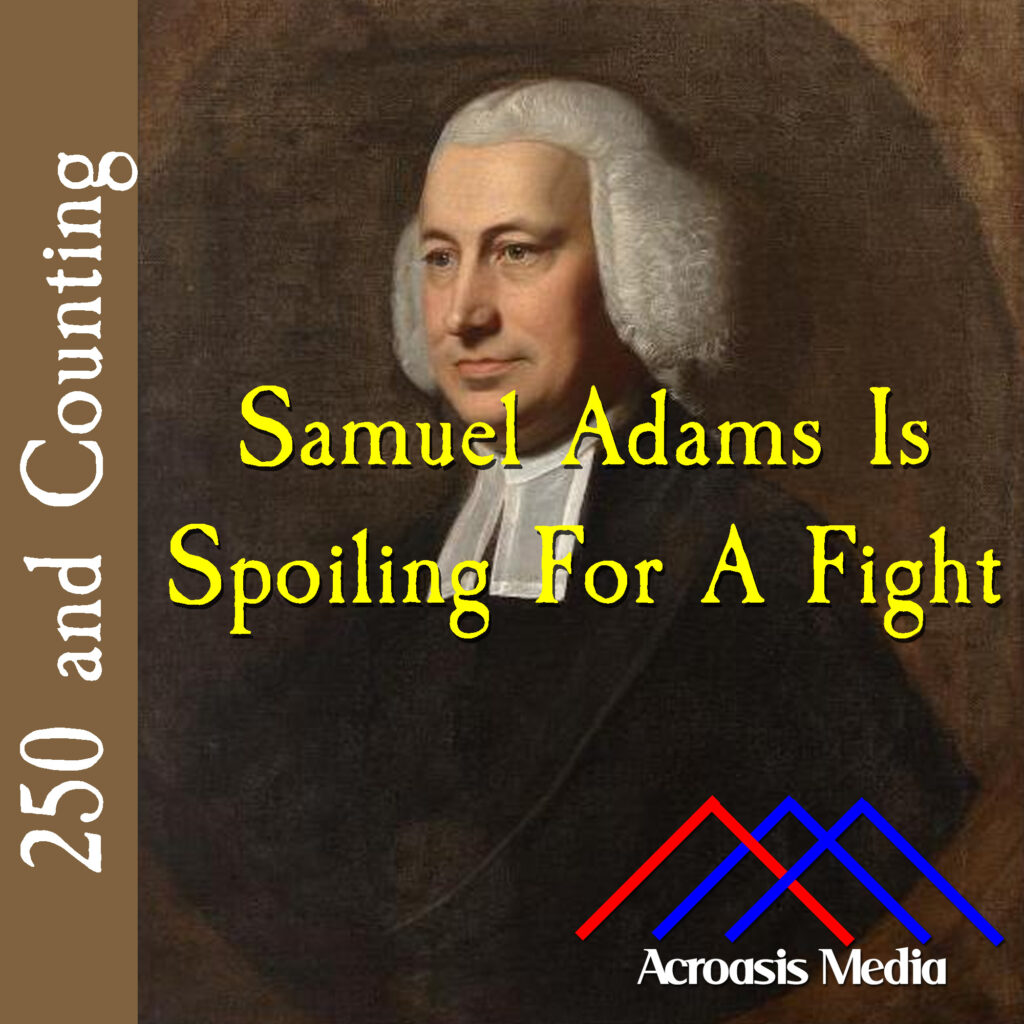
    Cover art for December 26, 1775: portrait of Samuel Adams, 1772. By John Singleton Copley - Museum of Fine Arts, Boston, and Wikimedia Commons
    Portrait of Samuel Adams, 1772. by John Singleton Copley – Museum of Fine Arts, Boston, and Wikimedia Commons

    Most of us have a pop culture view of the American Revolution period, and some of us go so far as to have some idea of what happened via the 1970 film 1776. Oddly enough, that movie has both a ton of accuracy with its facts (but not necessarily in the right order), and a ton of dramatic license.

    One thing the film gets right is that John Adams was a bit of a nudge, constantly pushing the other delegates toward the Indepency movement. He wasn’t considered exactly obnoxious, but maybe a bit zealous. At the same time, his cousin Samuel Adams wasn’t represented at all in the movie. And that’s a shame, because while he was the quieter one overall, he was instrumental in shaping the debate.

    As far as historians can tell (and it’s tough, because Congress worked under a secrecy rule–their notes tell you what happened but not necessarily who did what), Samuel Adams acted as a kind of parliamentary whip, schmoozing with delegates and getting them to see his side of things. He was on most of the military committees, and in fact was the man who first proposed that George Washington become the Continental Army’s Commander-in-Chief.

    See? It’s not about the beer.

  • Confusing–And Howe–December 25, 1775

    Cover art for December 25, 1775: A portrait of Major General Howe, artist unknown. From the book A brief history of the North Carolina troops on the Continental establishment, by: Charles Lukens Davis & Henry Hobart Bellas, published 1896.
    Cover art for December 25, 1775: A portrait of Major General Howe, artist unknown. From the book A brief history of the North Carolina troops on the Continental establishment, by: Charles Lukens Davis & Henry Hobart Bellas, published 1896.

    The Battle of Great Bridge may be over, but its effects linger on.

    Lord Dunmore, the former Royal Governor of South Carolina, communicated to General Robert Howe that he’d like to effect a prisoner exchange.

    It’s not clear whether Howe was playing hard-to-get, or playing dumb, or something else. He and Dunmore exchanged several letters over the next couple of days, and apparently didn’t end in a prisoner exchange. It did, however, end in violence. We’ll be talking about that as we get into the new year.

  • Merry Christmas, Indeed–December 24, 1775

    Joseph Warren conferring with Israel Putnam prior to the battle at Bunker Hill
    Joseph Warren conferring with Israel Putnam before the battle at Bunker Hill, at which
    Warren was killed.

    Mike’s pretty much covered the story of the capture of a British ship in the episode, so I’m going to tell you a little bit about Joseph Warren, who (you may recall) was killed at the battle of Bunker Hill.

    Warren became a doctor early in his career, and he also became a Patriot before it was fashionable. He was a powerful speaker, and for several years in a row he would deliver a speech commemorating the anniversary of the Boston Massacre.

    In the fall of 1774, he composed the Suffolk Reserves, which urged armed resistance to the British and a boycott of British goods.

    So by the time 1775 rolled around, he was one of the most influential men in Massachusetts; in fact he was the president of the Provincial Congress, which by then was the body actually running things there.

    In addition, he was on the Safety Committee, ensuring that gunpowder and ammunition was available to militiamen who needed it.

    We’ve been talking about the Siege of Boston since April. That was his doing; he’d organized the siege in the first place. George Washington took over a while later. He then organized the building of the earthworks at Bunker Hill before that battle started. And when the British began to overrun the Patriots, he was instrumental in giving them an opportunity to escape. But that’s where his luck ran out: a British soldier recognized him and shot him in the head, killing him instantly.

    The Brits then stripped his body and stabbed it several times, then buried him in a shallow grave with another Patriot who’d been killed. Later on, Paul Revere had to identify the body.

    The point to all of this is that, had he survived the battle, Joseph Warren would almost certainly have been a much larger figure in the American mythos; maybe he’d even have been our first President instead of Washington.

    Ponder that!