Although Fort Johnston was originally a British fort, a few years into the Revolutionary War, the Colonies recognized that it could be a valuable place to have a fort, and in 1778 they appropriated the money to have it rebuilt. That fort was also destroyed and, although reconstruction began in 1794, it took many years to complete the project.
Time and again Fort Johnston was destroyed or abandoned, and then repaired or refurbished. The fort regained importance during the Civil War but was officially removed from seacoast defense in 1881. For many years it held multiple military-adjacent agencies or tasks, until it was finally decommissioned altogether in 2004.
Given the fact that the existing government of Virginia was technically extra-legal, it’s a little amusing to think that they themselves felt the need to conduct extra-legal activities of their own. A more cynical mind would think that they were hedging their bets, so that if anything Revolutionary were to come up and the British started rounding up people, they could say, “That wasn’t us…it was that Virginia Convention crowd!”
A more cynical mind would think that. Heh.
But the various conventions, while not having large agendas, did have important ones, and they managed to help the colony get their act together and improve their overall effectiveness during the Revolution.
If you’re going to be in rebellion, you may as well do something rebellious.
Thus was (presumably) the reasoning behind Ben Franklin putting forth a resolution that the Colonies would effectively ignore a ban on the importation of weapons and gunpowder to the Colonies.
And while we’ve mentioned numerous times that the Congress doesn’t seem to do a lot more than form various Committees, again we need to stress that these were serious men, who gave serious thought to whatever they presented to the larger group, because they knew that any votes had to be unanimous. They took the job with great gravity, and in fact worked long hours. And in Philadelphia in the summer time…that is no joke, my friend. I mentioned it in a Baltimore context during the show, but remember that these cities aren’t very far apart, and thus have similar climates.
Lord John Wilkes was an interesting person who was always willing to run against popular opinion if he felt strongly that he was in the right.
In 1769 he fought for the right of his voters – rather than the House of Commons – to determine their representatives. In 1761 he got Parliament to concede the right of publishers to print the content of Parliamentary debates. In 1776 he put forth a bill proposing Parliamentary reform.
But on this day in 1775, Wilkes managed to anger a great number of people in Parliament when he expressed support for the Colonial rebels.
Unfortunately, after one of his actions had an unfortunate effect, his politics became increasingly conservative and as a result he lost his seat in Parliament in 1790. Not long afterward he took a position as a magistrate, and he seemed to once again show more compassion toward the lower classes.
The Speech to the Six Nations is one of those documents that pretty much answers what was going on with the Native Americans during the Revolution. Athough to be fair, it largely addresses what happened with the Native Americans in Upstate New York. But that area, being a border with Canada, was pretty important to the Independence cause.
Part of the reason that the tribes took the document seriously is that each tribe received a series of belts which represented our intent and desire for peace. The belts themselves were reportedly larger than usual for such a task, in the hopes that the tribe leaders would understand the gravity of the situation.
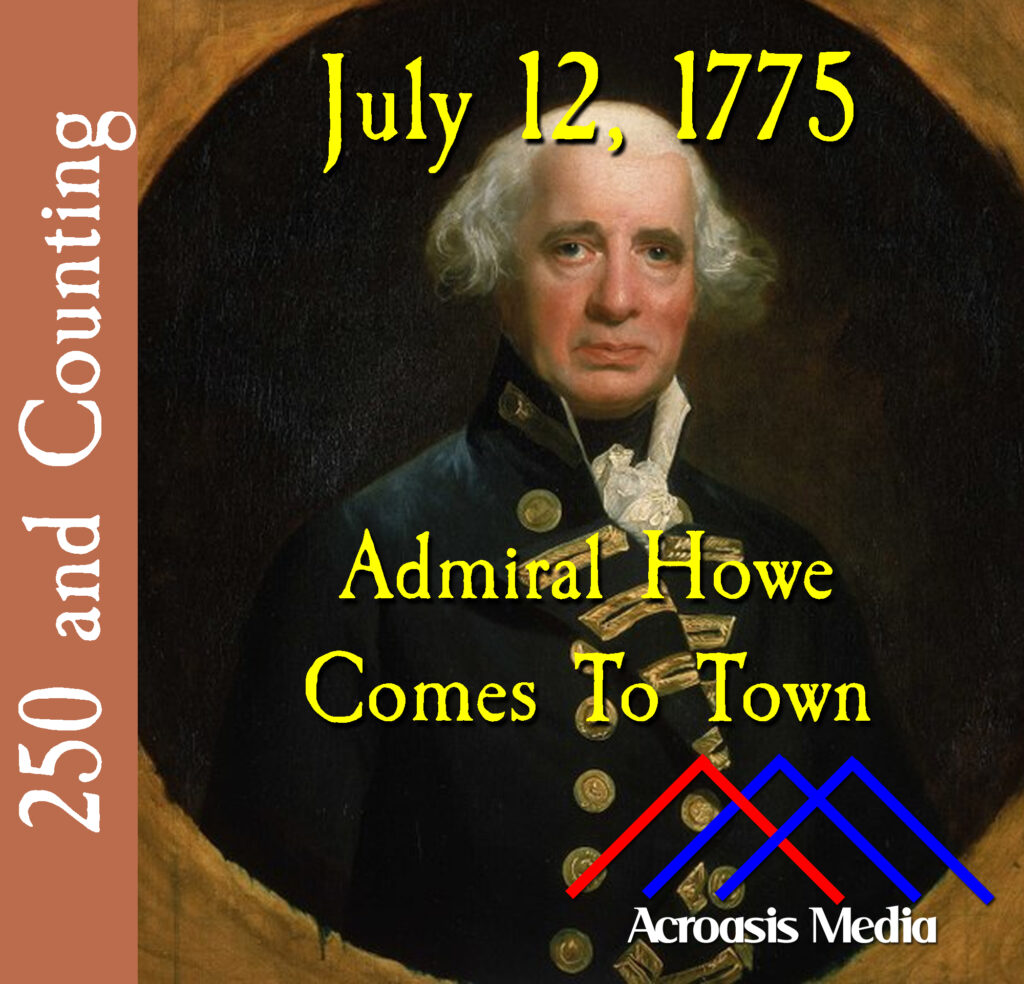
General Sir William Howe was already in Boston when his brother, Admiral Richard Howe, arrived. So, say what you will about Boston during the siege, but you can’t say there was a lack of no Howe.
Hi-yooooooooooooooooo! I apologize.
Richard’s biggest problem was that he was known to have been part of prior reconciliation efforts and therefore known to sympathize with the colonists. But even though he did his duty, he was sometimes short on materiel to get the job done, and as a result he took the blame for blockade failures. People thought he was deliberately letting blocked vessels through. But the fact was, he just didn’t have what he needed to do it properly.
For some reason, William didn’t catch quite the same level of ire, though he was also part of the reconciliation effort. He did catch plenty of blame as the revolutionary dust began to settle, though.
Oof, that’s a mouthful of title. Oh well, what’s done is done.
As noted in today’s episode, James Warren was not related to Joseph Warren. On the other hand, he is related to Mercy Otis Warren, because he’s her husband.
James and John Adams had a few ideas in common; the hard part was convincing a few others that they were in the right.
Meanwhile, did you know there’s another Long Island? That sort of thing really plays havoc with our research. This one is in the Boston Bay, and it’s a familiar story because something similar happened a few weeks ago. But tune in anyway.
Day Four of this thing and I’m still sounding kinda sexy. Or not, I have no idea.
A look through George Washington’s orders of each day gives us an interesting peek into his mind. This was a guy who definitely had his finger on the pulse of what was going on with his troops. But if there was something he didn’t know about, he also recognized that there were things he didn’t know, so he would endeavor to find out.
He was a strict commander; there are numerous accounts of his ordering courts martial for assorted men, with various punishments that we’d consider medieval today.
One of these was the “Wooden Horse.” As described by Francis Grose, in 1786, “The wooden horse was formed of planks nailed together, for as to form a sharp ridge or angle about eight or nine feet long; this ridge represented the back of the horse; it was supported by four polls or legs, about six or seven feet long, placed on a stand made movable by trucks [wheels]; to complete the resemblance, a head and tail were often added. When a soldier or soldiers were sentenced by a court-martial, or ordered by the commanding officer of the corps, to ride this horse… they were placed [on the plank] with their hands tied behind them, and frequently, to increase the punishment, had muskets tied to their legs, to prevent, as it was jocularly said, their horse from kicking them off…” (At right: a Spanish version of this device.)
Had enough? It was abandoned in the 1760s by the British because too many people had been permanently injured by it. However, its use persisted in the Colonies for another few years. Then it returned during the Civil War before being left behind permanently.
As you’ll hear today, I have a huge sinus infection and it took a lot of effort to get today’s episode recorded, so I hope you’ll excuse this part being rather brief.
John and Abigail Adams was probably one of the best documented relationships of the Colonial Era, and it’s a ridiculously touching love story. It’s clear that they hated being apart, and you’d do well to watch the HBO/Max miniseries about him.
In future episodes we’ll have to dedicate some portion to the literal language between the two. In the meantime, enjoy my Barry White impression.