There are plenty of scholarly books and articles out there regarding American History, but there are elements of British history that stick out, too. General Gage giving the order today that his troops begin to march on Roxbury. It was a relatively small gesture at the time, but many, many colonial events can be traced to that particular action.
And as a result the Colonists determined that Britain can’t move numbers of men like that again without bumping into a few flintlocks along the way.
One of the interesting things about many of the British officials who were around during the early days of the American Revolution is that most of them were actually pretty good at their job. It’s just that they were given rather thankless tasks to do which wound up backfiring on them.
And then there’s John Murray, the Fourth Earl of Dunmore. History has not been especially kind to Lord Dunmore, not should it be. He often acted rashly and without consulting some of the people he should have consulted, and in the end he wound up getting a lot of people very angry, instead of getting a few people a little annoyed.
Lord North, over in London, is often defined as the Prime Minister who lost the Colonies, but Dunmore clearly did his part to ensure that they stayed lost regardless of the outcome. And today in history, Lord Dunmore issued a proclamation against electing delegates to the Second Continental Congress, but the Second Virginia Convention, by now in its last day or so, ignored him and sent people anyway. (They’d already elected a couple, so Dunmore’s proclamation was a little bit of closing the barn after the horse had escaped.)
We’ve spent a lot of time talking about events in Virginia lately, but that doesn’t mean that the folks in Massachusetts weren’t getting things done. It just means that they weren’t making a big deal about it.
For the past several weeks, they’d been working on the down-low to make plans in case the British took any action that they might find too intrusive, from simple confiscations to an all-out shooting offense. (Of course that was still on the table; nobody had forgotten the Boston Massacre.)
It wasn’t until this day in history that they made their resolution publicly known. And in the wake of Patrick Henry’s very recent proclamation, nobody would be surprised if things escalated sooner rather than later.
Benjamin Franklin was pretty good at diplomacy, but even when given several years to try, he was unable to bring about peace between England and the Thirteen Colonies.
From December 1774 through February 1775, he and some of his British friends tried to put together a map to peace, but unfortunately both sides were too entrenched to even consider compromise. Franklin finally went home on this day in 1775, but he left one final impression that we’ll learn about tomorrow.
The people in Virginia were getting pretty upset about what was going on between the Colonies and the British Parliament. They called a convention and, as we’ve noted over the past several days, each county sent delegates with specific instructions, many of which recommended that the colony commit itself to resisting the British and supporting any efforts made by other American entities in that respect.
The Second Virginia Convention finally met on this day in 1775, and they elected Peyton Randolph as its president. This was no surprise to anyone, as Randolph had been the president of the First Virginia Convention, and of the First Continental Congress.
Randolph was also briefly the president of the Second Continental Congress but had to return to Virginia and was replaced by John Hancock. Shortly thereafter he had a fit of apoplexy (what we now call a hemorrhagic stroke) and died in October 1775.
So even though he didn’t live to learn of the signing of the Declaration of Independence, Randolph is frequently considered to be one of our Founding Fathers.
Among the casualties of the early days of American History are all the friendships that were damaged by people being on opposite sides of the political fence. Good thing we’re all past that sort of petty nonsense nowadays, amirite?
Sigh.
We’ve talked in the past about John Adams and his former friend Daniel Leonard, who sparred in print under pen names and never quite repaired their relationship. Today we talk about Benjamin Franklin and Edmund Burke, a member of the British Parliament who was good friends with Franklin, though perhaps not publicly. Today marks the likely last day that the two men ever saw each other, as Franklin was on the final trip to England of his lifetime. Sadder still, Burke was actually sympathetic to the Colonist cause, though he wasn’t entirely convinced that they’d win a war.
On the other hand, hardly anyone was convinced that Britain would be defeated, so there’s that.
Over the last few days we’ve heard from several counties in Virginia sending delegates and instructions to the Second Virginia Convention, which would meet in another few days. Many of these counties published their instructions, called “Resolves,” in newspapers, so that anyone who was literate would know where the freeholders of those counties stood.
And today it’s Augusta County which weighed in by publishing their Resolves in the Virginia Gazette. Augusta County is quite close to both Fincastle and Botetourt counties, at what is now the western edge of the state. And we have to think that it’s meaningful that these communities, which were relatively far from where anything meaningful was taking place, was taking notice of those events and acting proactively, when only a few weeks earlier they would have been indifferent to it, because after all, it didn’t really affect them. Not yet, anyway.
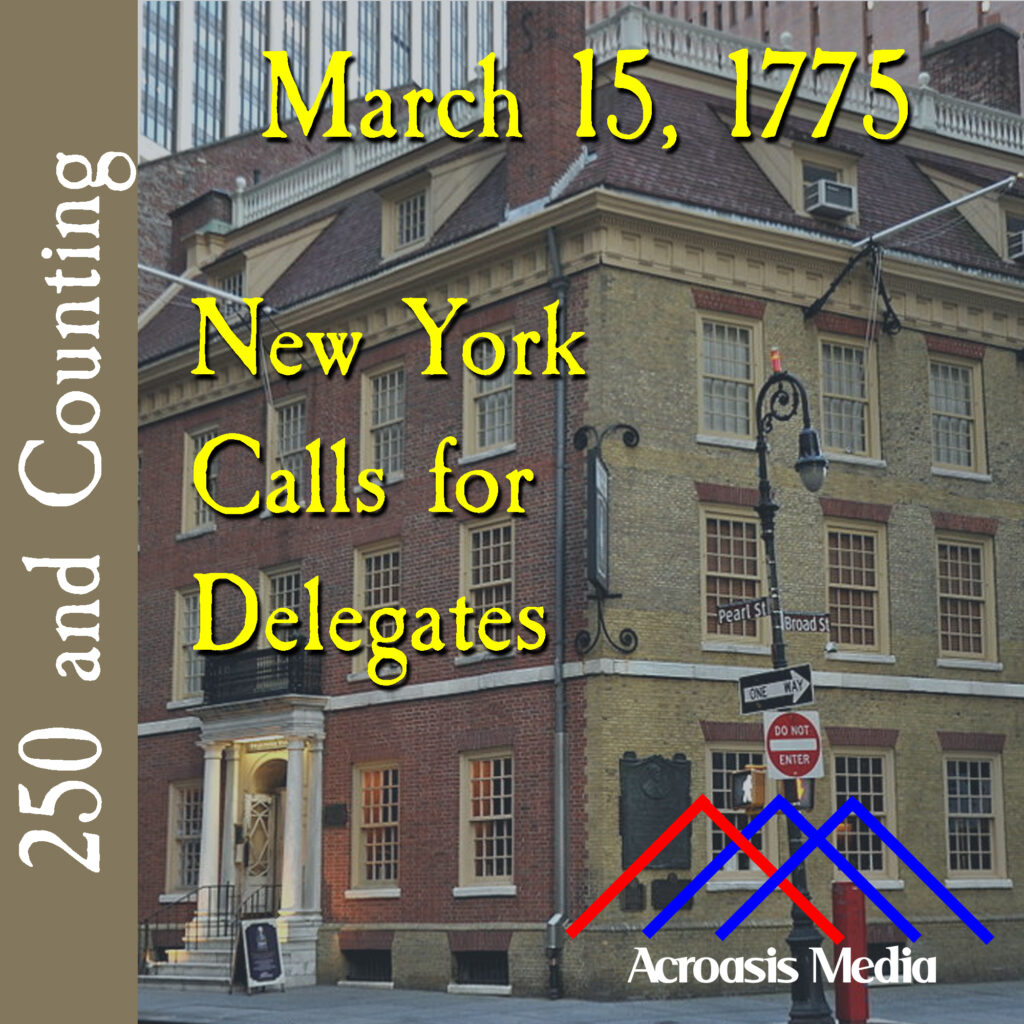
The New York colony gets a bad reputation for not having its act together when it came to American Independence, but the fact is, they were late to the party because they held on to their loyalty to the Crown until there was clearly no more reason to do so. Simply put, they were the last holdout.
What makes this extra remarkable is that most of the residents of New York really had no reason to be loyal to King George III, since they weren’t English-born, nor were they the descendants of Englishmen. Instead, most of them were descended from Dutch settlers from over a hundred years earlier.
But eventually they did come around, and when they did they showed an ability to snap into action quickly.
John Murray, the Fourth Earl of Dunmore, or more commonly Lord Dunmore, came to the Colonies in 1770 to become the Royal Governor of New York, but fate intervened and he wound up as the Royal Governor of Virginia instead.
He might have fared better in New York, but given the events of the Westminster Massacre you learned about yesterday, we’re not sure it would have made much difference. Dunmore wasn’t an especially good politician in general, and he didn’t hold the Colonists in an especially high esteem. And that’s the sort of thing that A) isn’t easily concealed, and B) doesn’t always go over well with your constituents. Not always.
[NOTE: our apologies for those who came early and got the wrong file. We hope at least that you enjoyed the re-run. The correct file is now in place. –CC]
Topsfield, Massachusetts wanted to be prepared when the British came. What’s more, they wanted to ensure that their militiamen were drilled and fully outfitted should the need arise. To that end, they offered some of the best wages for their Minutemen.
But they had some trouble recruiting at first, until the town’s selectmen decided that their initial force wasn’t nearly formidable enough.