Category: American Revolution

  • To Stay, Or Not To Stay?–September 12, 1776

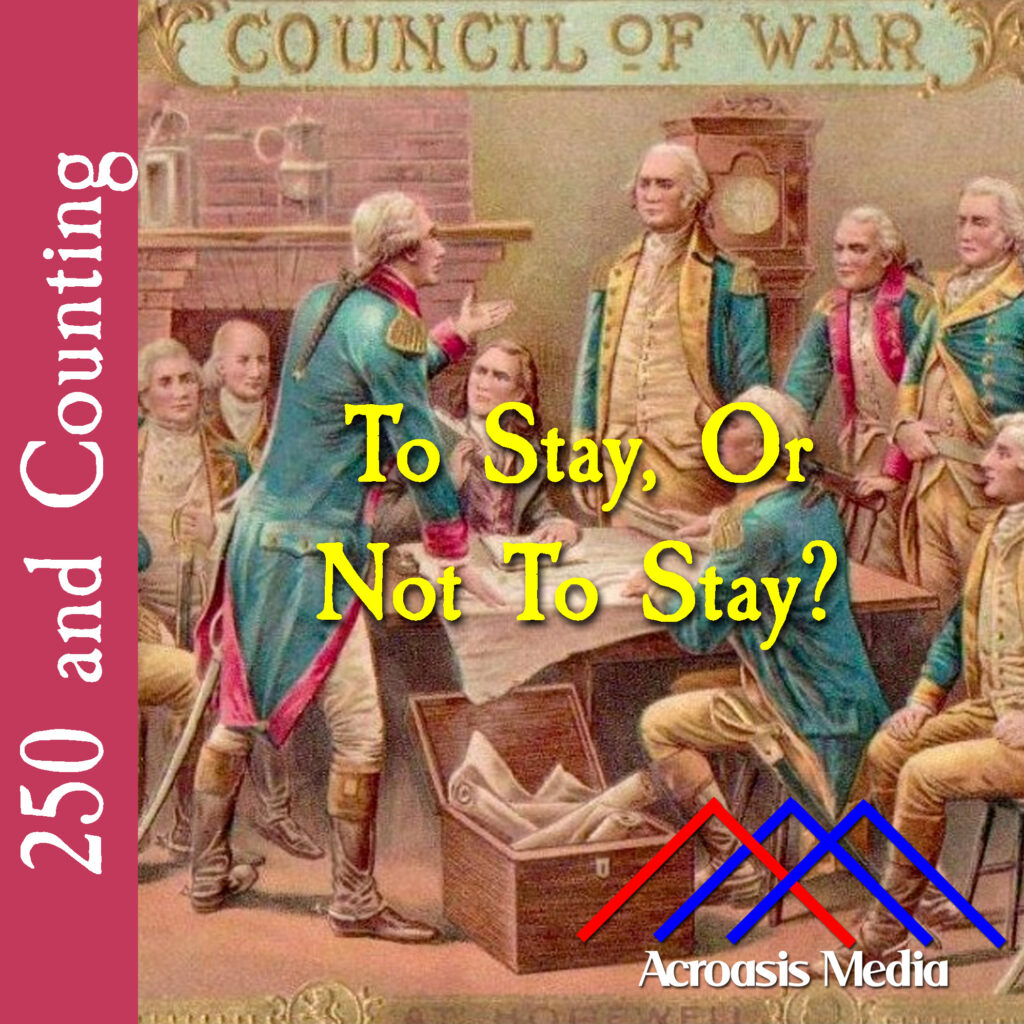
    Cover art for September 12, 1776: "Washington's Council of War at Hopewell," James Edward Kelly, 1884. Cigar Box inner label based on a relief sculpture.

    George Washington’s Council of War finally got to meet on this day in 1776, to figure out what happens next.

    The Battle of Long Island was a rout for several reasons. In addition to the Continental Army being outnumbered by roughly two-to-one, there was poor communication and a couple of tactical errors. And the only reason more soldiers weren’t captured or killed was because poor weather prevented the British from figuring out that they were escaping across the East River until it was far too late.

    So, as any good soldier would, Washington took a moment out to seek advice from his Council of War. Nathanael Greene recommended just getting out of town and regrouping elsewhere, but he also suggested burning the city down to keep it out of British hands. Washington already knew that Congress didn’t like the burning thing.

    Most of Washington’s council recommended leaving the city, but Washington still wanted to ensure that some portions of the city were fortified and made appropriate plans. Unfortunately those plans fell apart rather quickly, as we’ll soon learn.

  • The Staten Island Peace Conference–September 11, 1776

    Cover art for September 11, 1`776: The Billop House on Staten Island, where the aborted peace conference took place. Via Wikimedia Commons.

    The Staten Island Peace Conference was a bust almost from the beginning. Not because the sides were so opposed, but because one side didn’t have the authority to do any real negotiation.

    John Adams, Edward Rutledge and Benjamin Franklin had to row over from Perth Amboy, New Jersey to get to the Totten House, which is near the southernmost tip of New York State, on Staten Island. At the narrowest point I could find from the vicinity of the house, that’s nearly a half-mile across the mouth of the Arthur Kill River where it opens into Raritan Bay and ultimately the Atlantic Ocean.

    Unfortunately, Admiral Howe was so limited from a diplomatic standpoint that there wasn’t a lot he could do at that point, so after a few hours they broke up and the delegation was allowed to return to New Jersey. The war would continue for another severn years before concluding.

    In retrospect, we have multiple attempts for Admiral Howe to meet with George Washington, which failed on the basis of protocol (Howe wouldn’t refer to Washington as a General), so now we have to wonder what direction negotiations would have gone had one of those attempts succeeded. Would things be different, or would it wind up the same, and the events of today be obviated? If a meeting in July had ended in no agreement, would John Sullivan even have been paroled to go to Philadelphia and present the plan?

    I’ll leave that for you to chew on. In the meantime I’m still sounding pretty sultry, so enjoy that.

  • More Bad News–September 10, 1776

    Cover art for September 10, 1776: portrait of William Heath, artist and creation date unknown, via New York Public Library print collection.

    General William Heath was around for the battle at Lexington and Concord, but you may remember him from our episode from just a few days ago.

    He was already a Brigadier General in Massachusetts before Lexington & Concord, and as the siege in Boston started, he worked at training the troops. When the Continental Army officially formed, he retained his title and was promoted to Major General in August 1776.

    Unfortunately (as Mike notes), George Washington didn’t think much of him and kept him largely sidelined. And the one time Washington did ask him to do something important, it didn’t go well at all.

  • Nathan Hale’s Fateful Decision–September 8, 1776

    Cover art for September 8, 1776: Statue of Nathan Hale at the Tribune Tower in Chicago by Bela Pratt. This statue is probably the model for two postage stamps issued in the 1910s. via Wikimedia Commons.

    There are lots of images of Nathan Hale that have him looking like a middle-aged fellow, and then there are others that have him looking like some kind of idealized young man, with a prominent jaw and youthful good looks.

    The fact is, nobody today is 100% sure what he looked like, because no contemporaneous images of him have been found. The best we have is a description written by a fellow soldier of his, Lieutenant Elisha Bostwick. Bostwick wrote:

    I can now in imagination see his person & hear his voice—his person I should say was a little above the common stature in height, his shoulders of a moderate breadth, his limbs strait & very plump: regular features—very fair skin—blue eyes—flaxen or very light hair which was always kept short—his eyebrows a shade darker than his hair & his voice rather sharp or piercing—his bodily agility was remarkable. I have seen him follow a football and kick it over the tops of the trees in the Bowery at New York, (an exercise which he was fond of)—his mental powers seemed to be above the common sort—his mind of a sedate and sober cast, & he was undoubtedly Pious; for it was remark’d that when any of the soldiers of his company were sick he always visited them & usually Prayed for & with them in their sickness.

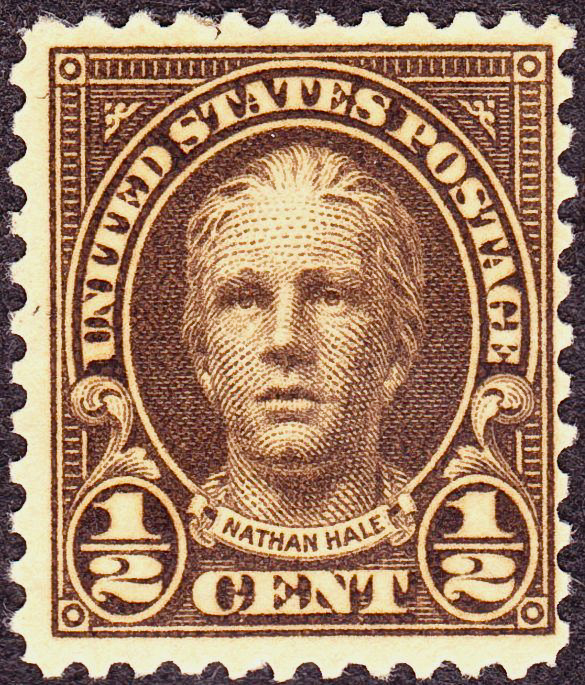
    Hale was twenty-one years old in 1776, so the images of him as an older man are almost certainly incorrect. The statue used in today’s cover art is one of several copies cast in 1912 from a sculpture by Bela Pratt. (Baltimoreans note: Bela Pratt was a distant cousin of Enoch Pratt, the man who founded the city’s libraries.) In addition, Pratt’s sculpture was the model for two postage stamps issued in 1925 and 1929.

    We know nowadays that Hale’s efforts to infiltrate the British didn’t work out very well, and Mike and I will return to his story in a few days to tell you specifically how it shook out, and a long-standing controversy over his last words—what did he say, and how did he say it?

  • All Under Heaven Is Chaos–September 7, 1776

    Cover art for September 7, 1776: Cutaway diagram of the Turtle, drawn by Lt.C. Francis M. Barber of the US Navy in 1875. via Library of Congress.

    …but the situation was not excellent, for the American side, anyway.

    George Washington got a wake-up call in the form of a letter from Congress. In that letter he was told that it was not a good idea to burn down New York City; what’s more, they weren’t quite so invested in his holding the City as he thought they were. This was a good news/bad news situation for him, since he knew that strategically, the British occupying New York had the potential to be a huge problem, especially if they were able to take the entire Hudson Valley.

    But even if they didn’t, having one of our biggest and busiest ports was going to create a lot of headaches, regardless of what was supposed to be moving in or out of the city.

    Meanwhile, we have Ezra Lee making his first attempt at genuinely deploying the Turtle submersible. The currents plus the darkness made maneuvering very difficult, and while he did get close enough to Admiral Howe’s ship to stick the explosive charge to it, the spear he used couldn’t penetrate the hull enough to stick. In recent years it’s thought that he tried to pierce the hull near the rudder, which had an iron plate on it; another theory involved the recent use of copper on ships’ bottoms, but this copper was quite thin and would have been easily pierced.

    Lee made one more attempt with the Turtle, on October 6, but that try also failed. The Turtle was lost less than a week later when the sloop serving as her tender was sunk by British ships. Who knows? Maybe there are still pieces of her in the Hudson River.

  • More Brooklyn Aftermath–September 5, 1776

    Cover art for September 5, 1776: The Capture of Nathaniel Woodhull, John Ward Dunsmore, 1910. via New York Historical Society.

    The American Army has evacuated Brooklyn. Reports are coming in from all over that the Loyalists are being rather sore winners over the event. Refugees are coming into Connecticut from across the Long Island Sound. George Washington, literally the last man out of Brooklyn, is trying to figure out his next move, and that of the British.

    Nathanael Greene, who missed the Battle of Long Island because he’d been seriously ill, finally returns to duty. At last, some good news for General Washington! And maybe some sage advice regarding what should be done next to preserve New York City!

    And Greene tells him to get out of town. There’s no way that you can hold a place like New York City if you can’t control the shoreline across the East River, no more than a few hundred feet away.

    Washington doesn’t think this is a good idea, partially because he thinks New York is more important to the Continental Congress than it actually is. But Greene has another idea, which we’ll get into in a couple of days.

  • Down By The Bay–September 3, 1776

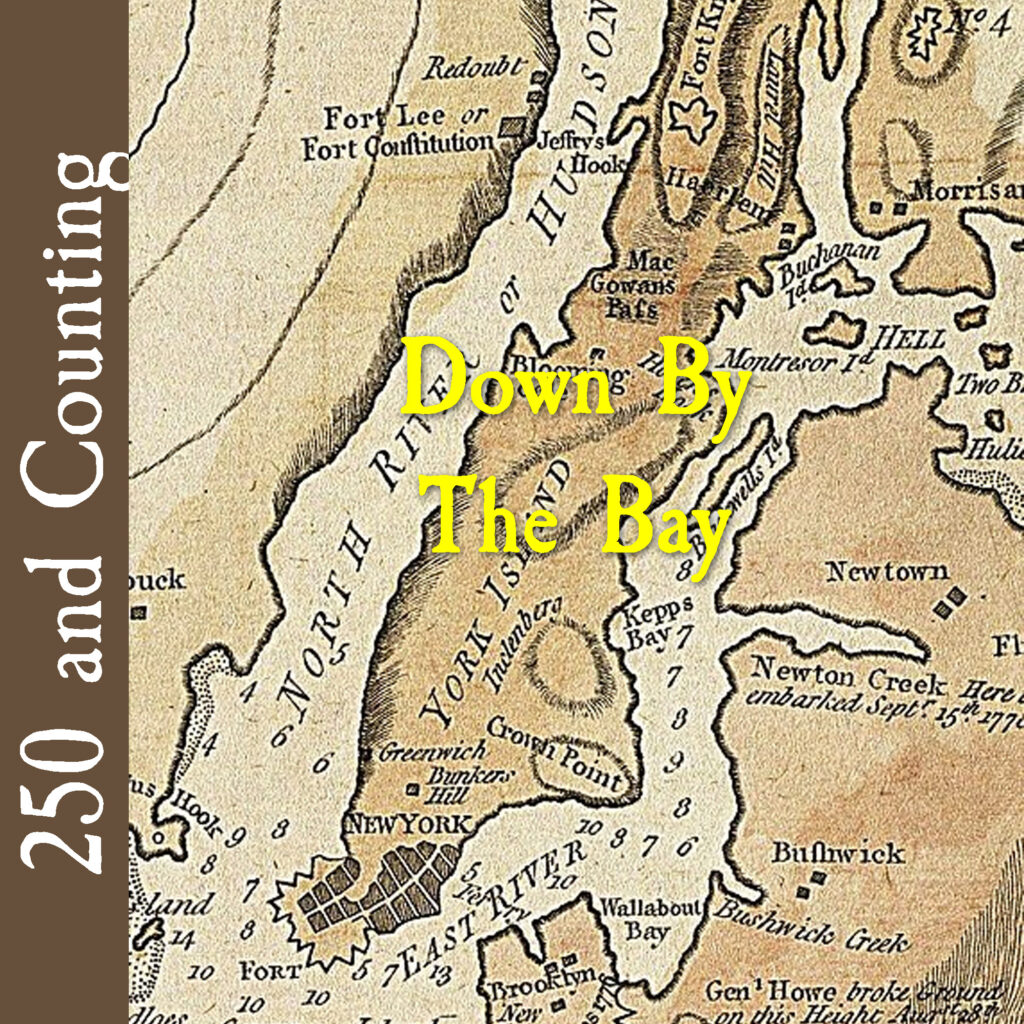
    Cover art for September 3, 1776: A 1781 British map of Manhattan; Kip's Bay is labeled as "Kepps Bay". via Boston Public Library.

    The HMS Rose was a British ship that we first discussed a little over a year ago. Her job was largely to patrol the waters off southern New England to prevent smuggling activity on the part of the Americans.

    In July 1776 the Rose was dispatched—like many, many other British ships—to New York Harbor for the invasion of Long Island and, later, New York City. And today we look at some of her activity in the East River.

    For those of you who know the area at all, the Kip’s Bay neighborhood is where the Midtown Tunnel opens at the Manhattan end; presumably it was an especially good place to do this because unlike much of Manhattan, the land that needed digging up wasn’t solid bedrock; it was a combination of wetland and fill material from construction projects. In fact, for a while there was a cement factory nearby and a lot of their castoffs were thrown in there. Cement is tough but it’s easier to get through than bedrock, especially when it’s not one big solid chunk.

    At any rate, this move on the part of the Rose was just the beginning to what became known as the Battle of Kip’s Bay. So we’ll be coming back to this place a couple of times in the near future.

    Not long after this action, the Rose moved down to the Chesapeake Bay and then to Georgia, where she was eventually deemed unfit for service and scuttled in the Savannah River, making ship passage impossible until the war’s end.

  • A British Offer–September 2, 1776

    Cover art for September 2, 1776: portrait of John Sullivan at age 34 in 1774. Painted by Richard Morell Staig circa 1876, based on a mezzotint print from 1776.

    General John Sullivan had been captured only a few days before by the British, during the Battle of Long Island.

    Now, Mike tells us in this episode that the Howes talked him into approaching the Continental Congress with their peace offering, but equally likely is that Sullivan simply agreed to deliver the message because it would get him out of captivity, at least for a while. (He was paroled specifically to deliver the message. Once he had his answer, it was “Back to jail with you, Johnny.”)

    Part of the problem Sullivan had was that Congress didn’t think the offer was sincere; another part is that some members didn’t think Sullivan was sincere. Sullivan returned to the British, delivered the reply from Congress, and was re-imprisoned for another few months, until he was returned in a prisoner exchange.

    So we haven’t heard the last of John Sullivan!

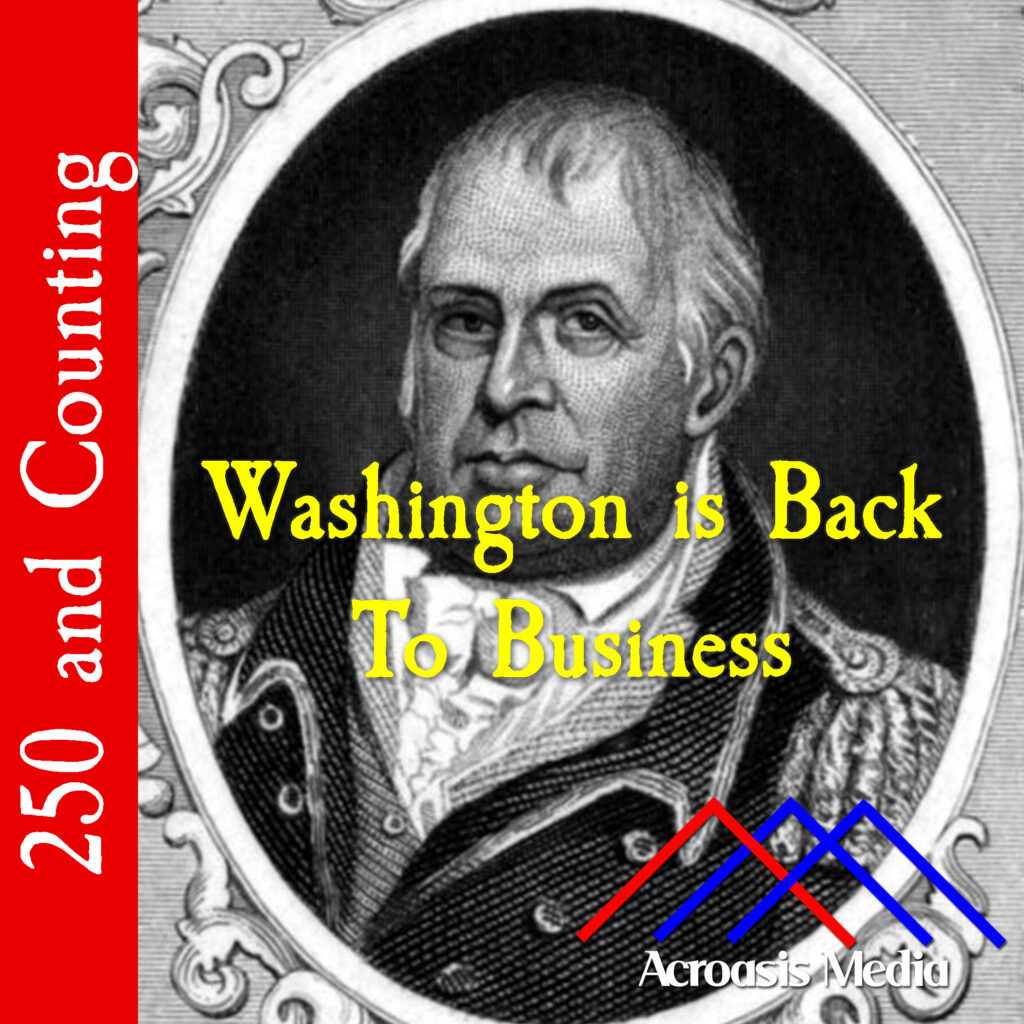
  • Washington Is Back To Business–August 31, 1776

    Cover art for August 31, 1776: General William Heath. Artist and date unknown. via New York Public Library.

    Washington wrote two letters today: one to General William Heath, and the other to Congress.

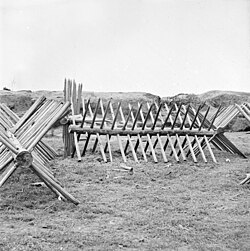
    To Heath, he basically gave a little bit of an “attaboy” in agreeing with Heath’s assessment regarding the British Army’s next move. So he recommended that chevaux de frise be sunk in the waters nearby the next likely target (Huntspoint), to thwart the British ships moving in. Other than that, some reinforcements are on their way, so until the British arrive, just hurry up and wait.

    Now, a cheval de frise (“chevaux” is plural) was tough for me to explain during the show, but picture a sawhorse with long spikes protruding from it. That’s a basic cheval de frise. (The one in the picture is from the Civil War.) But they’re not limited to this specific design; some stone walls had broken glass, or sharp rocks embedded in their tops to make it tougher to climb over them; those are also considered to be a cheval de frise. The ones that Heath were expected to sink in the East River looked more like boxes with angled spears pointed in the direction the ships were likely to be coming from.

    Washington’s other letter, to the Continental Congress, wasn’t so much to inform them of his loss on Long Island as it was to assure them that he was alive and well, and that most of his troops had gotten away despite the magnitude of the loss. It would be several months before Washington could truly notch one in the “Win” column against the British.

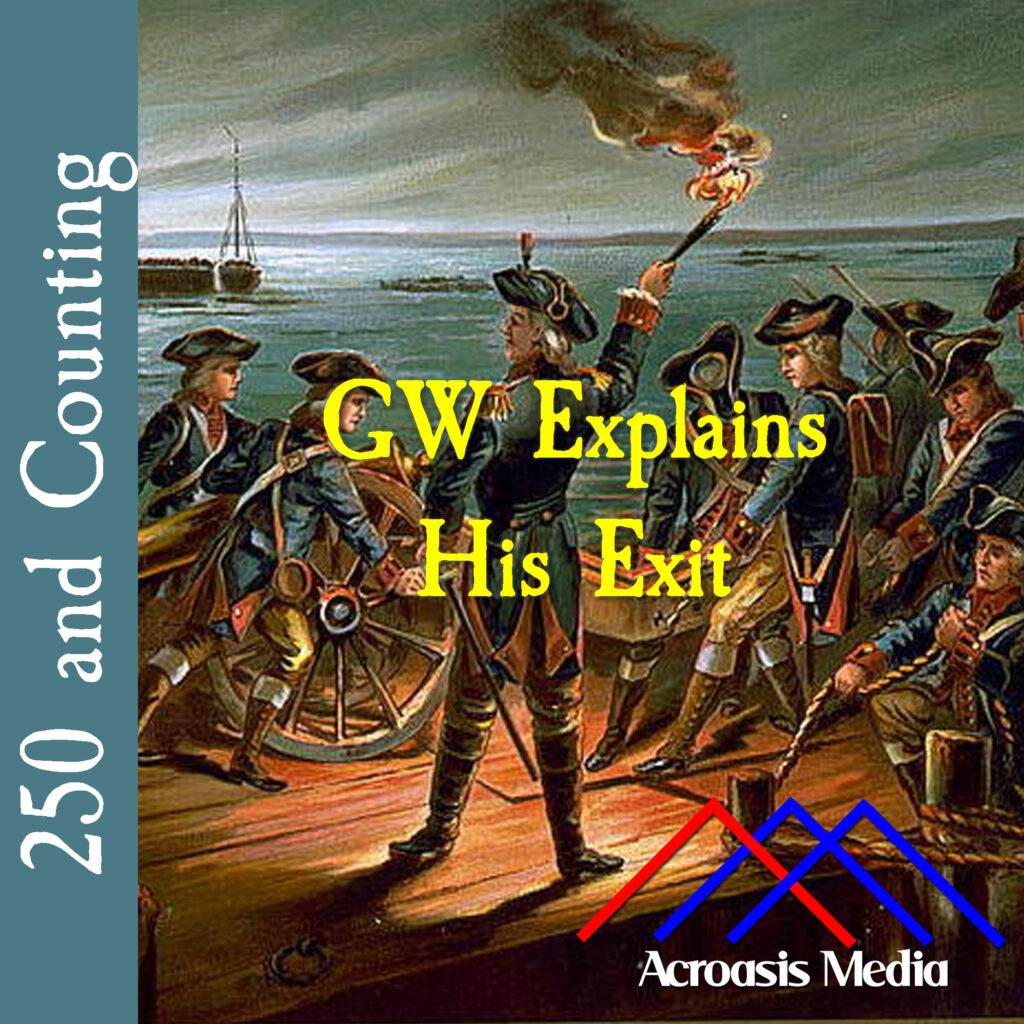
  • GW Explains His Exit–August 30, 1776

    Cover art for August 30, 1776: "US Army--Artillery Retreat from Long Island 1776, an 1899 portrait from the Werner Company of Akron, Ohio.

    Even though George Washington was in charge of the whole Continental Army, he still had people to answer to. Most directly that would be the Continental Congress and that will happen very soon, but in the meantime there were also some local officials he had to placate.

    Which brings us to today’s episode, in which Washington wrote to the New York Convention, which was the name at that time for the body of state’s representatives. He’d kept them up to date on everything that was going on so far, so it only made sense that he’d send them another note to let them know why the troops had bailed on Brooklyn. There were lots of good reasons, but the one he didn’t write about was the fact that his army was getting shellacked and it was either get killed outright, or run away to fight another day.