Category: US History

  • Thomas Jefferson’s Origin Story–May 14, 1776

    Cover art for May 14, 1776: Portrait of Thomas Jefferson in 1791, by Charles Willson Peale. Now hanging in Independence Hall.

    Thomas Jefferson gets most of the credit for writing the Declaration of Independence, but Thomas Jefferson’s background clearly informed his writing of that document. That’s what Mike talks about in today’s episode.

    In this space I’d like to tell you a little about Declaration House. The building was newly erected at the time Jefferson rented out a room from its builder, a bricklayer named Jacob Graff (which is why it was originally called the Graff House, go figure).

    Jefferson lived in the space with his 14-year-old enslaved valet, Robert Hemmings. Between 1776 and 1883, the house underwent several remodelings until it was finally torn down. It was reconstructed in 1975 by the National Park Service, and when it’s open, it has some museum exhibits on the first floor along with a short film about the drafting of the Declaration. The second floor is a reproduction of the space Jefferson used, containing period furnishings.

    As this is published, the site has been closed to the public since 2025 as part of a comprehensive rehabilitation project.

  • America Benefits From French Politics–May 12, 1776

    Cover art for May 12, 1776: Charles Gravier, comte de Vergennes by the French artist Antoine-François Callet, 1780.

    Charles Gravier, comte de Vergennes, was France’s Foreign Minister from 1774 to 1787 during Louis XVI’s reign.

    France was still salty about having lost the Seven Years’ War. On this side of the pond we refer to it as the French and Indian War, but this was a global affair that took place mostly in Europe. France and Austria took on Great Britain and Prussia, and a few other nations joined in with the coalitions. Winston Churchill once called it the “First World War” because so many nations were in conflict on four different continents, and he’s not wrong in the bigger picture.

    At any rate, Charles Gravier (more properly referred to as “Vergennes”) hoped that by helping the Americans, he could weaken British dominance on the global stage. (You may remember we talked about this ten days ago.) In the end it turned out to be a mixed bag: while the Americans eventually were successful in their attempt to break away from Britain, France didn’t get a lot out of it by the time the dust settled, and the French finances (which were already weakened) were further damaged. And then, of course, the French people took the hint from America and had themselves a French Revolution.

  • Cornwallis Arrives In Halifax, NC–May 11, 1776

    Cover art for May 11, 1776: The ruins of The Grove, the house where Mary Montfort Jones lived at the time of Cornwallis' occupation. The photo was published in 1912.

    Ugh. Before I tell you any more about The Grove, I have to take care of a couple of corrections.

    If you’ve listened to the episode already, you might be a little confused about Mike telling you that you’d be in Nova Scotia. Obviously he got his Halifaxes crossed.

    Second, after I’d completed today’s episode and finished all the post-production stuff, I discovered that Willie Jones’ first name isn’t pronounced the way I thought it was. While most people would make the same error I did and say it as “Will-E”, it’s actually pronounced “Wylie”. A reasonable mistake but I should have paid closer attention. I did see one place where it was spelled “Wyley” but didn’t make the connection. mea culpa.

    And yes, I do have a little more information about The Grove. A few years earlier, a young man named John Paul, who had recently turned up in America after having fled Scotland, spent some time at The Grove as a guest of the Jones family. Shortly thereafter he was granted some land in Frederick County, Virginia. At around this time, John Paul began appending “Jones” to his name, apparently in honor of Willie.

    And, of course, shortly thereafter he became a lieutenant in the newly-minted Continental Navy.

  • Change Comes From Within–May 10, 1776

    Cover art for May 10, 1776: Portrait of Richard Henry Lee (cropped) by Charles Willson Peale, ca. 1795-1805. via National Portrait Gallery.

    You may remember a couple of the Colonies chose to endorse independence without necessarily declaring it. This suggested that a formal declaration from the Colonies as a whole was likely imminent.

    You may also remember that motions by the Second Continental Congress needed to be voted on unanimously in order to pass, so they could “speak as one voice.”

    To that end, the Congress recommended today that Colonies with a government that wasn’t in favor of independence, form a new government that would be more likely to endorse independence. It’s not entirely clear how they expected the individual Colonies to effect this recommendation, but before long it wouldn’t be difficult at all.

  • Words From Ward–May 9, 1776

    Cover art for May 9, 1776: Statue of Artemas Ward that stands in Washington DC, just a few blocks northwest of the National Cathedral.

    Artemas Ward was the man left in charge of things when Washington made his trek to New York, so you know that this was a man that Washington trusted. As a result they corresponded with one another frequently.

    So it only makes sense that once in a while, the two would write to one another on the same day, and this was one of those days. Washington wrote to Ward his concern that the British would return to Boston and therefore the city should be fortified to protect against such an event, and Ward wrote to Washington about a pair of ships that had been captured in the Bay just a couple of days earlier.

    In an astonishing coincidence that would stun even Robert Ripley, Abigail Adams’ letter to John Adams from May 7 addresses both of these issues.

    For what it’s worth: Ward Circle, where the statue from today’s cover art is located, is in the middle of a peculiar looking traffic circle on Massachusetts Ave NW. There are no pedestrian crossings that will get you close to it, so if you do choose to make that particular pilgrimage, stop off at the National Cathedral first and ask for divine intervention, ’cause the traffic can easily make that a nightmare to cross.

  • Abigail, On Power–May 7, 1776

    Cover art for May 7, 1776: portrait of Abigail Adams, 1764, by Benjamin Blyth. Photographed by Claude Call at the Massachusetts Historical Society.

    Abigail Adams had some thoughts when it came to arbitrary power, and how fragile it is.

    But you get all that from the episode itself. Instead, here in the show notes, I’m going to point out that I’m the one who took the photo used for today’s cover art.

    The painting hangs at the Massachusetts Historical Society, and because they keep it relatively dim there, you can see the reflection of the stairwell leading down to the main entrance. The white spot over Abigail’s head is the reflection of a light across the gallery, which is maybe 15 feet across. I’m standing at a slight angle so I’m not part of the reflection. (It’s also partially cropped here; I’m not that bad a photographer.)

    The painting was donated to the Society by one of John and Abigail’s descendants, who is coincidentally also named John. The docent I spoke with didn’t know whether there was a family tradition of naming sons “John” as homage to our Founding Father, but he conceded it’s certainly likely.

    The letter cited in today’s episode is part of the MHS collection, though it wasn’t on display the day Mike and I visited. MHS has literally thousands of Adams Family documents, and there are people there who work only with those documents. That’s their only job!

  • Valentine Efner–May 5, 1776

    Cover art for May 5, 1776: a cropped photo of the old Blenheim Covered Bridge, spanning Schoharie Creek, River Road. Photo by Jet Lowe and available via the Library of Congress.

    Given the fact that Valentine Efner (sometimes spelled “Effner”) skipped so many roll call votes in Congress, it’s a wonder he ran for Representative in the first place.

    We have to think that Efner was an informal kind of representative, and being in the rarefied air of Congress had him missing the farm life, to which he returned immediately after his term of office had ended.

    PS Pardon the brief notes, we had a veterinary emergency here that ate up most of my night. Fortunately our dog is well.

  • Rhode Island Goes First–May 4, 1776

    May 4th is Rhode Island Independence Day, marking the date that one of our smallest states became the first of the Original Thirteen Colonies to declare its independence from Great Britain.

    Almost.

    Here—as the late, great Paul Harvey would say—is the rest of the story.

    All of the colonies were required to sign oaths of allegiance to King George III, or whoever was in charge at the time. On May 4, 1776, the Rhode Island Assembly passed the Act of Renunciation, which repealed that oath. They didn’t formally declare independence; that didn’t happen until mid-July, when they approved the Declaration as written by Thomas Jefferson and his fellow delegates.

    If you look closely at the cover art, you can see that there’s some material on the Renunciation that was X’ed out. Those are some accusations against the Crown that the Assembly apparently thought better of. I guess it wasn’t worth getting a new sheet of paper, then; they’d fix it in engrossing or at the printer’s.

  • Washington Cracks Down–May 3, 1776

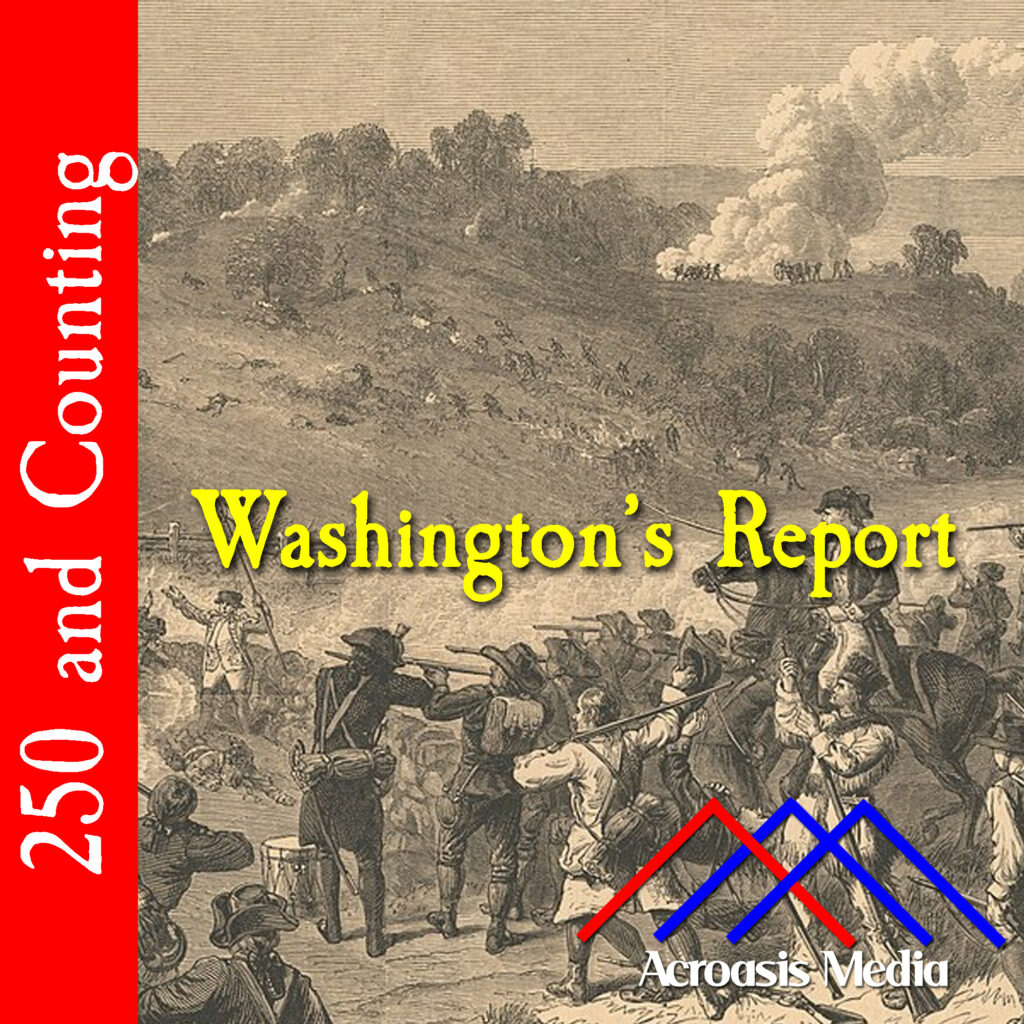
    George Washington was good at what he did because he’d studied military discipline, among other things. He read a lot about tactics and famous battles, and the importance of a well-trained army, and then he would meet with veterans and engage with them to learn what they thought.

    During the Seven Years’ War he asked to use some of those techniques with the men under his command. Sometimes, but by no means all the time, was he able to enact some of his ideas.

    So when Washington took over the Continental Army in July of 1775, he had some ideas about what that army should look like. And he had generally good counsel coming from other people who’d been through much of the same things as him.

    But the problem was that the recruits of the early days of the Revolution weren’t committed to anything more than a single year. They didn’t get much time to learn the things they should have, and as a result they left before they could learn everything they should have, or they did learn what was needed and left anyway. And those who were left behind were still pretty new, and had little sense of military discipline.

    So Washington decided he needed to get a little tougher.

  • Help From Abroad–May 2, 1776

    Cover art for May 2, 1776: King Louis XVI, Roi de France et de Navarre by Antoine-François Callet, 1779.

    We’ve noted before that France had been helping the United Colonies for a little while, using gray markets and go-betweens in order to give themselves some plausible deniability. Britain and Spain were both a little salty about having been beaten by Britain in the past, so they were only too happy to have somebody else fighting them while they stood by and watched. And in the long run it didn’t cost them much to provide materials to the Colonies to help them get the job done.

    But while both nations committed money and supplies to the cause, it was at least another year before either of them would formally announce an alliance. This was more like an eighteenth century version of the Lend Lease Act that allowed us to arm Allied Powers in World War 2 before Pearl Harbor.