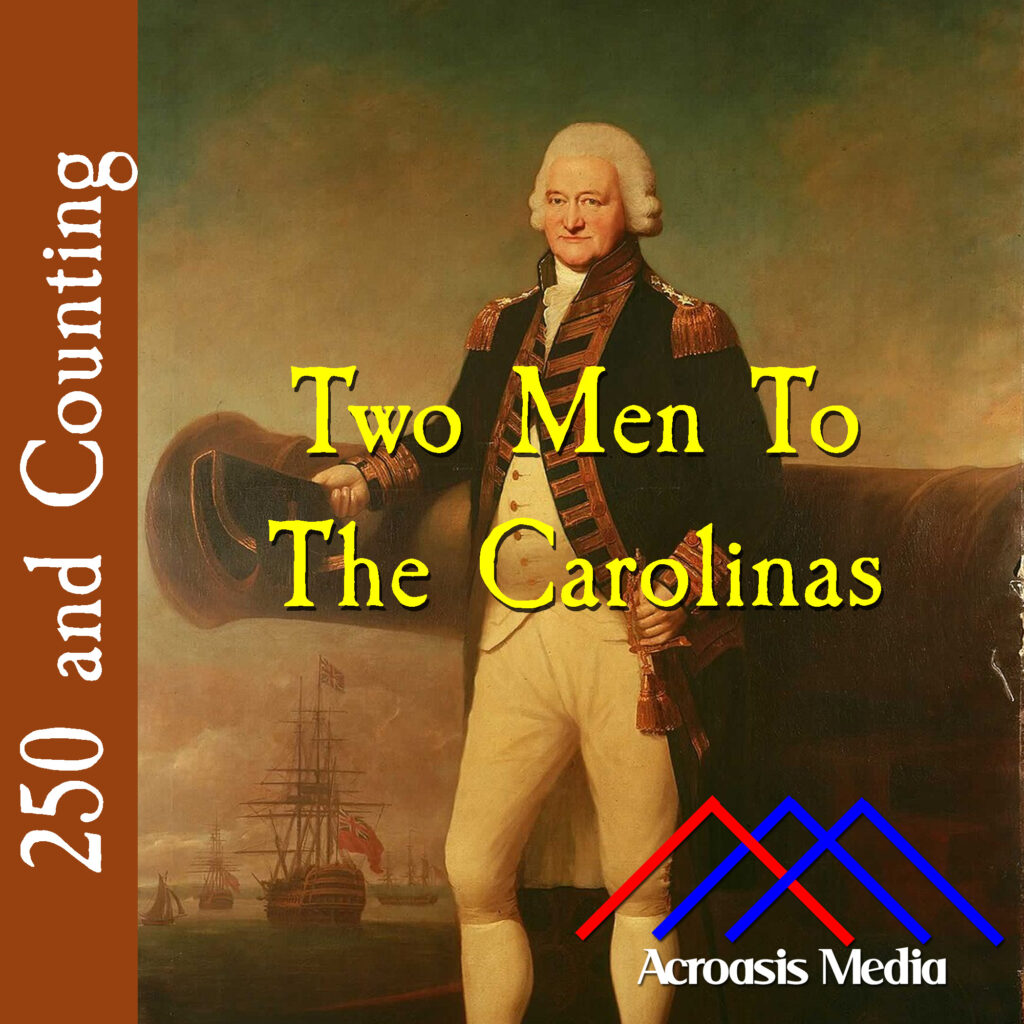
This day in American History, 250 years ago.

  • Thomas Jefferson Has Bad News–November 29, 1775

    Cover art for November 29, 1775: portrait of Thomas Jefferson by Mather Brown, 1786.

    Thomas Jefferson wasn’t as prolific with the letters as John Adams was with his own wife (over ten thousand letters between them during the course of the Revolution!), nor as much as George Washington, but he was still a deep thinker and he did write well and with purpose.

    In today’s example he has to convey some unfortunate news to a political rival; specifically that the rival’s brother had died unexpectedly. His letter to John Randolph about Peyton’s death was rather brief and matter-of-fact. He also wrote Randolph his analysis of the battle at Hampton and the overall effect he thought it was having on attitudes in general toward Loyalists and the British. Most of this he pins on King George III, whose behavior he felt was inappropriate and is only going to push the Colonies farther away from England.

  • The Capture of the Nancy–November 28, 1775

    Cover art for November 28, 1775: Wood blcck engraving of John Manley, 1782. Artist unknown. Via Peabody Essex Museum.

    The capture of the British brigantine Nancy wasn’t Captain John Manley’s first (it was perhaps his third), but it was probably one of his most significant, considering the cargo. It was also probably the first British ship of any real consequence to be captured by any American.

    Overall, Manley’s effectiveness as a Navy captain was rather variable. He was a big risk/big reward kind of sailor, and so when he was successful, he was very successful, and when he wasn’t, he wound up imprisoned. And frankly, there were a few times he wasn’t successful.

    But that doesn’t take away from his successes. Between 1775 and 1783 Manley was the sole ship captain for the capture of ten ships, and was an active participant in the capture of five others.

    The US Navy has named three ships after him, the most recent a Forrest Sherman-class destroyer which was decommissioned in 1983 after 26 years of service.

  • Prelude To Battle–November 27, 1775

    Cover art for November 27, 1775: Portrait of William Woodford in the late 1770s when he was a general. Artist does not appear to be known.

    Happy Thanksgiving!

    Many people celebrate the day by watching the parade, or some football, or some special episodes of television shows, or Thanksgiving-themed movies.

    Personally I like a combination: I’ll watch the parade, then play an episode or two of The West Wing (there are two Thanksgiving episodes), and then get in a little football. I live in Baltimore and the Ravens are playing tonight, so I’ll be parked in front of the TV for that.

    For the last few years I’ve hosted Thanksgiving, so all of this is going on while I’m cooking during the day, so this is the first time in a bit that I’ll actually be paying attention to what’s on the tube.

    Meanwhile, back in the Revolution, we have the events that precipitated what is probably one of the most overlooked battles of the Revolution, which is a shame because many future events hinged on this happening, and Colonel William Woodford (later a General) is also rather overlooked these days.

  • Escape To The War–November 26, 1775

    Cover art for November 26, 1775: colorized image of slaves being corralled by British soldiers (yeah, we cheated on this one.) via NYPL digital archives.

    As we’ve mentioned a couple of times before, Lord Dunmore’s Proclamation offering freedom to Patriot-owned slaves who fought for the British created a stir that was felt in all thirteen colonies.

    Huge numbers of people showed up, not just men, but women and children as well. And of course, because most of them had escaped to join the British forces, that meant that the slave-hunting business experienced a huge boom.

    And, of course, the company formed by these escapees only fought in one battle of any note; many of the soldiers died of illness, some were sent back to their plantations of origin. Very few of them remained free.

  • The Fate of War and Some Refugees–November 25, 1775

    Cover art for November 25, 1775: a manuscript map of Boston showing Point Shirley to the far right, away from the city. (It's under the "fu" in "refugees")

    It’s hard to emphasize just how remote Point Shirley is compared to the Boston. Let me try anyway. On most maps of Boston, Point Shirley isn’t even on the map. It’s so far to the east that it’s nearly in the ocean. I’m not sure it’s even possible to see Boston from Point Shirley.

    And given Point Shirley’s location at a place between the bay and the ocean, and the fact that it’s November, and you’ve got a cold, windy place where you’ve just dumped 300 sick, destitute people without provisions or a means of getting warm.

    Here’s a weird coincidence: if you look closely at this “manuscript” map from 1775, Point Shirley is at the center right. Need another hint? It’s just under the “fu” in the word “Refugees.” And if anyone got a big FU from the British, it was this group.

  • Considering North Carolina–November 24, 1775

    Cover art for November 24, 1775: Crop of a map by Henry Mouzon of the northeastern portion of North Carolina in 1775. via Library of Congress Maps website.

    Two days ago, Mike had a case of the Martian Flu or something, so I needed to record in his place. today he sounds as good as ever. Since I could never bounce back from anything affecting my voice that quickly, I think it’s necessary to hurl invective his way. But I won’t ’cause I’m classy.

    Where were we? Oh yeah. One of the interesting things about the American Revolution is that even though there were major, busy ports up and down the coast, only a few of them captured Britain’s attention. Boston MA and Portsmouth NH caught a lot of grief. New York wasn’t much of a shipping powerhouse yet. New Jersey, ditto. And most of the Jersey coast wasn’t conducive to shipping anyway. But Delaware and Maryland had some deep-water ports but were largely overlooked during the war. Virginia caught a little bit, Georgia was ignored, South Carolina…well, we’ve already talked about that quite a bit, haven’t we?

    But North Carolina, which had bays and sounds protected by barrier islands, had a great deal of attractive waterways, but it seemed like nobody really thought about it, until today. That’s when the Second Continental Congress decided that there were too many governments replacing the British one originally there, and therefore everyone needed to get their boats steered in the same direction, you should excuse the expression.

  • A Day of Thanksgiving–November 23, 1775

    Cover art for November 23, 1775: detail of the proclamation of a day of Thanksgiving as published in the New-England Chronicle (Cambridge, Massachusetts) on November 16, 1775.

    November 23, 1775 was at least the fifth time that a day of Thanksgiving was declared in North America. It might be the sixth, but the documentation for one of them is kind of thin,

    It might be the first Thanksgiving held on a Thursday, but again it’s tough to know for sure. It’s certainly the third held in New England.

    This is my first Thanksgiving in a few years in which I’m not the person cooking the meal, so I’m a little bit at loose ends this weekend; usually I’m already in pre-game mode. But I get to do Christmas, so I’ll save Family Madness Preparation for that week instead.

    If you’re the one preparing for Thanksgiving, don’t forget to take a moment now and then to relax a bit and take in the day.

    And the parade, of course. Watch the parade. And a couple of episodes of The West Wing (you know the ones, if you’re a fan like Mike and I are).

  • The End of the First Siege at Ninety Six–November 22, 1775

    Cover art for November 22, 1775: the reconstructed fort at Ninety Six. via the US Park Service.

    The siege and battle at Ninety Six managed to end abruptly, largely because the leaders on both sides were convinced that something was about to happen the would benefit the other side.

    What a gentlemanly way to go out!

    For all that shooting, hardly anyone was seriously hurt. There was one death on each side, and most of the others who were injured had the ability to get treated right away. But for the second important battle of the Revolution in South Carolina, and the first one to get someone killed in the name of Independence there.

  • George Kremer–November 21, 1775

    Cover art for November 21, 1775: a hand-colored engraving depicting George Kremer reading a journal headlined "Reform". It's thought to be a sarcastic image. Collection of the U.S. House of Representatives, accession number 2012.052.001

    While George Kremer is depicted in today’s artwork as a sophisticated “man of the people”, it’s thought that the artwork was meant to be sarcastic, since Kremer’s colleagues didn’t respect him very much, thinking he was a kind of bumpkin back-bencher.

    And indeed, George Kremer’s political legacy, at both the state and Congressional level, is fairly thin, with the exception of the allegations he made against Henry Clay. At that time, if there was no clear majority winner of the presidential election, the House of Representatives chose the winner. Clay backed John Quincy Adams, who came in second to Andrew Jackson in the vote count. When Adams won and Clay became Secretary of State, that got a few people suspicious.

    It’s actually not unlike what was thought to have happened in the 1970s when Richard Nixon resigned, Gerald Ford became President and then pardoned Nixon. When Ford became Vice President, the Watergate scandal was already brewing, so it was thought that perhaps Ford cut a deal with Nixon: “appoint me VP, and if you resign I’ll pardon you.” This probably didn’t happen, however, since Congressional leaders gave Nixon almost no choice in the matter.

  • The 1st Canadian Regiment–November 20, 2025

    Cover art for November 20, 1775: Portrait of James Livingston by Archibald Robertson, c. 1795.

    Robert Livingston now enters the picture in the broad tapestry of the American Revolution.

    Given that the cover art today comes from an image from twenty years after the war; we can assume that he was quite young during the war, plus he held up pretty well in the interim.

    At any rate, this isn’t the last we’ll hear from Robert Livingston; we’ll be back to visit him next month.