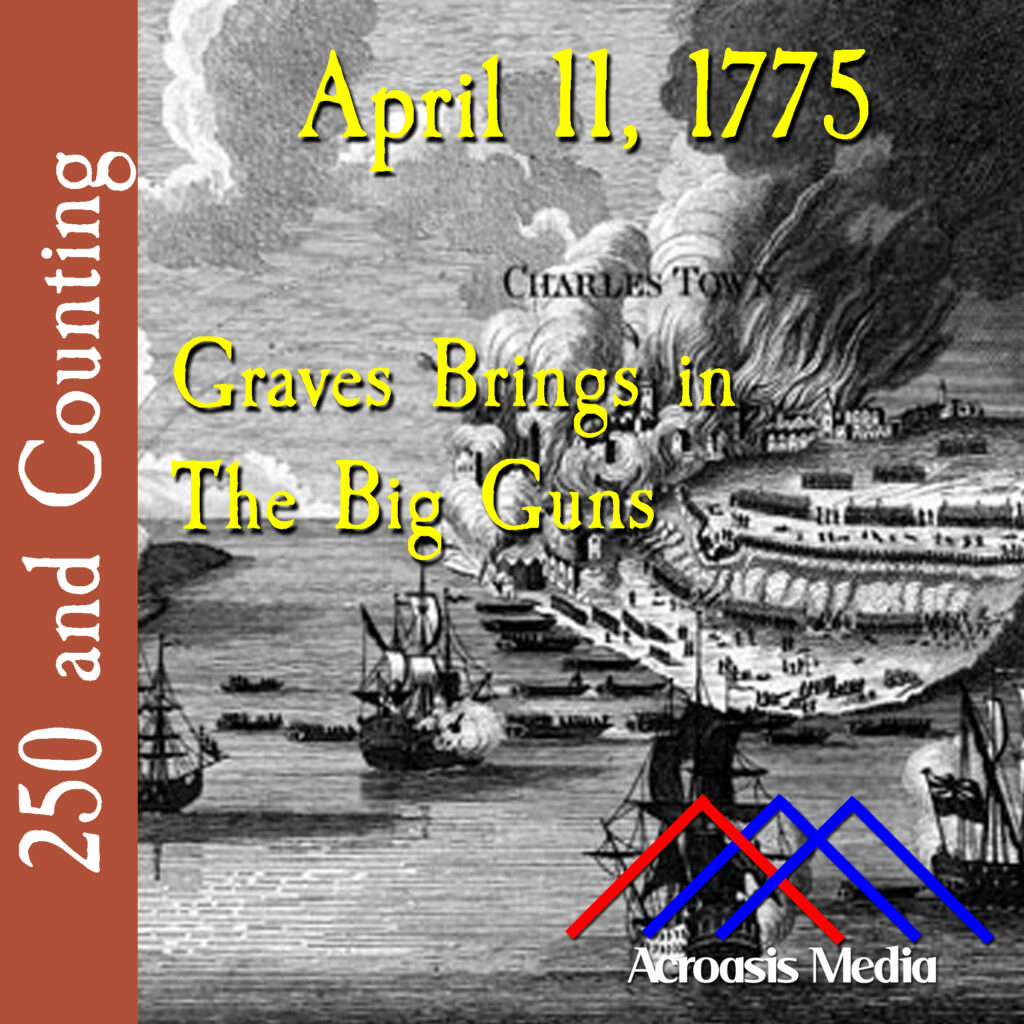
When the HMS Somerset first reached Boston, she was an old, leaky, weathered mess. Admiral Graves asked for permission to repair it, and while the work was slow at first, the sailors actually managed to get the important parts of the work completed. By this day in 1775, the ship was considered seaworthy and capable of doing more from its perch in the harbor, so Graves moved it into the place of two other ships, largely to demonstrate that he could do it, and safely.
Had the lookouts been more alert when the battles of Lexington and Concord first broken out, the outcome could have been quite different.
It’s cake and candles today for Francis Cabot Lowell, a manufacturer who helped modernize the textile industry in the United States, largely through industrial espionage: in the middle of a trade war with Europe, Lowell visited England and memorized the processes they were using so that he could bring them back to this side of the pond, helping us to break the hold on imported goods from Europe by innovating the cradle-to-grave manufacturing process for fabrics.
Yet, despite his prominence in the industry, and despite the statue that stands in his name in the town of Lowell, Massachusetts, the silhouette seen in today’s cover art is the only hint that we have regarding what he might have looked like. There are no portraits extant that we know of.
Calvin Jones may have looked like an unassuming fellow, but that unassuming look concealed a very powerful mind and a strong moral compass.
And today we’ve got Cake and Candles for him, since this day in 1775 was the date of his birth. Jones was a physician before his teenage years ended, and he began to design criteria that would separate good doctors from bad ones. He organized militias even though he was under no orders to do so. And then when the War of 1812 broke out, he became a major general with a reputation for excellence, to the point where nobody really worried about whether North Carolina would fall to the British.
After the war he basically helped shepherd the development of a brand-new field of medicine, and after his death, much of his land became Wake Forest University. What’s more, it was because of Jones that the school has a head-scratcher of a name rather than an incomprehensible one.
Never let it be said that we can’t find the less-obvious folks in American History. Thomas Bayly was definitely one of them.
Bayly was a one-term congressman to the US House of Representatives as part of the 13th Congress (as this is written, we’re in the 118th). By most accounts he wasn’t especially distinguished, but only serving for the one term didn’t mean that he was politically finished. A few years after he left Congress, he was elected to the Virginia House of Delegates, and he was part of the Virginia Constitutional Convention.
Bayly was “minor” enough in history that we were only able to find a single image of him—the one in the cover artwork. And it’s actually a black-and-white rendering of a color painting that’s been zoomed in to the point where you can see the texture on the canvas. It’s a detail from a painting of the entire House of Delegates around 1820.
(Yeah, we couldn’t fit all that on the title card and have the artwork still visible.)
Happy St. Patrick’s Day, if you’re the type to celebrate! We have a little Easter Egg (shamrock?) in this episode for you.
Ninian Edwards was an interesting character in that he tried very hard to make the best choices for the people he represented, and while he succeeded in some respects, in others it seems he left a trail of hard feelings and broken plans.
But with a single exception he doesn’t seem to have acted out of malice, or greed. It’s just that most of the things he’s known for didn’t quite work out the way he hoped. And yet, he still remains in the record book for a job he held in his youth, and for being one of Illinois’ first senators.
Henry Eckford was born in Scotland on this day in 1775 and died in Constantinople in 1832. In between he spent a great deal of time in the Thirteen Colonies and then the United States, primarily in New York.
Eckford also dabbled in politics, serving in the state legislature and as a delegate to the Electoral College, before moving to the Ottoman Empire to assist with rebuilding the fleet there. He died quite suddenly there, probably of cholera, and his body was brought back to America, where he was buried in the graveyard at St. George’s Episcopal Church in Hempstead, L.I., along with his wife.
Coincidentally, many years ago I attended a wedding in that church. The weird bumps you make with history when you live on the East Coast, I tell you what.
(At right: Eckford’s grave; picture via findagrave.com)
The Powell Family was a prominent one in the Loudoun County, Virginia area. It’s about due west of Washington, DC. If you’ve ever been anywhere between Leesburg and the Appalachian Mountains in Virginia, you’ve been to Loudoun County.
The Powells were among the first to fight for Virginia during the American Revolution, and as the Thirteen Colonies broke away and became the United States, they found themselves with a sense of noblesse oblige and took to representing their area in the political arena. Today we celebrate one of that family, a man born on this day in 1775.
Back when Mike and Claude were kids, February 22 was celebrated as a national holiday, the 22nd being recognized as George Washington’s birthday. Lincoln’s Birthday was February 12, so we had two Federal holidays close together. (To be fair, Lincoln’s was always unofficially recognized.)
Until, that is, 1968, when the Uniform Monday Holiday Act came along, and many holidays were moved to the Monday of that week. Not every state complied right away, but eventually Lincoln’s Birthday disappeared and Washington’s Birthday moved from the malleable February 22nd to the always-on-Monday Presidents Day.
But here’s the part they don’t always tell you: George Washington wasn’t born on February 22. He was actually born on February 11, 1731 but that was under the old Julian calendar. In 1752, Britain and all its colonies switched to the Gregorian Calendar, which changed Washington’s birthday (well, everyone’s, really) by a year and 11 days, to February 22, 1732.
Believe it or not, people did not take the calendar change well. Because it was essentially a Catholic innovation (named after Pope Gregory XIII), Protestants thought it was a Catholic plot to return them to the fold. Other people, especially in the Colonies, thought that time was being stolen from their lives, and they demanded that the “lost” days be returned. It wasn’t until public figures—including George Washington—adopted the new dates and made a big deal about doing so, that people started to calm down.
None of this is relevant to the story you’ll hear in today’s episode, but this whole Washington’s Birthday thing doesn’t get told nearly enough. In the meantime, enjoy Mike’s story of William Seymour.
Of all the indignities we laid upon Claudius Herrick in this episode (okay, there weren’t that many), the worst is that we misspelled his name in the cover art.
Until Israel Gregg came along, steamboat commerce on the Ohio river was considered impractical, largely because the currents were so strong.
But Gregg had an interesting approach to demonstrate that it was, in fact, possible. In some portions of the river, there was a confluence with another river, which meant that there were multiple currents in the river for some distance. This is what made it hazardous in the first place.
Gregg made a point of seeking out the currents of a specific river in each confluence, and navigating only that river’s current. So from Brownsville to Pittsburgh, Gregg used the currents of the Monongahela River. From Pittsburgh to Cincinnati, he used the currents of the Ohio River. Then he remained with the current of the Ohio to Louisville. From there he returned to Pittsburgh, running against the current of the Ohio. A few cycles of this had people convinced, and his ship, the Enterprise, became one of the first of that name to go down in history. (Specifically, it was the third in American history.)