It’s one thing to hear someone hollering “The British are coming!” and quite another to actually see them arriving in your port. And that’s especially true when they’re also seen confiscating the cannons that you’d hidden upriver.
This wasn’t the first time something like this had happened, but there was something different about the Colonists’ response—and it almost touched off the war nearly two months before it actually did.
The interesting thing about surveillance in the 18th century is that, when you’re dealing with trans-Atlantic distances, the information moves slowly, and errors can be costly.
We told you not long ago about someone who’d heard about the Minutemen, but had their numbers wrong by a factor of thousands. Fortunately in that case, it was just casual gossip rather than actual spycraft. But today in history, a bit of information about Colonial artillery that was reported to the Provincial Congress in Massachusetts leaked to the British, along with information about the Minutemen’s numbers and level of preparedness. But as we’ll discover in the next couple of days, the British were already taking precautions.
We’ve mentioned in the past that the intent of most of the Intolerable Acts and the Coercive Acts were designed to punish the Massachusetts Province, but it had some effect on the other colonies as well. What’s more, there was a growing worry that, if Parliament could do things like this to Massachusetts, what’s going to stop them from doing it to us?
To that end, the city of Albany, NY, began making plans just in case war broke out. It was against the law, but their reasoning was that it was better to have a militia and not need it, than to need it and not have it.
Only a few people had figured it out, and it’s not clear whether they were just guessing, but by this point in time both England and the Colonies were locked into a path that would lead inevitably to a shooting war.
To that end, Parliament approved sending over four thousand soldiers and sailors to the Colonies to help keep them in line. But it wasn’t as simple as that; there were still some people protesting the action, not that anyone listened to them.
Today we also peek in on someone who’s watching the action and has some thoughts.
When it comes to Black people and their role in the American Revolution, the one name that most people appear to remember is that of Crispus Attucks, largely because he was the first person killed in the Boston Massacre, and that event is thought of as the beginning of the Revolutionary War, therefore it’s significant that the first person to die in the name of American freedom was a person of color.
Other people, more fussy about events, would say that Lexington & Concord was the beginning of the war. The reasoning behind that is that it’s the first event in a series of hostile actions that took place close to one another. But the real argument is that most historical events of this nature don’t have definitive “beginning” and “ending” points; it’s much like a roll of paper towels. Sure, there are perforations marking each sheet, but you know for a fact that when you pull one off, it’s going to tear at an oddball angle and those perfectly rectangular sheets are a rarity.
The fact is, however, that over 100 Black men fought as part of the militia in the opening battles of the Revolution. Here’s the story of one of the first.
The first week or two of February 1775 could best be described as a series of misunderstandings and communication breakdowns. Any attempts on both sides to reach out with some form of conciliation managed to fail for various reasons.
And during all these breakdowns, the situation on the American side of the pond only got worse as time went on, largely because each side thought that the other wasn’t being responsive.
In the end, however, it didn’t really matter, because as we’ve discussed with the episodes dealing with Massachusettensis and Novanglus debating one another in print, the one thing they agreed upon was that these attempts to reach out were always, at their heart, rooted in some attempt to wrest control from the other party. Both reaching for it, neither attaining it nor caring what the other side’s argument meant at the core.
(Forgive us the jokey headline–sometimes it’s late at night when we post this stuff and we get punchy.)
Over the course of a single year—and beginning with this day in 1775—John Cox experienced what any reasonable person would call a “meteoric rise” in his personal and professional fortunes. He started out adjudicating British laws in the Colonies, but moved quickly into assisting with the Colonial resistance effort and subsequently to assisting with the actual war. He did this both materially (as a Quartermaster) and passively (allowing his land to be used by Patriot troops).
He died in 1793, at the age of 60, and even this week he’s probably still more productive than most of us.
After the Boston Tea Party, Parliament enacted what they called the Coercive Acts and the Colonies called the Intolerable Acts. The Colonists were neither coerced, nor were the acts tolerated (hence the name). And you know that because we’ve told you this already several times.
In October 1774 the Continental Congress composed the “Petition to the King”, and as you’ll learn in greater detail tomorrow, it was pretty clear that the petition crossed an ocean and still managed to go nowhere. In fact…
At about the same time, King George III decided that New England needed some more “convincing” to fall into line. This was the beginning of the New England Restraining Act. As the name suggests, it affected mostly the New England colonies, but people in the other colonies took notice and wondered “Hey, this could happen to us too, couldn’t it?” As a result, everyone continued moving down the path they fervently hoped they wouldn’t travel.
Hugh Mercer is one of those people who was terribly important to the cause of Liberty during the American Revolution, yet his story goes untold largely because he died early in the effort.
But if Mercer hadn’t come to America because he was on the losing side of a battle in Scotland, he wouldn’t have become a doctor in Pennsylvania.
And he wouldn’t have joined up in the French and Indian War.
And if he hadn’t been wounded, then he wouldn’t have been rescued, transferred and promoted to Major.
And if he hadn’t been transferred, he wouldn’t have met George Washington.
And Washington wouldn’t have gotten the idea to invade Trenton, New Jersey at Christmastime 1776.
And Mercer wouldn’t have been killed the following month. Which is bad, but…
If Mercer hasn’t sacrificed himself so publicly, Washington’s troops wouldn’t have been inspired to re-enlist and continue the fight.
Also, the county surrounding Trenton, New Jersey would have a name other than “Mercer County,” so there’s that.
After the Boston Tea Party, the government in Britain enacted what they called the Coercive Acts, or what the Colonists called the Intolerable Acts. (From here, it doesn’t feel like one name was any better-sounding than the other.)
Because the Colonists were still hoping to preserve a decent relationship with the Mother Country, the First Continental Congress met in Philadelphia and put together a letter to the king, which said in essence, “We’re very loyal to you, O King, but it’s been a year and enough is enough. Maybe you could prevail upon Parliament to dial it back a little bit, hm?”
That was in October of 1774. Of course, documents moving slowly and all that, the reply from the king didn’t come back for a couple of months, and at the heart of it was George affirming his faith in Parliament’s actions, and nothing’s going to change for the forseeable future.
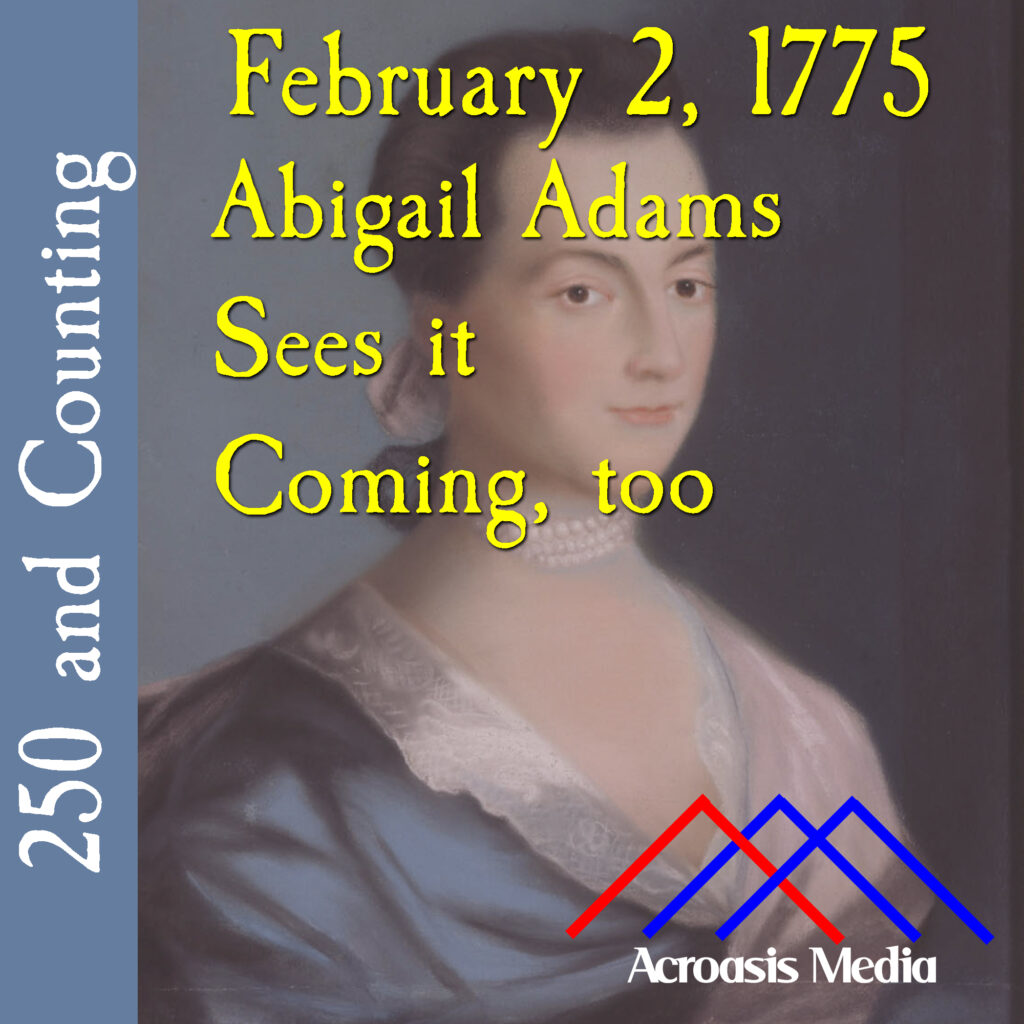
Both John and Abigail Adams, in different places at the time and in separate letters to friends, each relayed to friends their opinion that the tipping point had passed and that war was probably inevitable.
Guest Voice: Shannon Call, who needed a lot of convincing to get near a microphone.