On June 15, 1775, George Washington was appointed Commander of the newly-formed Continental Army.
On July 2, Washington finally arrived in Cambridge after a few stops in Trenton, New York and presumably a couple of other places. What he found was a huge mess.
So on July 3, he officially took command and started the work of turning this ragtag crew into some kind of organized fighting force.
As you listen to today’s episode, it’ll become clear that Mike had way too much fun writing and recording this one. But then again, I wrote the title, so.
There are plenty of jobs out there that are kind of obscure, in the sense that it’s a job that somebody has, but you never really thought about. For instance, did you know that with some high-end perfumes, the labels are put on manually? Someone’s out there sticking the labels on the bottles, because either the bottles don’t go through the machinery politely, or the levels of quality are low when they’re applied mechanically. So it’s easier to have someone stick on the labels.
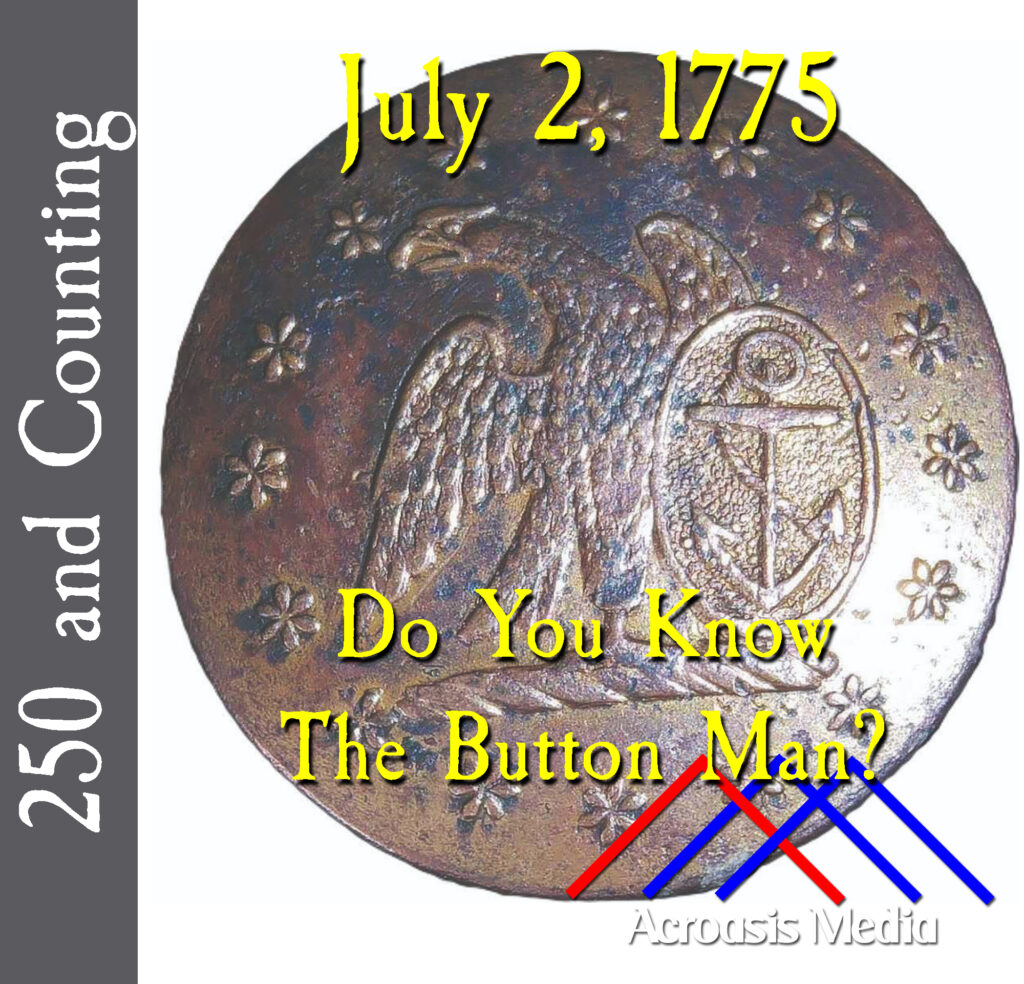
“Buttonmaker” is also a likely profession in this realm, largely because it is so automated these days. But back in the Colonial days, it was a specialty profession, especially since Aaron Peasley, the subject of today’s episode, refined the die sinking procedure used to make buttons then. And except for the specific means of creating the die (it’s done using electrical discharges nowadays), the overall technique hasn’t changed much.
But his talent didn’t end there. Listen in and see what else he did.
Additional note: the closeup photo of the button used in the cover art comes from a fascinating article written by 2ndLt. Kevin Rosentreter, USMC, who also took the photo.
Mike and I alternate on the writing and recording, but the final steps of the show, including the artwork and the show notes, are entirely my responsibility.
There are lots of times when historians have to pull a lot of small pieces together to get a decent picture of events. They use oddball clues such as artifacts in paintings to determine someone’s state of health, for instance. They have to take into account that published reports could be propaganda in nature.
But once in a while, something turns up that was written more or less at the time it happened, and what’s more it was written by someone who doesn’t necessarily have an agenda.
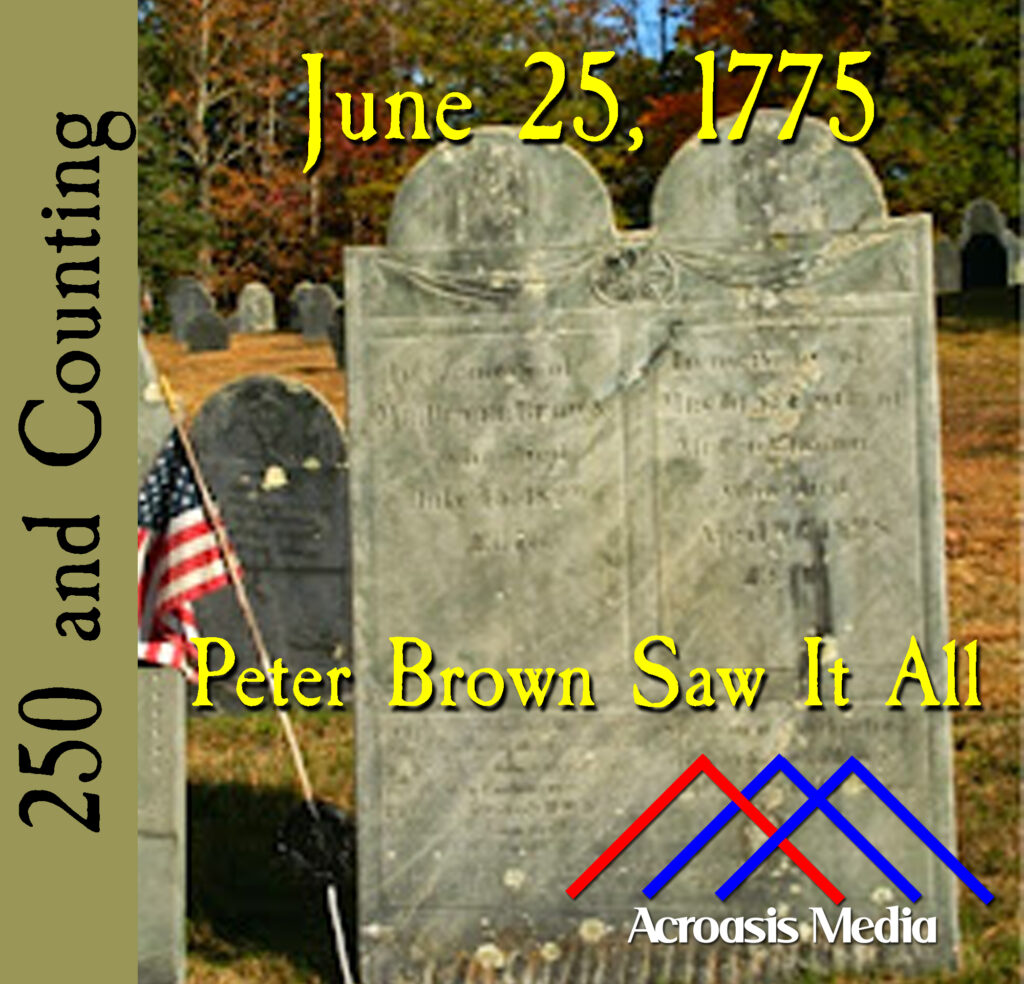
And in this case, nobody even knew it existed until a hundred years later. Exactly a hundred years later, in fact. A young soldier named Peter Brown wrote a letter to his mother just a few days after the Bunker Hill battle to tell her what happened. He spared few details and told a rather complete story of a couple of days’ worth of activity. And while he did mail the letter, and his mother did receive it, it mostly lay in family archives until 1875, when a descendant found it and realized that it might be important.
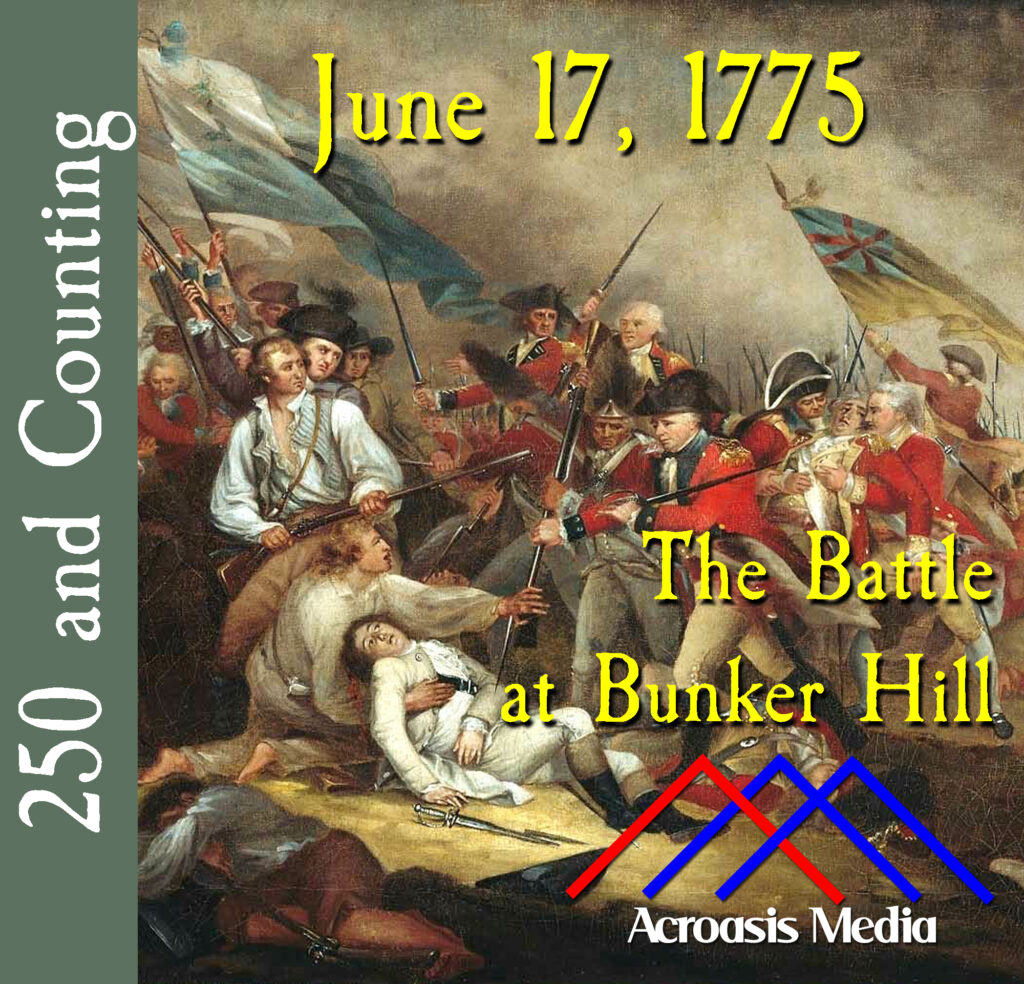
In the long run, the Battle at Bunker Hill Breed’s Hill was a tactical win for the British, but they incurred heavy losses and it took three tries to get that win.
So why is it one of the battles that so many Americans seem to remember all these years later?
We’re speculating here, but it’s possible that, between this battle and the ones at Lexington and Concord, the Colonial forces realized that this was a war that they could actually win: it wasn’t crazy at all to fight the British army. It almost didn’t matter that we didn’t win this one; the colonial militiamen could stand up against the British and force them to work much harder for their victories.
There’s a scene in The Godfather, Part II in which Michael describes an incident he’d seen earlier in the day. He says he saw some Cuban rebels being rounded up by the soldiers, and one of them, rather than being taken prisoner, detontated a grenade on his person, taking a Captain of the Guard with him. From that he concluded that because the rebels weren’t getting paid to fight, they can actually win.
Jeez, I gotta stop writing these titles late at night.
Sometimes the history books make it sound like some people just appeared out of nowhere, but they did have pasts. George Washington would be a good example.
Washington has been nearly invisible since this show started on January 1, but that doesn’t mean that the Congress hollered “Anyone wanna be a general?” and he stepped up first. In fact, he was a delegate to the First Continental Congress in 1774, and for some time he’d been a member of the Virginia House of Burgesses, often simultaneously with the Congress thing. And he did have a commendable military background dating back to the French and Indian War, so appointing him the Commander of Colonial forces wasn’t part of someone’s crazy scheme: they thought he could really do it.
It wasn't even close to being the first time, but this was an important "get": the colonist forces learned that troops were coming to capture Charlestown and Dorchester in an effort to break the siege. They got lucky, it all led to some ugliness and eventually both sides could call it a win, and both sides could call it a loss.
Some of what you’ll be hearing today will have overlap with yesterday’s episode, but we all have shorter memories, we read in an article…uh, somewhere.
But in the long run, that’s okay, because context is everything, and it’s important to understand what a big deal this particular incident was against the bigger picture.
Not to be confused with Chelsea of Battle Creek, who has worked for a famous cereal company for 28 years. (We may have made that up.)
Lexington and Concord was the first “official” battle of the American Revolution, but at best it was a draw: Patriots took a bunch of losses, soldier-wise, but the British were forced to retreat under fire the entire time, and they wound up mostly sequestered in Boston when the dust settled.
This could be considered the next chapter in that story, in that the Siege of Boston led directly to the events of this day, and the next, in 1775. Claude is setting up the story, and Mike will be finishing it off tomorrow. Enjoy!
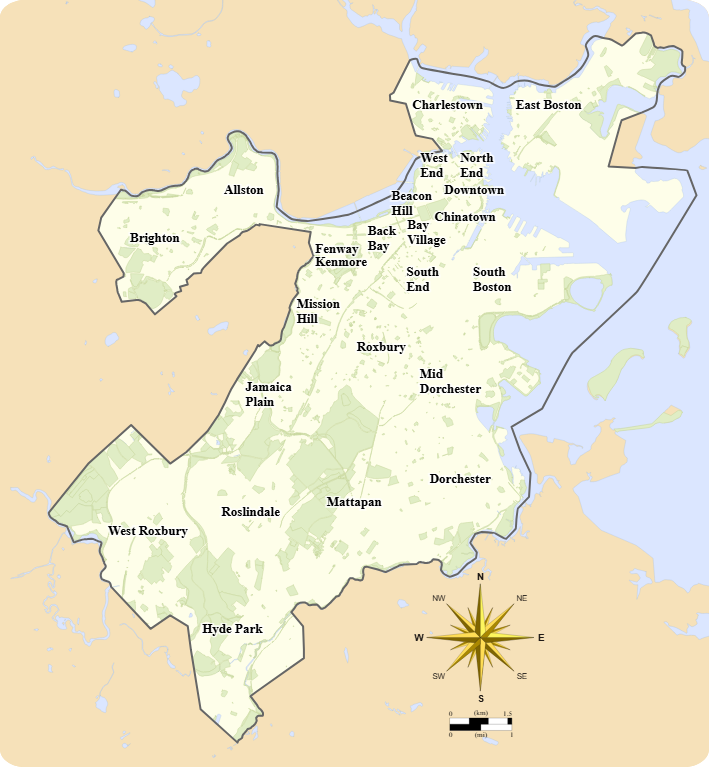
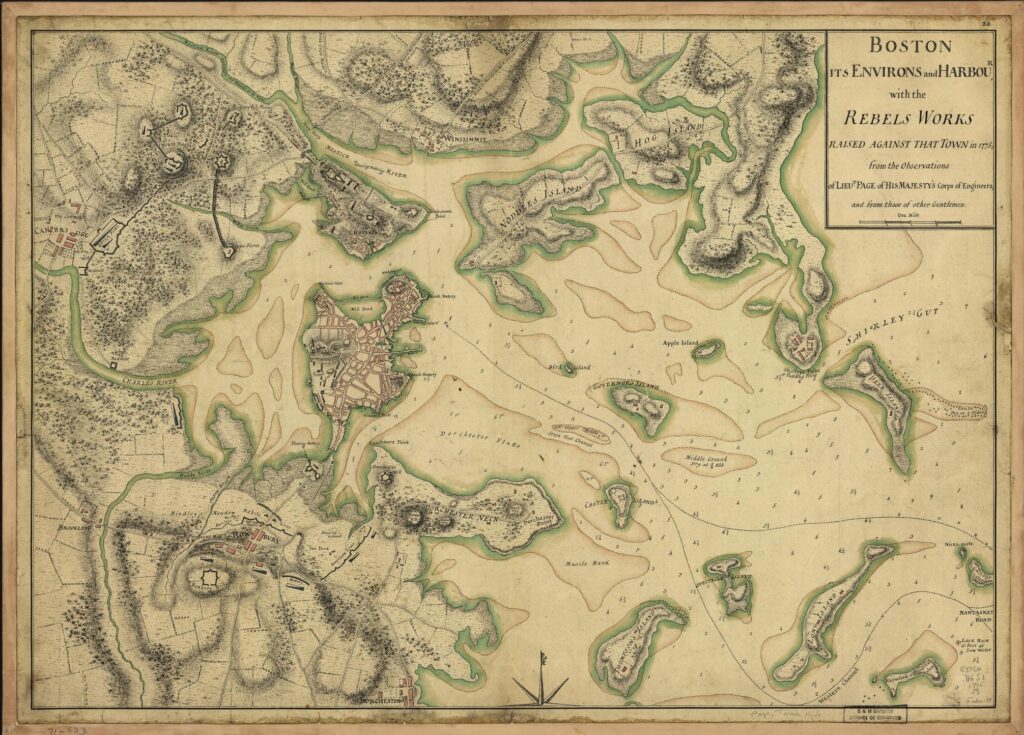
Sometimes it’s kind of tough to bring an image to life through an audio podcast, but we thought it was important enough that you needed to see it somehow.
It’s oftentimes hard for us to understand just how wild the Thirteen Colonies were back in the day. In 1775, New York City was roughly a square mile of the southern tip of Manhattan. Where today’s Wall Street is was literally a wall, keeping out anything to the north. That’s another 13 miles of island (roughly) to the north which might have some Europeans living there, but not many. So, to that end…
This is a map of modern-day Boston, with a neighborhood breakdown on it, per the city’s Office of Neighborhood Services:
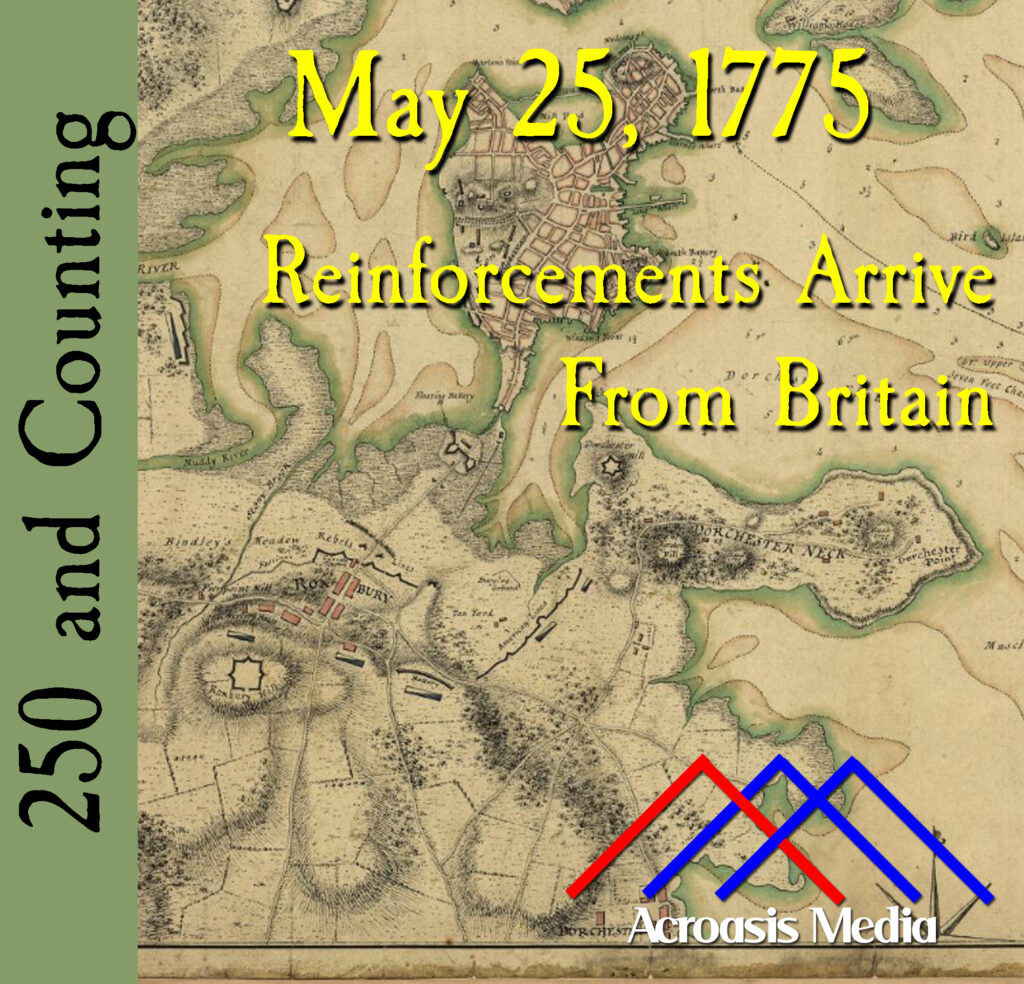
And this is the full map from the cover artwork. They’re slightly rotated to one another (more likely, the 1775 map is pointed toward magnetic north than true north), but the heart of Boston, at center left, is essentially the tip of today’s South Boston. On the map above, the siege line is about where the word “South” is printed.
So it was pretty easy to set up a line of defense to keep the city isolated, especially since the city was surrounded by water on three sides. Supplies and people could get in and out by water, but the city itself was still cut off for anyone approaching by land.
The Thirteen Colonies didn’t have a lot in the way of a navy to help them with their battles, especially not against perhaps the biggest and best navy ever up until then.
What they did have was people who were willing to act in lieu of a navy. Some of them did it out of sheer patriotism, and others were a little more mercenary about it. Specifically, privateers.
Now, “privateers” sounds a little like “pirates” and people often use the words interchangeably. You should stop being friends with those people. Privateers are a specific breed of sailor. They’re government-sanctioned to act as a kind of ad-hoc navy, authorized to take action in times of war. Typically, their job was to disrupt merchant vessels (hence the confusion with pirates).
It wasn’t long after the Revolution began that Fairhaven, Massachusetts, became a place known for privateer activity.
Extra credit activity: check out the West Wing, Season 4, Episode 18. You’ll learn more about privateers, and as a bonus, you’ll never think of Francis Scott Key the same way ever again.